

This guide offers a clear approach to learning how to make your Tibetan singing bowl sing and enrich your daily practice.
Patience and precise movements are essential: each instrument has its own vibrational signature depending on how it was made.
We explain striking and rubbing techniques, how to find the “sweet spot,” and simple adjustments that help stabilize the note.
Safety reminder: avoid placing the instrument on anyone under the age of 21. You can bring it within 20 cm of the body for a safe experience.
This short article serves as a practical guide for beginners and experienced practitioners alike. For detailed techniques and maintenance recommendations, see our practical guide and care tips.
The practical guide for beginners and the care tips complement this guide.
Understanding the vibrational nature of your instrument
Producing the note relies on the mechanism known as “stick-slip,” a microscopic back-and-forth movement between two surfaces.
This friction phenomenon transforms the pressure of the mallet into audible vibrations. The consistency of the movement determines the stability of the note and its harmonics.
The quality of the alloy and the shape of the object determine the richness of its timbre. Each bowl has a fundamental note that varies according to the metal and its thickness.
To improve, observe the relationship between pressure and speed while rubbing. Moving too quickly or pressing too hard breaks the continuity. A fluid movement allows the resonance to emerge.
- Treat the instrument as a genuine musical instrument; your practice will become more mindful.
- Through repetition, you will become better at distinguishing the harmonics of Tibetan bowls.
This quick guide expands on these technical concepts. To tune similar instruments, also see this tuning guide.
Preparing your environment and posture
Before playing, create a warm, stable environment to help sustain the vibrations. A mild temperature helps the instrument release its harmonics. A ray of sunlight or warmed hands can improve the expression of its timbre.

The ideal posture
Adopt a stable position with your back straight. This frees your breathing and makes the circular movement of your arm easier.
Hold the mallet like a pen to keep your wrist relaxed. This fluid movement prevents an imprecise sound and helps make the instrument sing more clearly.
Choosing a support
Place the bowl on a cushion made of fabric or silicone, or on a wooden ring, so that its resonance is not muffled. A hard surface restricts the vibrations.
- You can hold the bowl in the palm of your hand for a full sound massage, or on your fingertips to let the sound travel more freely.
- Keep your non-dominant hand flat so that it does not dampen the waves emitted by the metal.
- Make sure the mallet suits the instrument’s diameter, and regularly clean the rim for better grip.
Tibetan singing bowl: how do you produce a beautiful sound?
A precise strike on the rim initiates the resonance and establishes the foundation of the timbre.
The striking method involves delivering a quick, crisp tap to the upper rim to trigger an immediate vibration.
An initial strike before rubbing often stabilizes the note. The mallet should remain light and controlled. Avoid striking too hard; a heavy attack absorbs the waves instead of releasing them.
- To begin: use the striking method to identify the fundamental note.
- Mallet: choose a head suited to the bowl’s diameter.
- Speed: adjust it so that the singing bowl regains its full resonance.
| Method | Advantage | Use |
|---|---|---|
| Striking method | Clear attack, easy to learn | Ideal for beginners and for marking the start of a session |
| Rubbing method | Continuous resonance, rich harmonics | For extending the duration and preserving the note’s purity |
| Strike + rubbing | Initial stability and sustain | Recommended combined technique |
Learning how to make your instrument sing requires practice and patience. For a guided approach, see this practical guide for beginners.
Mastering the striking method for pure resonance
The striking method gives structure to the session by alternating moments of sound with restorative silences.
Strike with a loosely held mallet to produce a clean note. The impact should be precise without being too forceful, allowing the note to blossom and fade.
It is advisable to let the sound fade for 15 seconds to one minute. This silence between strikes creates a perceptual space that promotes relaxation of the body and mind.
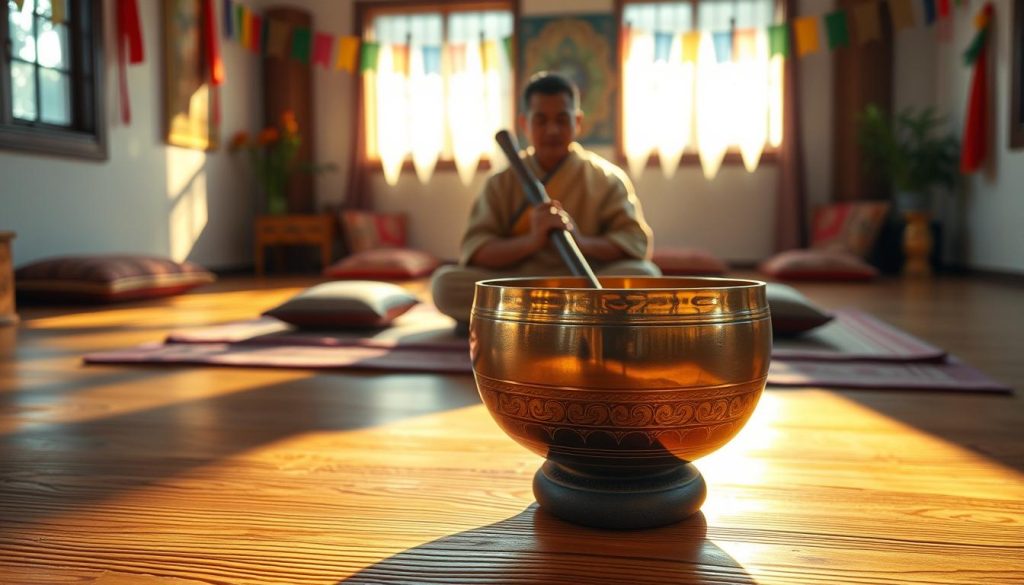
The rhythm between sound and silence
Maintain a regular interval between strikes so that the note can fade naturally. This preserves an optimal balance between the duration of the sound and the silence.
Striking the inner wall can produce a more penetrating sound and act directly on the body.
- Try four successive strikes in the four directions for harmonious diffusion.
- Alternate several bowls to create a progression of sound during the session.
- The speed of the mallet’s movement affects the clarity and sustain of the note.
Function: this method marks transitions and guides the participant. Keep your back straight and your hand steady for better control of the movement.
Perfecting the circular rubbing technique
Refining the rubbing movement transforms an unsteady vibration into a pure, sustained note. The aim is to harmonize movement, pressure, and speed to maintain resonance without causing distortion.

Arm movement
Initiate the movement with your arm and shoulder rather than with your wrist alone. This broader movement stabilizes the mallet’s path and distributes the force.
Hold the mallet loosely to stay relaxed. A controlled impulse prevents jerky movements and helps sustain the note.
Managing speed
Speed is crucial: if the movement is too fast, it makes the Tibetan bowl distort; if it is too slow, the vibration fades away. Make gradual adjustments to find the ideal threshold.
- Start slowly and accelerate until the note emerges.
- If you hear distortion, slow down or change the mallet’s angle.
- Reduce the contact area between the wooden mallet and the singing bowl to clarify the note.
The contact area
Rubbing the upper section produces high harmonics; the lower section produces low sounds. Maintain constant pressure on the outer rim to prevent the note from dropping out.
You can hold the bowl in the palm of your hand to massage the body while making the bowl sing consistently. Perseverance will help you find the right position and contact point.
| Area | Type of note | Practical advice |
|---|---|---|
| Upper section | High, rich in harmonics | Use light contact and moderate speed |
| Outer rim | Stable fundamental note | Maintain constant pressure with the mallet |
| Lower section | Low and deep | Slightly increase the contact area for a warmer sound |
Tip: this circular rubbing method allows you to make a Tibetan singing bowl sing continuously and create soothing sound waves. Keep practicing to find the exact balance between pressure and speed.
Tips for optimizing acoustic quality
A short preparation before the session encourages purer harmonics to emerge. Warm the instrument between your hands or expose it to sunlight for a few minutes; the metal responds better at a mild temperature and releases richer vibrations.

Choose a suitable support: a light cushion frees the resonance, while a hard surface muffles it. Hold the bowl in your palm to massage the body, or place it on a mat if the person is lying down.
Alternate sound and silence to encourage relaxation. The relationship between these two phases helps the listener absorb the frequencies and breathe slowly.
- Adjust the pressure of the wooden mallet to avoid distortion, especially when working over the back.
- Using several bowls allows you to vary the notes and enrich the soundscape.
- Drink water before and after the session to help eliminate toxins released by the body.
Mindfulness point: regularly ask the person how they feel and adjust the position and speed of the movement. To explore vocal and breathing practice in greater depth, see this resource on mindful voice work: Experience your voice mindfully.
Conclusion
Ultimately, achieving good resonance requires a balance between the initial impulse and fluidity of movement. Mastering the initial attack and maintaining a consistent movement are the foundations for making a Tibetan singing bowl sing reliably.
This guide has presented the striking and rubbing methods for achieving pure resonance. Relaxation and deep breathing enhance the effects on the body during each session.
Practice regularly to refine your sensitivity and explore the timbres of your bowls. By applying these tips, you will transform each session into a moment of well-being and active listening.