

With more than 10 years of experience, I offer you a clear guide to making the right choice. This article explains why manufacturing, size, and metal quality influence the richness of the sound and your practice.
Understanding the alloy and tradition helps you perceive the harmonics and vibrations that affect the body. Size determines the note and portability; price and listening time often guide the decision.
This guide provides practical advice for choosing an instrument suited to meditation or central to your practice. It takes personal feeling, budget, and intended use into account.
To explore different models and compare metal and crystal construction, see our selection and advice on how to choose your bowl.
Buying a Tibetan singing bowl: criteria to check for a successful selection
Testing the instrument in your hands often reveals more than the product description. Pick it up, feel its weight, and play it for a few seconds. Comfort in the hand affects how long you can use it and the precision of your movements.
Sound quality varies according to how the bowl was made: a hammered singing bowl often offers greater complexity than a cast model. Listen for the clarity and sustain of the note.
Size determines the depth of the vibrations. A larger diameter produces deeper sounds, which are useful for long meditation sessions and sound baths.
Set your budget before choosing a bowl: the alloy and finish affect the price. After 10 years of experience, personal feeling remains the most important criterion.
- Try several bowls in a store.
- Assess how they feel in your hands and their acoustic signature.
- Choose according to your intended use: meditation, healing, or daily practice.
| Criterion | What it indicates | Advice |
|---|---|---|
| Handling | Comfort and ease of use | Try several sizes |
| Manufacturing method | Harmonic richness | Choose hand hammering when possible |
| Size and weight | Depth and portability | Match them to the intended use (meditation or mobility) |
| Price | Complexity of the alloy | Set a budget before purchasing |
To learn how to identify an authentic instrument, read our guide on how to recognize a genuine bowl.
Understanding the difference between metal and crystal bowls
The material transforms the vibration: whether you choose metal or quartz changes everything.
Traditional metal alloy
Traditional bowls are made from an alloy composed of gold, copper, silver, mercury, lead, tin, and iron.
Each bowl hammered by hand releases a wealth of harmonics and vibrations. The tin content influences sound projection and the quality of the note.
Properties of quartz
Since the 1980s, quartz crystal bowls have offered a precise note. They are particularly useful for working on one chakra or several targeted chakras.
Crystal provides purity and consistency over time. Metal promotes grounding, while quartz prioritizes precise tuning for the energy body.
- Harmonic richness: metal.
- Note precision: crystal.
- Personal feeling: the deciding factor.
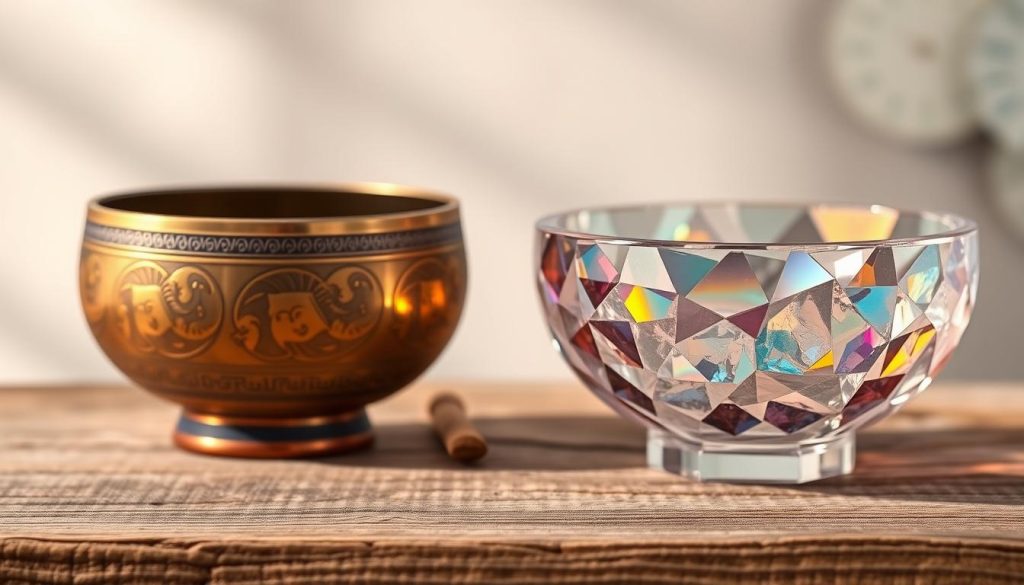
| Characteristic | Metal | Quartz |
|---|---|---|
| Sound | Complex, warm | Pure, precise |
| Use | Meditation, sound baths | Chakra work, targeted healing |
| Stability | Evolving | Consistent |
To compare models and crystal construction, see our selection on how to choose a crystal bowl.
The impact of artisanal production on sound quality
An artisan transforms a metal disc into a living instrument through repetitive, precise movements.
The value of hand hammering
Hand hammering creates a harmonic complexity that casting processes cannot reproduce. Each bowl develops a unique sound signature through the working of the metal’s structure.
In Nepal, artisans use an alloy rich in tin. This mixture improves projection and the longevity of the vibrations.
The blacksmith’s technique also influences how the instrument resonates through the body during a session. Full Moon bowls, shaped during specific lunar phases, embody this tradition and richness.
- Harmonic richness: more pronounced in a hammered model.
- Supporting artisans: choosing a traditional model helps Nepalese communities.
- Durability: hand finishing extends the sound’s sustain.
To explore the subject further and compare instruments and retailers, read our guide to find out where to obtain instruments.
Choosing the size and weight according to your needs
Choosing the right size directly affects the pitch of the note and the instrument’s handling.
Smaller models produce higher-pitched sounds, often preferred for relaxation and short sessions. Larger diameters provide deeper vibrations, useful for deep meditation and grounding.
Pay attention to weight: a 16 cm bowl can weigh more than one kilogram, making it much heavier than an 8 cm model. Weight increases exponentially with diameter.
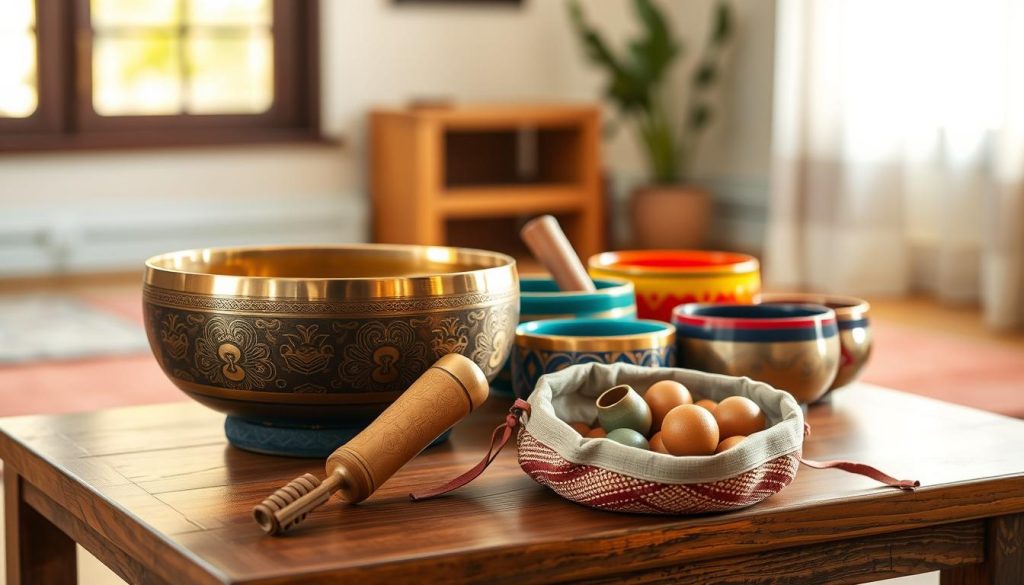
This affects the price, transportation, and your need for mobility. If you hold the instrument at arm’s length, choose a lighter size.
- Check the total weight before purchasing so you can adjust your budget.
- Test how it feels in your hand to ensure good playing quality.
- Choose according to your intended use: relaxation, healing, or intensive meditation.
The importance of note and frequency in your practice
The pitch and frequency of a sound source determine how the body resonates with it.
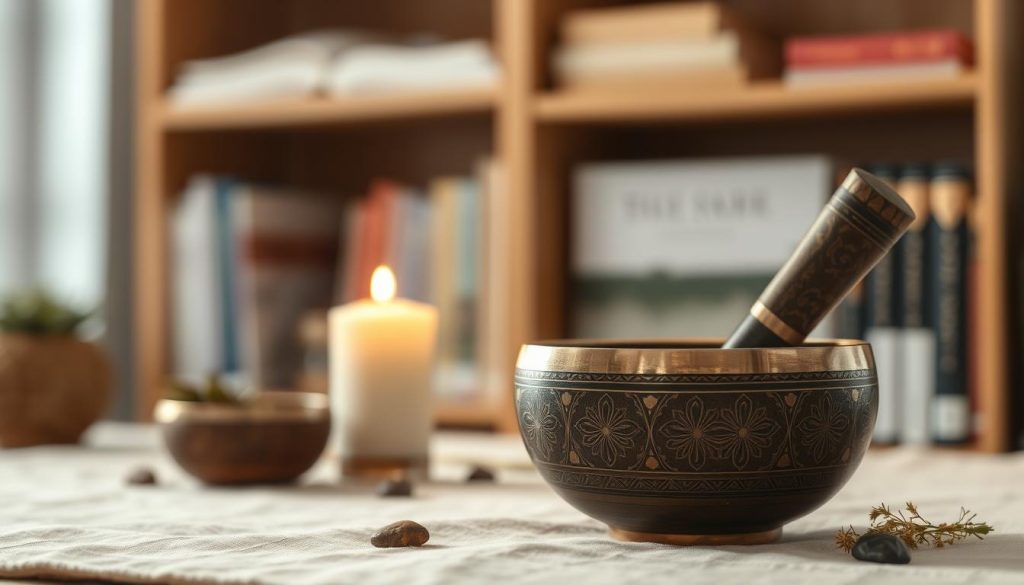
Correspondence with the chakras
An instrument’s fundamental note is often associated with a specific chakra. It facilitates targeted energy work on the body and heart.
Thanks to their alloy, metal bowls offer a wealth of harmonics that can harmonize several chakras simultaneously.
The reference frequency
The contemporary standard is 440 Hz. However, many practitioners choose 432 Hz or 528 Hz.
These alternative frequencies are valued for their gentler feel and perceived restorative properties.
Working with hertz
Working in hertz allows you to adjust the vibration to suit your practice. This influences the quality of meditation and the depth of relaxation.
Using a tuner ensures an accurate measurement of your instrument’s note and confirms that it meets your energetic expectations.
- Advice: test the note in a real-life setting.
- Tip: choose an alloy that produces rich harmonics if you are seeking a broad spectrum.
- Reminder: to make a better choice, read our guide on how to choose the note.
| Element | Effect | Recommended use |
|---|---|---|
| 440 Hz | Modern standard, consistency with other instruments | Group meditation, music |
| 432 Hz | Perceived as gentler and more soothing | Individual meditation, relaxation |
| 528 Hz | Alternative frequency associated with restoration | Targeted energy work, heart |
| Rich harmonics (metal) | Broad vibrational spectrum | Sound-bath sessions, overall balance |
Adapting your instrument to your personal use
Start by defining the main use you want to make of your instrument. Do you primarily want to use it for relaxation, daily meditation, or energy rebalancing? This will guide your choice according to your needs.
For work on the body and energy, choose larger models. Their deep vibrations penetrate more effectively and support in-depth work.
If you practice daily, a medium-sized instrument remains versatile. It is easy to handle and pleasant to listen to during short sessions.
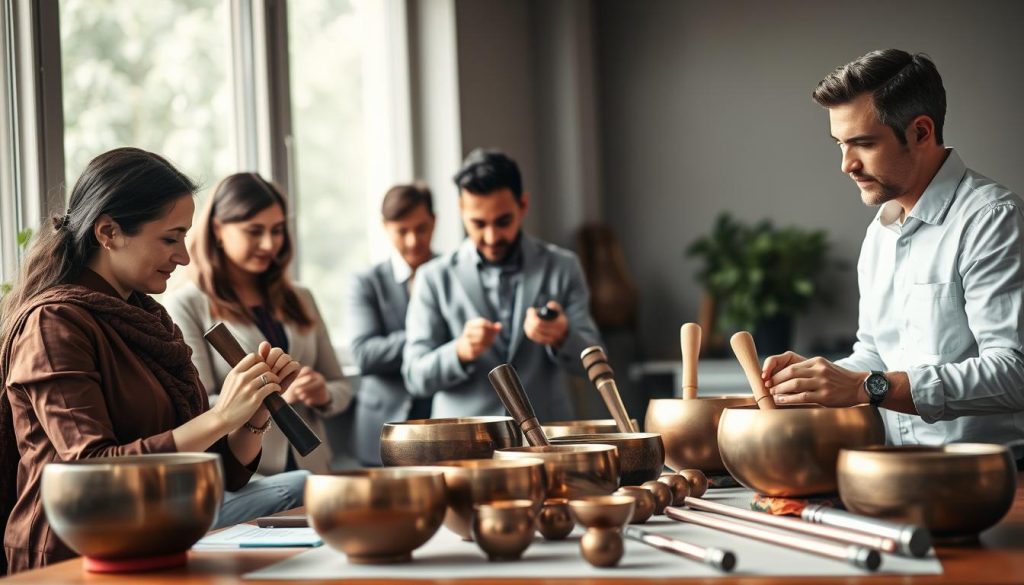
“Trying several models often reveals the one that resonates best with you.”
- Combine several bowls to create a complete sound journey.
- Test them in a real-life setting to determine which one feels best.
- Adapt the instrument to your needs for lasting relaxation.
| Use | Recommended type | Effect |
|---|---|---|
| Daily meditation | Medium | Versatile and easy to handle |
| Energy healing | Large | Deep vibrations affecting the chakra and energy |
| Occasional relaxation | Small | High notes, portability |
For detailed advice on choosing a Tibetan bowl for each chakra, read this specialized guide.
Assessing the budget required for a quality bowl
Setting a realistic budget prevents disappointment when choosing an instrument. The cost varies according to the size, the alloy of metals, and the presence of decorations or artisanal engravings.
An entry-level instrument may cost less than 50 euros.
Investing more often ensures better sustain and a longer lifespan.
Essential accessories
The mallet and cushion protect your instrument and improve its sound.
Include these items in your budget.
Comparing prices helps you find good value for money, especially if you are looking for a Nepalese alloy.
A large model requires more material and labor, so its price increases accordingly.
“A good-quality instrument is a long-term investment in your sound practice.”
| Item | Indicative price range | Impact |
|---|---|---|
| Small model | €30 to €100 | Portability, high notes |
| Medium | €80 to €250 | Versatility, better tone |
| Large or artisanal | €200 to more than €800 | Deep vibrations, complex alloy |
To guide your choice and compare the available options, read our guide to learn everything about singing bowls.
Tips for testing your instrument’s authenticity
How an instrument responds beneath your hand reveals its origin and quality. Touch the surface and look for signs of hand hammering: these indicate genuine work by Nepalese artisans.
Strike the bowl, then gently rub the rim. Listen to the sustain of the note and the richness of the harmonics. A warm, vibrant sound indicates a good alloy.
An excessively low price should be a warning: it may conceal industrial production and lower-quality metals. Ask for information about the origin of the metals and details about the manufacturing process.
- Test each bowl in your hand to feel the vibration.
- Look for signs of hand hammering.
- Check that the note remains clear after prolonged rubbing.
Tip: physical sensation is a powerful indicator: a good instrument transmits clear energy beneath your palm.
How to give a singing bowl as a gift
Choosing a gift that vibrates is a wonderful way to introduce someone close to you to meditation or relaxation. A musical gift quickly becomes a personal and meaningful object.
To make the right choice, select a medium-sized instrument between 12 and 17 cm. This size remains versatile and comfortable for most users to hold.
Sound quality should guide your decision. If possible, test the note’s sustain and the richness of its harmonics. A good tone makes a strong impression from the very first contact.
Include a mallet and cushion in your budget. Giving the complete set makes the gift immediately usable and more appreciated.
- Help the person choose a bowl according to how it feels rather than from a technical specification sheet.
- For a safe choice, select a versatile model suited to several practices.
- A musical gift remains a lasting memory that encourages peace and well-being.
“An instrument given with care opens the door to a personal and soothing practice.”
Conclusion
Ultimately, taking the time to try several models helps you find the instrument that speaks to you. Listen to the note and feel the vibration in your body.
Making the right choice requires assessing the quality of the alloy, the manufacturing, and your own feelings. Also consider the price in relation to the intended use and listening time.
This guide has explained how the note, targeted chakra, and size influence your practice and relaxation. Instruments du Monde offers more than 200 options for comparing bowls and models.
Investing in a quality instrument will enrich your experience. The best choice remains the one that brings immediate and lasting peace.