
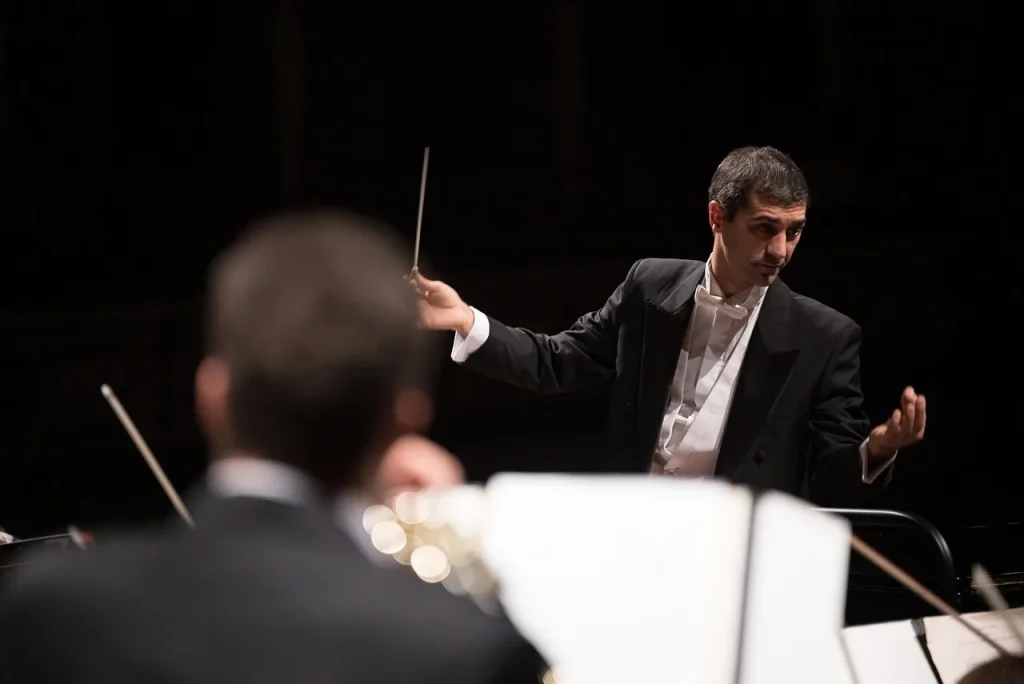
Soundpainting is a form of collective musical improvisation that requires precise coordination and creative direction to work effectively. The conductor in Soundpainting plays a crucial role in this undertaking, serving as a musical guide and directing the entire group of musicians.
However, this role is not limited to that of a simple guide. The conductor in Soundpainting is also responsible for artistic creation, coordinating the different voices and instruments, and bringing all the elements into harmony to create a coherent musical work.
In the following sections, we will explore in detail the key role played by the conductor in Soundpainting, examining their nonverbal communication, creative responsibility for artistic direction, ability to coordinate and harmonize the different voices, and contribution to collective musical creation.
Soundpainting: a form of collective improvisation
Soundpainting is a form of collective musical improvisation in which musicians interact with one another to create compositions in the moment. Soundpainting is unique in that it requires precise artistic direction from the conductor so that the different voices and instruments are harmonized and the performance is successful.
This is where the conductor’s role comes into its own. In addition to directing the group in the traditional way, the Soundpainting conductor is the creative guide who stimulates each musician’s creativity and takes part in composing the music in real time.
Soundpainting is therefore more than a simple exercise in collective improvisation. It is a unique experience in which every musician is given the freedom to express themselves while contributing to a shared work. This makes it a truly collaborative art form, in which the magic of improvisation can produce astonishing results.

Nonverbal communication: a central tool for the conductor
In Soundpainting, nonverbal communication plays an essential role in coordination between the conductor and the musicians. Using a series of precise gestures, the conductor guides the musical ensemble and communicates instructions about dynamics, rhythm, texture, intensity, and much more.
These visual signs were developed specifically for Soundpainting and enable clear, effective communication. The conductor can indicate to each musician the precise moment when they should enter, which instrument to use, which technique to apply, and which expression to convey, without uttering a single word.
Moreover, nonverbal communication provides a high degree of flexibility and adaptability during performances. The conductor can adjust the signs according to the musical ensemble and the desired artistic direction, providing a wide variety of possibilities for creating music in real time.
In short, nonverbal communication is a central tool for the Soundpainting conductor. It enables effective coordination and complete creative freedom for the musical ensemble, resulting in a harmonious, organic, and dynamic performance.

Artistic direction: a creative responsibility
In Soundpainting, the conductor plays an essential role as the ensemble’s artistic director. They are responsible for giving the performance an overall vision while encouraging the musicians’ individual expression. Artistic direction encompasses several key elements, such as selecting themes, determining the performance’s overall structure, and even choosing the musicians who will make up the ensemble.
Soundpainting offers great creative freedom, and the conductor must be able to make quick, imaginative decisions to guide the ensemble. They must also be able to coordinate the different musical elements to create a coherent and harmonious work. This often involves working closely with the musicians to encourage their creative contributions while maintaining an overall vision.

Artistic direction in Soundpainting is therefore an important creative responsibility that allows the conductor to express their own vision while encouraging others to explore their own musical ideas. It is a collaborative process that requires great artistic sensitivity and strong communication skills.
“A competent conductor is an artist who can bring a score to life, but an exceptional conductor is one who can create music from a blank page.” — Michael Tierno
Coordinating and harmonizing the different voices
The Soundpainting conductor’s role is essential in coordinating and harmonizing the different voices and instruments in the musical ensemble. For the performance to be coherent and harmonious, the conductor must be able to guide each musician in their role and bring the musicians together to create a unique piece of music.
Through nonverbal communication, the conductor can tell each musician when to play, which key to use, and with what intensity, among many other elements. Using precise and expressive gestures, the conductor can coordinate the different voices and instruments to create a complex and harmonious work of art.
Soundpainting is a form of collective improvisation that depends on the conductor’s ability to coordinate the musicians and create a coherent musical experience. This ability is essential to ensure that the musicians can express themselves individually while working together to create an exceptional musical performance.
Creating music through Soundpainting
Soundpainting is above all a form of collective improvisation in which each musician contributes their own creativity to the creation of a musical work. It is in this context that the conductor’s role takes on its full meaning: they encourage each musician’s individual expression while harmonizing the creation as a whole.
The Soundpainting conductor must therefore be able to stimulate the musicians’ musical imagination by offering ideas and directions that enrich the collective creation. They must also be able to guide the entire orchestra in a coherent musical direction while leaving room for improvisation and experimentation.
To achieve this, the conductor must be able to communicate with the musicians clearly and precisely, using gestures and nonverbal signals to indicate changes in the musical creation. This communication must be adapted to the needs of each musician and each instrument so that everyone can find their place within the composition as a whole.
Ultimately, the Soundpainting conductor’s role is to enable the creation of a unique and original musical work by showcasing each musician’s creativity and directing the entire composition according to an overarching artistic vision. Soundpainting is therefore a stimulating and rewarding form of musical creation that gives musicians many opportunities to explore their creativity and musical expression.
Conclusion
In conclusion, the role of the Soundpainting conductor is unquestionably crucial. While serving as a guide for the musical ensemble, they must also demonstrate creativity and an ability to collaborate with the musicians to create collective, harmonious works. Nonverbal communication is another essential pillar of their role, as it enables them to convey clear and precise directions without interrupting the music.
We hope this article has helped you better understand the fascinating art of Soundpainting and the importance of the conductor’s role in this unique musical world. Feel free to learn more about this practice by exploring the many resources available online and attending live performances.