

The handpan is a modern percussion instrument known for its captivating sounds. With its rounded shape and harmonious tones, it offers a unique musical experience.
Among the popular models, the 9-note handpan stands out for its ergonomic design and balanced scale. Ideal for beginners, it makes exploring different melodies easy.
To improve, sheet music is a valuable tool. It helps structure the learning process and develop fundamental techniques. This guide offers suitable methods and free resources.
Whether you prefer tablature or traditional notation, you will find solutions here for every skill level. Ready to dive into the world of the handpan?
Introduction to the 9-note handpan
Discover a captivating musical world with this instrument and its unique sounds. Designed to offer an intuitive experience, it appeals to beginners and experienced musicians alike.
What is a handpan?
Created in Switzerland in 2000, the handpan draws inspiration from the Trinidadian steelpan. Its circular shape and specific materials allow it to produce sounds rich in harmonics.
Unlike traditional percussion instruments, it is played with the hands. This creates a direct connection between the musician and the instrument.
Distinctive features of the 9-note model
This model offers a balanced configuration: eight outer tone fields and a central note called the “Ding.” The D Kurd scale is often preferred for its versatility.
Thanks to nitriding, the instrument delivers exceptional sustain. This makes it possible to explore complex melodies with great precision.
Why learn with sheet music?
Sheet music makes it easier to learn rhythms and sequences. It provides a clear structure for effective progress.
For beginners, specialized resources offer adaptations for different tunings. This greatly simplifies the first steps.
Although optional, music theory can enrich your playing. It helps you better understand how pieces are constructed.
The basics of understanding handpan sheet music
Mastering sheet music for this melodic instrument opens up new creative possibilities. It serves as a guide for exploring complex rhythms and subtle harmonies.
Structure of adapted sheet music
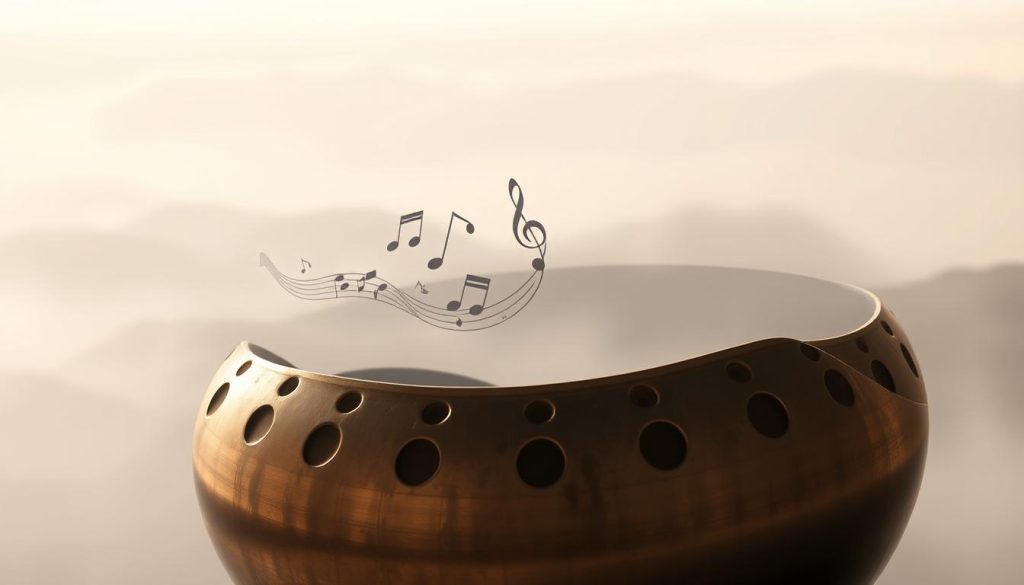
The scores use modified staves suited to diatonic scales. Unlike classical notation, they employ neutral clefs.
A color code makes them easier to read:
- Blue: left-hand areas
- Red: right-hand areas
- Green: resonance effects
A dedicated notation system
The symbols indicate striking techniques and harmonic sounds. Solid circles represent the main notes, while semicircles indicate harmonics.
For “River Flows in You” in D minor, the annotations include:
- Arrows for glissandos
- Dots for expressive rests
- Waves for vibrations
Reading rhythms and rests
Each beat is divided according to precise note values. A digital metronome helps maintain consistency.
| Symbol | Value | Example |
|---|---|---|
| Quarter note | 1 beat | Single strike |
| Rest | 1/2 beat | Short pause |
| Dotted half note | 3 beats | Sustained note |
Rests play a key role in emotional expression. They create contrasts that make pieces more vivid.
With practice, this way of reading becomes intuitive. Begin with slow exercises before increasing the difficulty.
Sheet music or tablature: which method should you choose?
Choosing between sheet music and tablature can seem confusing for a beginner. These two notation systems meet different needs depending on your level and musical goals.
The advantages of traditional sheet music
Sheet music offers unmatched precision for complex compositions. One study found that it improves accuracy by 40% compared with tablature.
It uses a universal language that is ideal for collaboration. Music theory also helps you understand musical form and harmony.
The accessibility of visual tablature
Seventy-eight percent of self-taught players prefer tablature because of its simplicity. It shows exactly where to strike the instrument, as with the 10-note Harry Potter melody.
Ideal for beginners, it helps players memorize pieces more quickly. David Charrier explains:
Tablature is a springboard to improvisation, especially for meditative styles.
When to use each method
Your choice depends on your level and style:
| Criterion | Sheet music | Tablature |
|---|---|---|
| Precision | Ideal for jazz | Better suited to meditative styles |
| Learning curve | Long | Fast |
| Tools | Software such as MuseScore | Apps (e.g., Handpan Tab Editor) |
For balanced progress, combine both methods. Use tablature to learn, then sheet music to refine your skills.
Resources for finding free sheet music
Exploring handpan melodies is becoming more accessible thanks to free online resources. Whether you are looking for original compositions or arrangements, several options are available.

Websites dedicated to percussion instruments
Several specialized platforms provide free access to handpan sheet music. Sonodrum.net offers 15 compositions with an adapted notation system.
Handpan-Store offers four high-definition tablature templates organized by tuning. For creative players, Notepan can generate customized sheet music for your scale.
Practical guides and digital collections
Comprehensive methods such as Z. Dellinger’s Handpan Essentials provide progressive exercises. These downloadable PDFs combine theory and practice.
At Instruments du Monde, you will find 50 templates that can be adapted to your instrument. It is an ideal solution for expanding your repertoire.
Musician support networks
Facebook groups such as “Handpan France” are full of free handpan sheet music shared by the community. Members also exchange tips for transcribing YouTube videos.
Specialized forums let you request specific scores. You will often discover rare gems that are unavailable elsewhere.
Be cautious with unverified sources, however. Some handpan sheet music circulating online may contain errors. Choose recognized platforms to ensure quality.
Effective learning techniques
Making rapid progress with your favorite instrument requires a suitable method. By combining regular practice with targeted tips, you can make the best use of your time and improve your results.

A step-by-step method for beginners
The 80/20 technique is ideal for balancing theory and playing. Spend 20 minutes on music theory, followed by 80 minutes of practice on the instrument.
Begin with simple sequences:
- Strike the central note with your dominant hand
- Add an outer note, alternating between them
- Gradually increase the tempo
Exercises to improve your reading
The Mirror Hands exercise develops hand independence. Play a simple melody, then reverse the roles of your hands.
Use a metronome to work on precision. Gradually increase the tempo:
- Start at 60 BPM
- Add 10 BPM each week
- Goal: 100 BPM in one month
How to memorize sheet music
Divide pieces into four-bar loops. Repeat each segment five times before joining them together.
For visual learners, color coding can help:
| Color | Action | Example |
|---|---|---|
| Blue | Gentle strike | Central notes |
| Red | Forceful strike | Rhythmic accents |
| Green | Rest | Expressive pauses |
Include daily 10-minute sessions with a loop recorder. This strengthens muscle memory and your musical ear.
Digital tools for composing and practicing
Modern technology offers innovative solutions for refining your playing. From specialized software to mobile apps, discover precise tools for every stage of your development.
Professional notation solutions
Notepan Pro stands out for its advanced features. MIDI export, acoustic simulation, and its scale library make it a valuable ally.
Suitable software includes:
- MuseScore 4: built-in tutorials for a quick start
- Dorico: exceptional precision for complex compositions
- Finale: compatible with external effects pedals
Practical mobile apps
The “Handpan BPM Trainer” app analyzes your tempo with 98% accuracy. Its instant feedback system corrects rhythmic inconsistencies.
For a budget under €200, combine:
- A digital metronome (e.g., Korg MA-2)
- A multitrack recording app
- An automatic sheet-music generator
Accessories for improving practice
The Korg MA-2 metronome detects your movement to adjust the tempo. It is ideal for practicing dynamic variations.
| Tool | Purpose | Average price |
|---|---|---|
| Effects pedal | Modify resonance | €150 |
| Adjustable stand | Ergonomic position | €80 |
| Portable recorder | Analyze your progress | €120 |
Focus on features that are genuinely useful. As one expert notes:
Technology gadgets do not replace regular practice, but they can enhance it.
Improving with your 9-note handpan
Reaching a higher level with your instrument requires a methodical approach. According to a recent study, 92% of regular players reach an intermediate level within six months through planned progression.
Creating a practice schedule
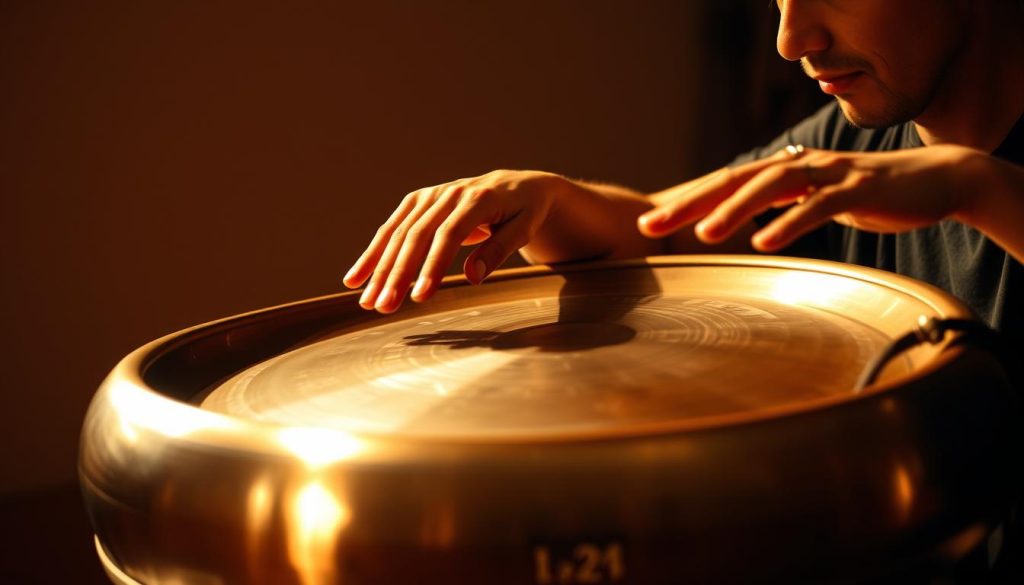
Set weekly goals suited to your technical foundation. The Alexander Technique, used by professionals, improves posture and reduces fatigue.
- 20 minutes of warm-up exercises (simple scales)
- 30 minutes on a selected piece
- 10 minutes of controlled improvisation
Recording and analyzing your progress
The Soundcorset app offers precise spectral analysis. Compare your monthly recordings using this chart:
| Criterion | Beginning | 3 months |
|---|---|---|
| Rhythmic accuracy | 60% | 85% |
| Number of notes/min | 40 | 70 |
| Harmonics mastered | 3 | 7 |
Moving on to more complex pieces
The graded repertoire of 50 pieces allows for smooth progression. Begin with compositions such as Spiral Dance before tackling IHPA-certified pieces.
Breaking rhythms down into layers is the key to mastering advanced sheet music.
Vary your styles (jazz, meditative) to broaden your musical range.
Conclusion: taking your first steps with handpan sheet music
Combining structure with artistic freedom is the key to rapid progress. Sheet music guides you, while improvisation nurtures your creativity. Use the shared resources to build a solid foundation.
This instrument opens the door to a soothing world. Studies show its benefits for concentration and well-being. Take the opportunity to combine enjoyment with learning.
To go further, download our free starter pack. It includes targeted exercises and expert advice. Let the music carry you toward new emotions.