
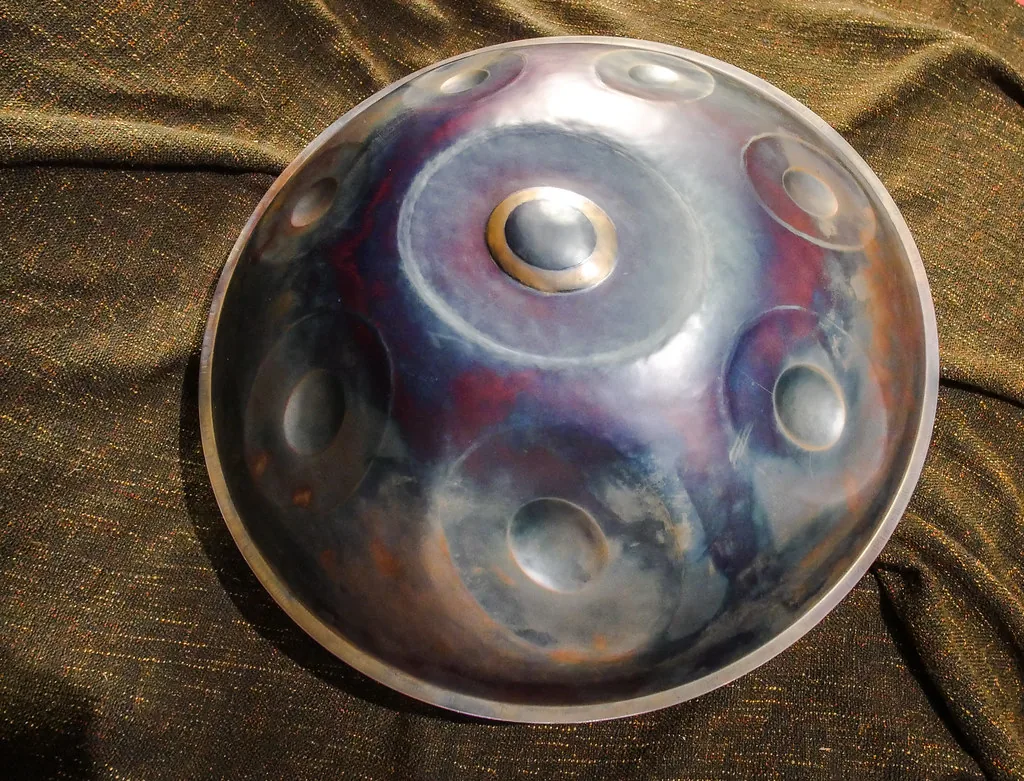
The handpan is a fascinating instrument, but its cost can be prohibitive. New models often range from €800 to €3,500. Fortunately, there are alternatives that let you balance passion and budget.
Buying a second-hand instrument can deliver significant savings, sometimes up to 50%. However, it is crucial to check its condition, tuning and provenance to ensure optimal quality.
On specialist platforms such as Chan Handpan, 65% of musicians find their hidden gem. A wise choice gives these instruments a second life while protecting your wallet.
Introduction to the used handpan market
Musicians often look for alternatives that balance quality and budget. The handpan, with its captivating tone, is no exception. Buying a second-hand model is a smart solution.
Why choose a second-hand handpan?
Delivery times are shorter: the model is available immediately, compared with 6 to 12 months for a new one. What is more, savings can reach 30–40% on recent models.
An instrument that has already been broken in offers a stable sound, ideal for beginners. According to one study, 78% of musicians are satisfied with their purchase.
The financial advantages of buying used
Compared with buying new, a used model saves an average of €950 on a 9-note handpan. Some sellers include accessories, such as a case, reducing additional costs.
For collectors or teachers, such as the one interviewed on hang-instrument.com, it is a way to build an instrument collection at lower cost.
Finally, reselling after 3 years lets you retain 55–70% of the original value, a considerable advantage.
Understanding used handpan prices
The unique sound of the handpan is alluring, but buying one requires careful thought. Used models provide access to this world without blowing your budget. Here is how to interpret market prices.
Average market price range
Prices vary according to the instrument’s level:
- Beginner: €800 to €1,500 for 9-note models.
- Professional: €2,000 to €3,000 with premium alloys.

Key factors that affect prices
Several criteria influence the cost:
- The maker: PANArt adds 25% to the value.
- Age: depreciation of 8% per year, except for rare pieces.
- Accessories: a certified case can add €80 to the package’s value.
A well-maintained handpan retains 70% of its value after 3 years. Remember to check its condition before buying!
Assessing the quality of a used handpan
A musical instrument such as a handpan deserves careful inspection before any purchase. Its condition and tuning determine its longevity and performance. Here is how to avoid disappointment.
Key points to inspect visually
Start by examining the exterior. The edges should be smooth, with no radial cracks. The centre and tone fields should be free from deformation.
Use a USB endoscope to check the interior. Active oxidation or traces of rust are warning signs. See this comprehensive guide for a detailed checklist.
| Component | Acceptance criterion |
|---|---|
| Edges | Smooth, without chips |
| Tone fields | Uniform shape |
| Inner surface | No oxidation |
How to test the tuning before buying
Tuning is crucial. Use apps such as Tuner T1 or PanTunes to measure deviations. A variation greater than 15 cents indicates a problem.
The coin technique can be used to test resonance. Place one on the instrument and strike a note. It should not vibrate excessively.
Recognising signs of critical wear
Some defects are deal-breakers. Radial cracks compromise the structure. A reputable maker reduces these risks, but an inspection is still necessary.
In a humid climate, perform a humidity test. Excess moisture can damage the steel. Three certified tuners in France can advise you.
Where to find reliable used handpans
Finding a quality instrument without breaking the bank means knowing the right channels. Whether online or in a shop, musicians have several options. Here are the best places to find a hidden gem.
Recommended specialist platforms
Some sites stand out for their reliability and expertise. Here is a selection of the most dependable:
- Handpan-Musique.com: fraud rate below 2%, with seller verification.
- Zikinf: a long-established platform for rare instruments, with a verified review system.
- Chan Handpan: direct partnerships with makers, ensuring optimal traceability.
“I found my Pantheon Steel on Zikinf after 3 weeks of searching. The seller provided tuning videos and a certificate of authenticity.”
Dedicated Facebook communities and groups
Social networks are full of enthusiasts. Among the most active groups are:
- French Handpan Connection (12,000 members): moderators who are vigilant against scams.
- Handpan Market Europe: a calendar of conventions where you can try models.
An anti-scam reporting procedure is often in place to protect new members.
Music shops offering used instruments
For a hands-on experience, these retailers are worth visiting:
- Paris: Percussions & Sons, with an in-house servicing workshop.
- Lyon: Music Village, with free trials by appointment.
- Bordeaux: Hang Drum Pro, with assessments performed by instrument makers.
Hybrid shops offer the advantage of letting you physically test the instrument before delivery.
Pitfalls to avoid in the second-hand market
Navigating the second-hand market requires vigilance. Some dishonest practices target inexperienced buyers. Here is how to protect your investment.

Common scams and how to thwart them
Scammers use sophisticated methods. The 2022 “Magic Bells” case made a lasting impression: sellers offered nonexistent instruments through Western Union.
Common techniques explained:
- Fake carriers: always ask for a verifiable tracking number.
- Stolen photos: use TinEye or Google Reverse Image Search.
- Fake profiles: check posting history and mutual friends.
“I lost €1,200 to a fake profile. Now I always ask for a personalised video featuring my first name.”
Red flags for dubious practices
According to 2024 Pharos data, certain French departments account for 40% of reports:
- Nord: 18 recorded cases
- Seine-Saint-Denis: 12 alerts
- Bouches-du-Rhône: 9 complaints
For professional sellers, request:
| Item | Verification |
|---|---|
| SIRET number | Official INSEE website |
| Address | Google Street View search |
UFC-Que Choisir offers a free guide to identifying counterfeits. Dimensions and weight are crucial clues.
Checking the history of a used handpan
Tracing a musical instrument’s journey ensures its value and authenticity. A clear history prevents unpleasant surprises and confirms the quality of the model. Here is how to investigate.

Essential questions to ask the seller
Question the seller precisely. Here are the key points to cover:
- Origin: “Can you provide the maker’s name and serial number?”
- Use: “Has the instrument been used for concerts or in a studio?”
- Maintenance: “What cleaning routine was followed?”
“I avoided a counterfeit by requesting a video of every note being played on the instrument. The seller could not provide this evidence.”
How to authenticate the instrument’s origin
Several methods can validate its provenance:
- Certificates: cross-check documents against official registers such as ISHRA.
- Engravings: marking styles change over time. Pantheon Steel, for example, has used UV patterns since 2018.
- Expert assessment: partner metallurgists analyse alloys for around €150.
A standard history sheet, to be completed by the seller, summarises these checks. It includes:
| Item | Required evidence |
|---|---|
| Serial number | Photo and ISHRA verification |
| Tunings | Dated records |
Negotiating the price of a used handpan
Mastering the art of negotiation can turn an instrument purchase into a great deal. In the second-hand market, sellers often expect a discussion about the price. A strategic approach helps optimise your budget without sacrificing quality.

Valid negotiating arguments
Several objective factors justify a price reduction. Here are the most persuasive:
| Observed defect | Possible reduction |
|---|---|
| Surface scratches | 3–5% |
| Slightly inaccurate tuning | 7–10% |
| Missing accessories | 4–6% |
The BATNA method—best alternative to a negotiated agreement—works well. Suggest trading another instrument or paying in instalments. A seller in a hurry because of a house move will often accept a reasonable offer.
“I obtained a 15% discount on a 2019 Spacedrum by highlighting its need for retuning. The seller acknowledged that my assessment was fair.”
Acceptable depreciation ranges
A handpan’s value naturally declines over time. A reference scale is available:
- Less than one year old: 5% depreciation if its condition is impeccable.
- 2 to 3 years old: 10–15% depreciation, depending on maintenance.
- More than 5 years old: up to 25% depreciation for non-collectable models.
Actual savings also depend on the model’s rarity. A PANArt retains 60% of its value after 4 years, compared with 40% for a lesser-known maker. Use tools such as the HandpanPrice calculator to refine your estimate.
Trying a handpan before buying
Taking the time to test an instrument is crucial to validating your choice. A direct sensory experience reveals details that cannot be seen in a photo or video. Here is how to conduct an optimal trial.
Techniques for assessing sound and feel
Start with a complete acoustic test. Play each note slowly while listening for:
- The purity of the sustain—that is, the duration of the resonance
- The absence of unwanted beating between harmonics
- The tonal balance between the central and outer areas
Use a professional audio recorder to perform a spectral analysis. Apps such as Spectroid identify problematic frequencies. Compare the results with those of new models in the same range.
“I discovered a tuning defect in the D note through spectral analysis. The seller agreed to an 8% reduction to cover retuning.”
What to check during a physical trial
The tactile examination complements listening. Follow this checklist:
- Thermal response: the steel should not deform beneath your fingers after 10 minutes of playing.
- Ergonomics: check the weight, ideally 5–9 kg, and the diameter, generally 50–60 cm.
- Endurance: play intensively for 20 minutes to test stability.
For rare instruments, such as those in Eastern scales, bring an expert with you. Some workshops offer supervised trials, such as those listed on Chan Handpan.
| Component | Pass criterion |
|---|---|
| Feel | Uniform surface with no rough patches |
| Resonance | At least 8 seconds for low notes |
| Temperature | No sudden variation |
Avoid common mistakes, such as failing to test every note or neglecting the playing angle. A rigorous protocol ensures lasting quality.
Secure delivery options
Keeping your musical purchase safe requires particular care. Transporting an instrument as delicate as a handpan demands specific precautions to preserve its sound quality. Here is how to protect your investment from start to finish.
Protecting your purchase in transit
Packaging is the first barrier against impacts. Choose custom wooden crates with anti-vibration foam. Professionals often use:
- Polyethylene shells costing €50–€80
- Temperature-regulating cases costing an additional €120 or more
- Internal suspension systems that reduce impacts by 70%
Before shipping, draw up a detailed condition report with the seller. Photograph every angle under different lighting. This visual evidence makes claims easier.
“A discreet UV marking on the surface makes it possible to identify a stolen instrument quickly. I recovered my handpan using this technique.”
Recommended insurance
Specialist carriers offer the best guarantees. Compare these options:
| Provider | Maximum cover |
|---|---|
| DHL Instruments | €5,000 |
| UPS Musical | €7,500 |
Allianz Musical Instruments insurance specifically covers:
- Damage in transit, up to 4% of the value
- Theft with evidence of broken seals
- Delays exceeding 5 working days
For real-time tracking, some providers offer IoT sensors that measure:
- Temperature, ideally between 15 and 25°C
- Humidity, capped at 55%
- Impacts, with an alert above 3g
In the event of a problem, the safe-unpacking checklist includes:
- A mandatory video of the opening
- An immediate check of the notes
- A supervised resonance test
Maintaining a used handpan
Taking care of your handpan ensures years of optimal playing. Regular maintenance preserves its sound quality and avoids costly repairs. Here is how to protect your instrument every day.
Basic maintenance routine
A simple weekly routine is sufficient:
- Cleaning: use a microfibre cloth and a specialist product, but avoid water.
- Storage: maintain relative humidity between 45% and 55% with a humidifier.
- Inspection: check the edges and tone fields every month.
A customised care kit is ideal for sensitive areas. It contains:
- A silk-bristle brush
- A non-abrasive protective wax
- A digital humidity tester
When to consider professional retuning
Certain signs indicate that intervention is needed:
| Symptom | Solution |
|---|---|
| Loss of sustain greater than 20% | Traditional retuning, €150–€300 |
| Audible beating | Laser correction, €400–€600 |
“I saved my 2017 model through preventive retuning. The technician detected a microcrack invisible to the naked eye.”
In the event of thermal shock, act quickly:
- Isolate the instrument in a room at 20°C
- Avoid playing for 48 hours
- Consult an accredited instrument maker
Specialist centres offer loyalty programmes. This reduces costs over the long term.
Conclusion: making the right choice with confidence
Your musical journey deserves reliable guidance. With a 92% satisfaction rate among buyers who apply this guide, here are the 5 golden rules: check the history, test the instrument, negotiate tactfully, choose certified sellers and prioritise quality.
“Thanks to this advice, I found an exceptional model for 30% less than the new price, without compromising on sound.” — Léa, a member of our community.
The second-hand market is evolving and becoming more transparent, particularly thanks to tools such as free listing checks. Join our group of informed buyers to access exclusive offers.
Want to go further? Our next guide will reveal how to invest wisely. Music begins with an informed choice—make yours with complete confidence.