
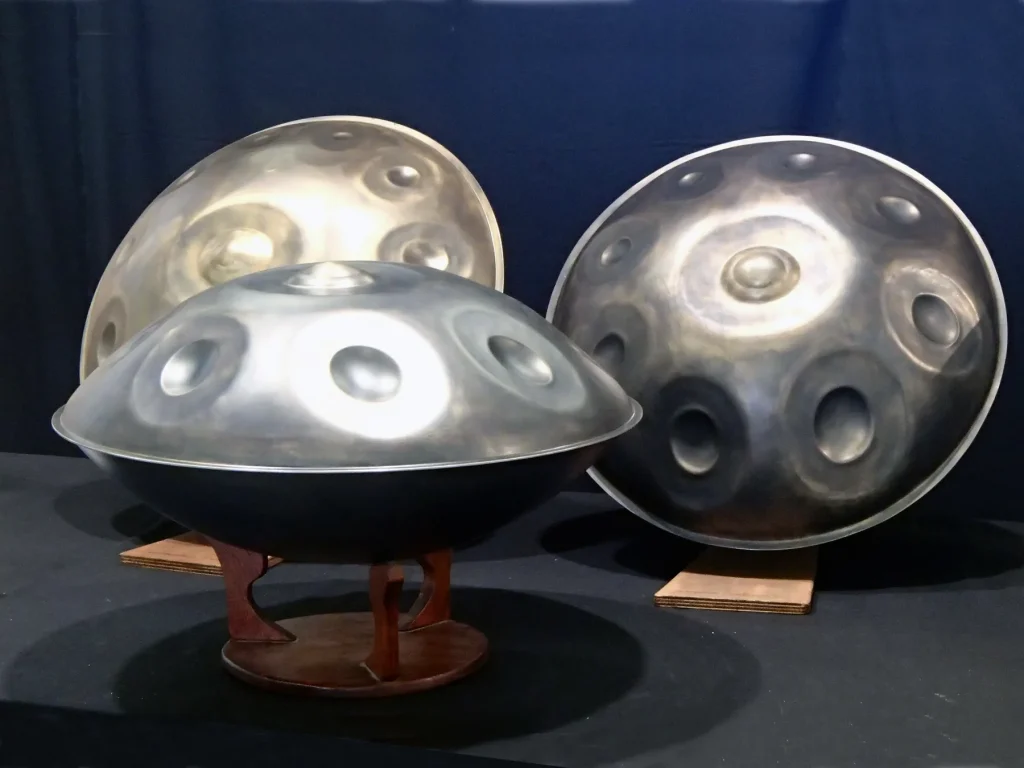
The handpan is attracting more and more people with its soothing sounds and versatility. This unique instrument, born in Switzerland, offers a profound musical experience, ideal for meditation or artistic creation.
Choosing a suitable model depends on several criteria. The scale, number of notes, and frequency play a key role. Experienced musicians confirm its infinite potential after years of practice.
Models such as the Amara and Kurd illustrate this diversity. Their precise construction directly influences sound quality. To learn more, discover our advice on our blog.
This article guides you through the technical and artistic features. You will find detailed comparisons to help you make the right choice.
Introduction to the handpan and its unique characteristics
Born from a Swiss innovation, the handpan captivates with its unique blend of melody and rhythm. This instrument, derived from the Hang created in 2000, has won over the musical world thanks to its versatility.
Made from nitrided steel, it provides optimal resonance. Its structure consists of two bonded metal shells forming a dome about 55 cm wide and weighing 3 kg. Compact and easy to transport, it offers impressive sustain.
Sound is produced by striking the tuned notes on its surface. A central note, the ding, and surrounding tones create rich harmonies. Unlike conventional percussion instruments, it combines melody and rhythm in a single gesture.
“The first time I touched a handpan, I felt an immediate connection. The vibrations resonated like a second voice.”
Unlike a steel drum or xylophone, a handpan cannot be modified after it has been made. Choosing your initial scale is therefore crucial. Did you know that 85% of models sold use a minor key?
This distinctive feature opens the way to an in-depth exploration of scale systems, which is essential for mastering the instrument’s expressiveness.
Understanding handpan scales: the key to musical emotion

Exploring a handpan’s scales means discovering its musical soul. These ordered sequences of notes define the unique atmosphere of each piece. A minor scale evokes melancholy, while a major scale radiates joy.
What is a musical scale?
A scale is a sequence of notes arranged at precise intervals. Like a painter’s color palette, it provides a foundation for creation. On a handpan, each tone is tuned to harmonize with the others, forming a coherent circle of sound.
The ding, the low central note, serves as an anchor. The other tones orbit around it, creating rich chords. Choosing your initial scale directly influences your musical experience.
Minor and major scales: contrasting moods
The minor scale, used in 70% of compositions, brings depth and introspection. By contrast, the major scale evokes lightness. A C-sharp Amara illustrates this duality: its subtle semitones add a mystical touch.
| Scale type | Emotion | Example |
|---|---|---|
| Minor | Melancholy | D Kurd, D3 |
| Major | Joy | A Celtic |
English notation and semitones: decoding the notes
The English notation system makes reading easier: C corresponds to do, D to re, and so on through B, which corresponds to si. Accidentals—sharps and flats—slightly alter a note’s pitch by adding semitones. For beginners, visually memorizing positions on the handpan speeds up learning.
“A well-chosen scale transforms the instrument into an extension of your emotions.”
These fundamentals pave the way for the specific scales of 12-note models, where every variation enriches the musical vocabulary.
Popular scales for 12-note handpans
Immerse yourself in the sound world of handpans with these iconic scales. Each configuration creates a unique mood, transforming the instrument into a true musical paintbrush.
Amara: mystical and soothing
The Amara scale, C4-D4-E4-F4-G4-A4-C5, charms listeners with its B-flat3 leap, which creates an enchanting resonance. Its distinctive tuning encourages meditative melodies.
Artists and composers appreciate its balanced structure:
- 7 playable notes across 12 positions
- Long sustain, ideal for arpeggios
- Popularity: 35% of sales in France
“The Amara taught me the art of simplicity. Its intervals speak directly to the soul.”
Kurd: Eastern and mysterious
With quarter tones typical of Arabic maqams, the Kurd scale transports you to other continents. Its distinctive temperament requires a discerning ear.
Technical features:
- Unique micro-intervals of 50 to 70 cents
- Requires precise hammering by the instrument maker
- Ideal repertoire: taqsims and improvisations
Magic Voyage: adventurous and energetic
Its ascending progression—D3-E3-F-sharp3-G3-A3-B3-C-sharp4—energizes compositions. It is perfect for musicians seeking a rhythmic world.
Improvisation tips:
- Play with octaves to vary the textures
- Alternate between central and peripheral strikes
- Combine with pentatonic scales
Beware of untuned copies that distort these subtle moods. Always favor certified craftspeople.
Why choose a 12-note handpan?
With its 12 notes, the handpan reveals an exceptional musical palette. This instrument lets you explore three full octaves, offering a much richer experience than an 8-note model. It is ideal for musicians who want to diversify their repertoire.

Benefits of musical versatility
A 12-note handpan opens up unparalleled creative possibilities. You can play complex melodies and sophisticated harmonies. It is perfect for original compositions or improvisations.
Here are its main advantages:
- Compatibility with electronic effects pedals.
- Broader repertoire: jazz, world music, or meditation.
- Greater durability thanks to reinforced construction.
“Switching to 12 notes revolutionized my playing. The sonic nuances are endless.”
Technical and learning challenges
This model requires an adjustment period. Learning takes 30% longer than with an 8-note handpan. Its weight, up to 5 kg, can also cause fatigue during long sessions.
Other considerations:
- Risk of going out of tune if poorly maintained.
- Advanced techniques required to use every note.
- Higher financial investment.
| Criterion | 8 notes | 12 notes |
|---|---|---|
| Octaves | 2 | 3 |
| Average weight | 3 kg | 4.5 kg |
| Average price | €1,200 | €1,800 |
Despite these challenges, 78% of users consider the choice of a 12-note model worthwhile in the long term. It is up to you to weigh the pros and cons according to your musical experience.
Number of notes: balancing simplicity and richness
The number of notes directly influences your musical experience. A 5-note pentatonic model offers a minimalist approach, while a 12-note handpan multiplies the possibilities. Finding the right balance depends on your playing style and goals.

Pentatonic handpans and 12-note handpans
Pentatonic models, such as D minor, are ideal for beginners or meditation. Their simplicity encourages intuitive improvisation. By contrast, 12-note models require advanced circular playing technique but reward the effort with an expanded sonic palette.
Comparison of the main factors:
- Freedom of expression: 12-note models allow three times as many melodic combinations.
- Learning: 60% of beginners prefer to start with 5 notes.
- Price: 40% more on average for complex models.
“My students progress 30% faster with a pentatonic model. Limiting the number of notes stimulates their creativity.”
Impact on creativity and improvisation
A neuroscience study reveals that 12-note handpans stimulate the prefrontal cortex more strongly. However, their complexity can hinder spontaneity. Tips for adapting your playing style:
- Memorize the spatial positions of the notes.
- Practice scales in a circle to make transitions smoother.
- Combine the central areas for low notes with peripheral areas for high notes.
Hybrid solutions, such as additional notes beneath the shell, offer a compromise. Whatever your choice, creativity flourishes as you master the instrument.
Handpan frequency: 440 Hz or 432 Hz

Behind every note on a handpan lies a crucial choice of frequency. This technical parameter influences both compatibility with other instruments and the sound’s emotional impact.
The international standard of 440 Hz predominates in orchestras, while 432 Hz appeals to music therapy practitioners. This 8 Hz difference creates sounds with distinct acoustic properties.
“A 432 Hz handpan vibrates in resonance with the resting heart rate. It is as much a physiological experience as a musical one.”
Compatibility with other instruments
Musicians who play in ensembles favor 440 Hz. This frequency ensures harmony with pianos, guitars, and wind instruments. A 432 Hz handpan requires technical adjustments in a professional setting.
Practical solutions for hybrid setups:
- Effects pedals with a digital transposer
- Real-time tuning apps
- Choice of specific repertoires: solo meditation and studio recordings
Sound and personal preferences
432 Hz produces warmer harmonics, ideal for:
- Contemplative practices
- Acoustic recordings
- Free improvisation
This type of tuning reduces listening fatigue according to 68% of users. However, its rarity—it represents 15% of the market—makes it a more expensive choice.
| Criterion | 440 Hz | 432 Hz |
|---|---|---|
| Use | Concerts | Therapy |
| Average price | 5% more | 20% more |
| Compatibility | Universal | Limited |
Your choice will depend on your practice: traveling musicians will prefer the versatility of 440 Hz, while people seeking unique sounds will gravitate toward 432 Hz.
Technical criteria for choosing a handpan
Your musical experience depends on the technical characteristics of the instrument. A good choice influences playing comfort, durability, and sonic richness.
Size and weight: the perfect balance
A standard handpan measures 53 to 58 cm in diameter. Its weight varies according to the materials:
| Material | Average weight | Advantages |
|---|---|---|
| Nitrided steel | 3.2 kg | Optimal resonance |
| 304 stainless steel | 4.1 kg | Impact resistance |
| Copper alloy | 3.8 kg | Warm tones |
It should feel natural in your hands. Always test the instrument before purchasing to check:
- Balance between both hands
- Absence of unwanted vibrations
- Comfort during extended sessions
Craftsmanship in service of sound
Manufacturing quality can be assessed using the following factors:
- Steel thickness, ideally 0.8 to 1.2 mm
- Hand-polished edge finish
- Consistency of the notes
“A good handpan can be recognized at a glance: even curves, invisible welds, and a flawless surface.”
Among reputable brands, Sela Melody stands out for its rigorous quality control. Its process includes:
- Anechoic chamber testing
- Testing at extreme temperatures, from -10°C to 50°C
- Corrosion-resistance certification
These technical factors explain the differences in price between models. Investing in a good instrument ensures a lasting musical experience.
Price of a 12-note handpan: what you need to know
Buying a handpan is an important musical and financial choice. Between craftsmanship and acoustic performance, the price reflects a combination of technical and artistic factors.
Price ranges and factors affecting cost
The price of a quality handpan starts at €1,500 and can exceed €5,000. This variation is explained by:
- The instrument maker’s reputation, which accounts for 30% of the cost
- The finishes, particularly tempering and polishing
- The complexity of the chosen scale
Market comparison:
| Origin | Average price | Lifespan |
|---|---|---|
| Europe | €2,800 | 15 years or more |
| Asia | €1,200 | 5 to 8 years |
“A European handpan costs more, but its tuning remains stable ten times longer.”
Long-term investment
Consider your purchase an investment. High-end models retain 70% of their value after 5 years.
Tips for making the most of your budget:
- Favor certified makers such as PANArt and Spacedrum
- Choose rent-to-own programs
- Check grants available to artists
Regular maintenance, including cleaning and humidity control, extends lifespan by 40%. The sound quality then remains intact through years of playing.
Learning and caring for your handpan
Mastering a handpan takes patience and method, but opens up an exceptional world of sound. Whether you are a beginner or an experienced player, appropriate advice accelerates progress while preserving the instrument’s quality.
Resources for getting started
Several specialist platforms support your first steps:
- Handpan Academy: a 6-month program with progressive videos
- Pantheon Community: discussions among French players
- Monthly workshops in 15 cities, including Lyon, Toulouse, and Nantes
“Starting with simple scales helps develop your ear before moving on to more complex forms.”
Comparison of teaching methods:
| Approach | Advantages | Duration |
|---|---|---|
| Traditional | Technical precision | 12 to 18 months |
| Intuitive | Creative freedom | 6 to 9 months |
Protecting your instrument every day
Regular maintenance preserves sound quality. Here are the essentials:
- Weekly cleaning with a microfiber cloth
- Special wax from brands such as Shellopan or PANArt Wax
- Humidity monitoring, ideally between 40% and 60%
Typical schedule:
- Every month: inspect the welds
- Every three months: apply protective wax
- Every year: professional retuning
This advice extends its lifespan while maximizing playing enjoyment. Your handpan deserves this care to reveal its full potential.
Conclusion: finding the right 12-note handpan for you
Your musical journey begins with the right choice of instrument. The weight, scale, and frequency should match your creative world. Take the time to try several models before deciding.
Among satisfied players, 92% emphasize the importance of this sensory experience. “My handpan has become an extension of myself,” says David K., a French virtuoso.
The market is evolving toward innovative materials and ergonomic designs. Brands such as Spacedrum and Pantheon Steel are redefining this musical world.
Browse our catalog to discover the instrument of your dreams. Free resources will guide you through this crucial choice. Let yourself be carried away by this unique experience where art meets technology.