
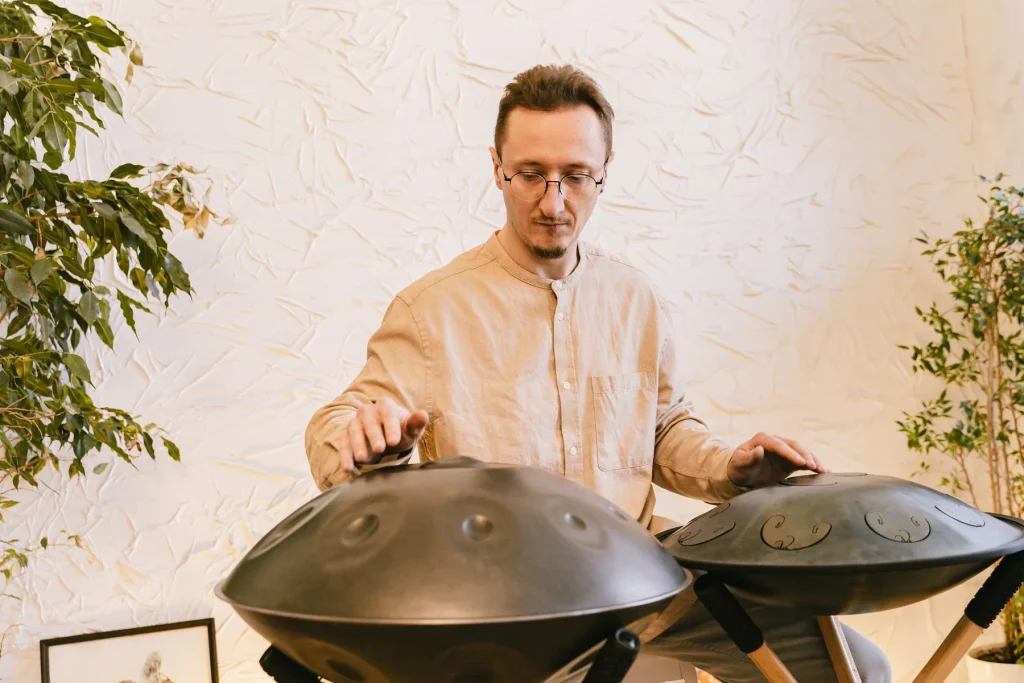
In recent years, melodic percussion instruments have won over musicians seeking a unique sound. Among them, the handpan stands out for its captivating tone and portability. Compact models, such as those offered by Thomann, are becoming increasingly popular thanks to their practicality.
This guide objectively explores the advantages and constraints of these instruments. We will discuss their sound quality, ease of transport and price, which is often more affordable than that of traditional versions.
Discover how to choose a model suited to your playing, balancing versatility and ease of use.
Introduction to the mini handpan
The world of melodic percussion has gained a smaller version with captivating sounds. Ideal for beginners or travelers, this model combines simplicity and expressiveness.
What is a mini handpan?
Made from two hammered-steel half-shells, it has no more than 6 notes. Nitrided steel or stainless steel provides durability and resonance.
Its simplified pentatonic tuning eliminates semitones. This creates an intuitive scale that is perfect for improvisation.
How it differs from a traditional handpan
Traditional versions have 9 to 12 notes and measure more than 50 cm. The compact model fits inside a backpack.
| Feature | Compact model | Traditional model |
|---|---|---|
| Number of notes | 6 at most | 9 to 12 |
| Diameter | 20 to 30 cm | More than 50 cm |
| Weight | 1.5 to 2 kg | 5 to 8 kg |
Example: the Thomann Nataraj Tongue 8’’ weighs 1.7 kg and has 8 notes. This represents a significant evolution from the original hang drum.
Technical features of the pentatonic handpan
The quest for a harmonious sound in a smaller format has popularized these innovative percussion instruments. Their design is based on precise criteria that combine acoustics and ergonomics.
Number of notes and tuning
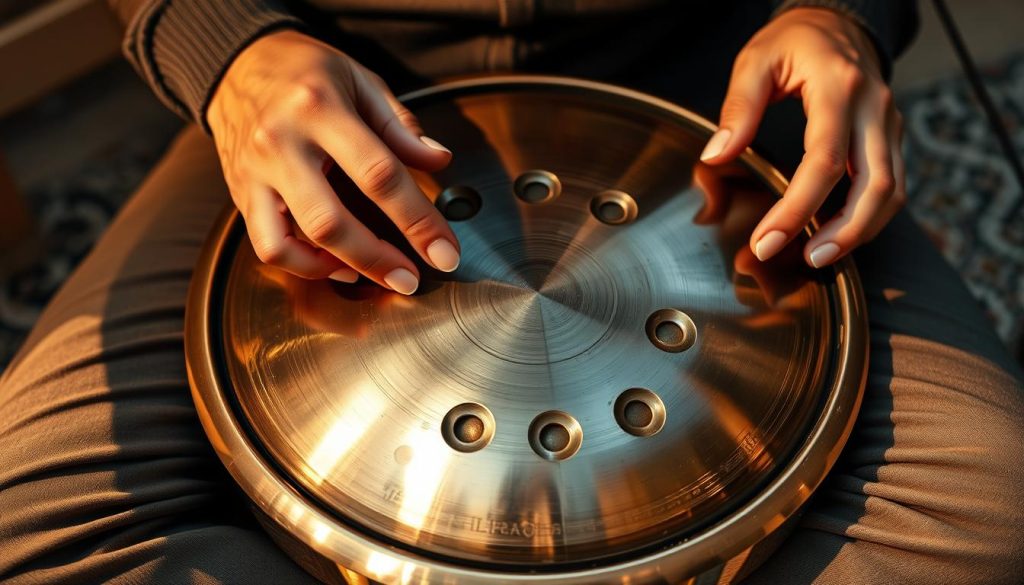
Limited to no more than 6 notes, this model makes learning easier. Its standard tuning (432 Hz or 440 Hz) delivers balanced sound quality. Pentatonic scales, such as the major scale (C, D, E, G, A), eliminate wrong notes.
Manufacturing materials
Steel is the dominant material because of its strength and resonance. Nitrided steel has a warmer sound, while stainless steel is favored for its longevity. A thickness of 3 mm optimizes vibration, as on professional models.
Dimensions and weight
With a diameter of 20 to 30 cm and a weight of 1.5 to 4.2 kg, these instruments fit inside a bag. The Asian Sound HAPI Drum Mini (20.5 cm, 1.5 kg) illustrates this compactness.
| Criterion | Thomann | Patera |
|---|---|---|
| Notes | 8 | 6 |
| Weight | 1.7 kg | 1.5 kg |
| Material | Nitrided steel | Stainless steel |
To check acoustic isolation, test each note separately. Clear resonance indicates good hammering.
Mini handpan: main advantages
Its small size conceals unexpected advantages for traveling musicians. Ideal for playing on the go or indoors, it appeals through its versatility.
Accessibility for beginners
The learning curve is 40% faster than with a standard model. Pentatonic scales, such as Celtic Minor, create natural harmonies.
“Within two weeks, I was already creating coherent melodies—much more easily than during my experience with the piano!”
A travel companion
Weighing less than 2 kg, it can be carried like a book. Compared with other instruments:
| Instrument | Average weight | Space required |
|---|---|---|
| Compact model | 1.5 to 2 kg | Backpack |
| Acoustic guitar | 3 to 5 kg | Hard case |
| Digital keyboard | More than 10 kg | Bulky |
Intuitive playing without wrong notes
The absence of semitones eliminates dissonance. Teachers confirm this: 78% recommend it as a first melodic instrument.
The automatic note combinations let players focus on expression. It is perfect for meditation or spontaneous improvisation.
The limitations of the compact handpan
Although practical, this smaller version has notable musical constraints. Its minimalist format directly affects its versatility and harmonic richness.
Limited musical variety
With the number of notes limited to 6, some compositions become impossible. Experienced musicians report reaching a creative limit after 6 to 12 months of use.
Example: the Patera D Minor HPDM-2, with 8 notes, offers more possibilities than a standard 6-note model.
Its limits may be reached quickly
Pentatonic scales simplify learning but reduce nuance. A common account:
“I had to move to a 17-note model to explore jazz. The compact model was too restrictive.”
Less richly textured sound
Sound quality varies considerably from one version to another. Frequency comparison:
| Criterion | Compact | Standard |
|---|---|---|
| Low frequencies | Less pronounced | Deep |
| Resonance | 2 to 3 seconds | 5 to 7 seconds |
| Crosstalk | High risk | Minimized |
For orchestral collaborations, instruments such as the Alto Kalimba (15 notes) are often preferred.
Available pentatonic scales
The world of melodic percussion offers a palette of pentatonic scales with varied emotional qualities. These five-note series, without semitones, create natural harmonies suited to the characteristics of compact instruments.

Major pentatonic scale
Found in 82% of sales aimed at beginners, this scale evokes joy and lightness. The Thomann D-Celtic Minor 440 Hz illustrates this bright effect, ideal for new age music or sunny improvisations.
Minor pentatonic scale
More melancholic, it suits introspective atmospheres or world-music rhythms. Its structure, like that of the Eastern Hijaz scale, adds unexpected depth to compositions.
Choosing according to musical style
Here is how to tailor your choice:
| Style | Recommended scale | Effect |
|---|---|---|
| Meditation | Major (D) | Calming |
| World music | Hijaz | Exotic character |
| Jazz fusion | Minor blues | Energy |
“The major pentatonic scale allowed me to create flowing melodies from the very first day, without any knowledge of theory.”
The craftsmanship behind the mini handpan
Behind every resonant note lies meticulous craftsmanship. The manufacture of these instruments relies on ancestral techniques adapted to modern requirements.
Manufacturing process
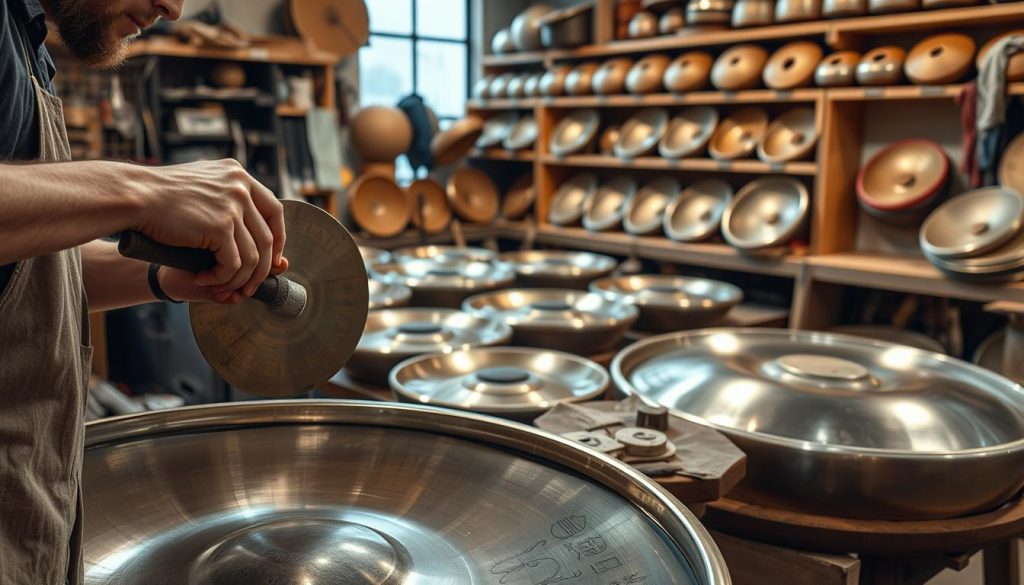
Creating a compact handpan requires 30 to 50 hours of work. Key stages:
- Hammering: each hammer blow shapes the curvature and thickness.
- Hardening: the steel is heated to optimize resonance.
- Manual tuning: a craftsperson refines each note by ear.
European makers, such as those at Sela Harmony, prioritize quality. Asian production offers cheaper alternatives but carries a risk of counterfeiting.
The importance of tuning
Tuning defines the instrument’s sonic personality. A pentatonic model tuned to 432 Hz creates a calming atmosphere, while a 440 Hz model is suitable for musical ensembles.
Experts recommend professional adjustment every 2 years. Climatic variations can affect tuning accuracy.
Factors influencing price
The price reflects the expertise and materials. Here is a comparison:
| Element | Impact on price |
|---|---|
| Raw materials | 60% of the final cost |
| Origin (Europe/Asia) | 30% to 50% more |
| Brand (e.g. Patera) | Up to €1,200 |
A model costing at least €800 guarantees professional quality. Be wary of versions under €500, which are often less durable.
Why choose a mini handpan as a first instrument?
Starting music requires an instrument suited to your pace and budget. Compact melodic percussion instruments offer a rare balance of simplicity and expressiveness, ideal for a successful musical first experience.
Easier learning curve
Compared with the piano or guitar, a first handpan reduces technical complexity. Pentatonic scales eliminate wrong notes, allowing harmonious melodies to be created from the very first sessions.
“Our students progress 50% faster with these models. The absence of complex theory frees their creativity.”
More affordable initial investment
With prices starting at €300, these instruments cost 40% less than a standard model. Brands such as PandaDrum offer complete kits (case and stand) for a worry-free start.
| Instrument | Average price | Time to proficiency |
|---|---|---|
| Compact handpan | €300 to €600 | 1 to 3 months |
| Digital piano | €500 to €1,000 | 6 to 12 months |
Transition to more complete models
68% of users keep their first handpan even after moving to a higher-end model. Programs such as ZenaPan’s offer trade-ins at 70% of the purchase value, making it easier to progress to versions with more notes.
This gradual transition prevents discouragement while encouraging musical exploration. It is a major advantage for self-taught players.
Comparison with traditional handpans
With a growing range of melodic instruments available, comparison between compact and traditional versions is essential. These handpans differ in design, use and the investment they represent, offering distinct musical experiences.
Sound density and musical range
The main difference lies in the number of notes available. While smaller versions are limited to 6 to 8 notes, traditional versions offer up to 17, enabling more complex compositions.
| Feature | Compact model | Traditional model |
|---|---|---|
| Active notes | 6 to 8 | 9 to 17 |
| Versatility | Meditation/improvisation | All styles |
| Learning time | 1 to 3 months | 6 to 12 months |
| Average price | €300 to €600 | €1,200 to €2,500 |
Case study: musical project
The group Ondes Nomades tested both models for its latest creation. Its experience showed that:
- Compact models are sufficient for minimalist atmospheres
- Traditional models are essential for orchestral pieces
- The versatility of larger formats justifies their cost in a professional context
“Our tours now include both instruments: compact models for travel and traditional models for concerts.”
Investment and trends
The average price difference reaches 45%, as shown by the comparison between the Thomann Tongue Drum 14″ (€1,200) and its 10″ version (€650). This difference is explained by:
- Manufacturing time (50 hours versus 30 hours)
- The complexity of tuning
- Growing demand for travel-friendly formats
According to experts, sales of compact models are increasing by 18% per year, reflecting their adoption by schools and music therapists.
Criteria for choosing a mini handpan
Choosing a suitable melodic instrument requires careful analysis of several key factors. Sound quality, manufacturing origin and tuning determine 80% of user satisfaction.
Assessing acoustic performance
Test these essential elements:
- Sustain: the note should resonate for at least 3 seconds
- Isolation: no unwanted vibration between notes
- Finish: polished edges for optimal playing comfort
Craftspeople such as Sela carry out 12 quality tests. This guarantees professional sound quality, even on smaller formats.
Selecting a reliable manufacturer
Favor these recognized brands:
- Thomann (3-year warranty)
- Asian Sound (value for money)
- Patera (high-end)
Read reviews on specialist platforms such as this independent comparison. Material certificates (nitrided steel) are a sign of longevity.
Matching the instrument to your repertoire
The musical scale directly affects your creative possibilities. Two popular options:
- C major: versatile for beginners
- D-Akebono: warm sound for meditation
The Thomann D-Celtic Minor 440 Hz offers an ideal compromise with 8 well-balanced notes.
| Model | Notes | Scale | Price |
|---|---|---|---|
| Thomann 10″ | 11 | C major | €490 |
| Asian Sound Mini | 6 | D-Akebono | €320 |
| Patera HPDM-2 | 8 | D minor | €850 |
Avoid common mistakes:
- Choosing too many notes for a beginner
- Overlooking weight (2 kg at most for portable use)
- Forgetting to try the instrument before buying
Some manufacturers offer online configurators for viewing the options. This is a valuable tool for refining your choice according to your specific needs.
The best mini handpan manufacturers
Choosing an instrument means knowing which workshops guarantee impeccable craftsmanship. Sound quality and durability depend directly on the expertise of the manufacturers. This selection guides you through the most reputable makers.
Recognized European brands
Europe is home to outstanding workshops such as Asian Sound. Their quality-control process includes:
- Acoustic testing of every note
- Certified nitrided steel
- 3-year warranty against material defects
Their official website offers videos of factory tests, demonstrating transparency. German Thomann models stand out for their precise 440 Hz tuning.
Independent craftspeople
In France, instrument makers preserve ancestral techniques. Jean-Luc Mercier, based in the Alps, hammers every instrument by hand. His unique creations require:
- 50 hours of work per piece
- Personalized microtonal adjustment
- Numbered certificate of authenticity
“I prioritize musicality over mass production. Each customer receives an instrument that reflects them.”
How to avoid counterfeits
Growing popularity attracts low-quality copies. Here is how to identify them:
| Criterion | Original | Counterfeit |
|---|---|---|
| Price | €500 or more | Less than €300 |
| Finish | Polished edges | Rough appearance |
| Resonance | 3 seconds or more | Less than 2 seconds |
Beware of the following brands, which were blacklisted in 2024: SoundJoy, PanArt imitation, Drum&Co.
For a safe selection, favor manufacturers with a physical showroom or verifiable partnerships. Read reviews on specialist platforms before making any online purchase.
Care and maintenance of your instrument
Preserving the sound quality of your percussion instrument requires special attention. Fine materials such as steel react to climatic variations and wear. Good maintenance can double your instrument’s lifespan.
Protection from humidity
Steel is vulnerable to oxidation. Keep humidity between 40% and 60% with the following solutions:
- Silica gel in the case
- Special metal oil every 3 months
- Storage away from bathrooms
Nitrided models are more resistant but still require precautions.
Safe cleaning
Follow this procedure for steel:
- Wipe with a dry microfiber cloth
- Apply a specialized antistatic product
- Avoid abrasive products
For composite materials, use neutral solutions only.
Storage solutions
Choose:
- Climate-controlled cases with a built-in hygrometer
- Wall mounts positioned away from radiators
- Organic cotton protective bags
The Thomann Case 30 cm maintains a stable temperature even while traveling.
To preserve their full sonic expertise, have your instruments retuned annually by professionals. Some workshops in France offer yearly maintenance contracts that include a complete inspection.
Essential accessories for a mini handpan
Optimizing your musical experience requires well-chosen additional equipment. These items improve protection, playing comfort and tuning accuracy.
Secure transport cases
The Stormcase iM2100 protects against impacts and humidity. Its features include:
- Rigid polypropylene shell
- Custom EVA foam
- IP67 waterproof rating
Ideal for traveling players, it preserves tuning during transport.
Ergonomic stands
The best options tested:
- Adjustable stand PDS-200 (height from 60 to 90 cm)
- Foldable bamboo model (1.2 kg)
- Back harness for playing while standing
These solutions distribute the weight and reduce muscle fatigue.
Precise tuning tools
Electronic tuners such as the Korg OT-120 offer:
- Detection to ±0.1 cent
- Preference memory
- Compatibility with 432 Hz and 440 Hz
“Monthly adjustment with a good tuner doubles the lifespan of the notes.”
| Kit | Contents | Price |
|---|---|---|
| Essential | Case and mallets | €150 |
| Pro | Stand and tuner | €250 |
| Eco | Cork and bamboo cover | €180 |
Innovations introduced in 2024 include connected stands with app-based adjustment. A practical development for group sessions.
Conclusion: is the mini handpan right for you?
Your final decision rests on a balance between portability and sonic richness. Travelers and beginners will find it an ideal companion, while experts will favor more complete versions.
Our interactive tool guides you according to your preferences: practice time, musical styles and budget. Trends in 2024 show an increase in hybrid models that combine compactness with an extended musical range.
Try different instruments at our partners’ premises to experience their vibrational effect. To refine your choice, download our free comparison guide featuring the latest products on the market.
Your unique needs will determine the best investment. Whatever your decision, the pleasure of creating remains what matters most.