
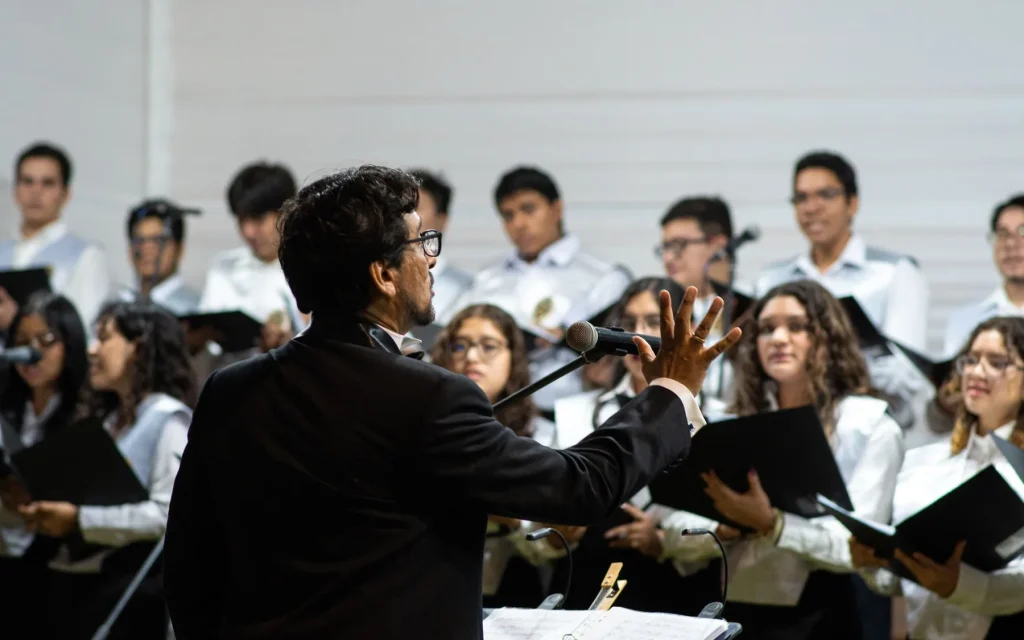
Welcome to this illustrated guide to the basic gestures of soundpainting. If you are interested in the world of vocal and musical art, you have undoubtedly heard of this emotionally rich discipline. Soundpainting is a collaborative art form in which a conductor, or “soundpainter,” directs a group of musicians and singers using a series of specific gestures.
The guide presented here is designed to help you understand these gestures and put them into practice. The included illustrations make learning easier and allow you to visualize each movement. Whether you are a beginner or an experienced practitioner, this guide will be very useful in improving your understanding of soundpainting.
What is soundpainting?
Soundpainting is a real-time composition language used for musical, theatrical, and choreographic performances. It was created in 1974 by Walter Thompson, an American musician, and has since been adopted by artists around the world.
Soundpainting consists of a series of gestures performed by a soundpainter, who directs a group of musicians, actors, or dancers using a set of signs that communicate musical ideas, rhythmic patterns, and stage movements. These codified gestures are used to direct the various aspects of the performance.
Soundpainting is a unique and expressive way of creating music in real time, using a combination of gestures and signs to direct and inspire the artists on stage. It is a collaborative art form that allows artists to work together to create something truly original and unique.
What are the techniques of soundpainting?
Soundpainting is a complex art form that requires training and regular practice to master. Soundpainting techniques include:
- Understanding the signs and gestures used to direct the various aspects of the performance
- Practicing nonverbal communication with the artists on stage
- Directing the performance in real time using codified signs and gestures
- Collaborating with artists to create original musical, theatrical, and choreographic performances
Artists wishing to learn soundpainting must be prepared to invest time and effort in their training. However, mastering this technique offers many benefits and can lead to an exciting and successful artistic career.
The benefits of knowing the basic gestures of soundpainting
Learning the basic gestures of soundpainting is essential for following a soundpainting tutorial or practicing this form of musical and vocal gestural language. Knowing the specific movements allows you to understand the conductor’s instructions and play an active role in creating music. Here are some of the benefits of knowing the basic gestures of soundpainting:
| Benefits | Description |
|---|---|
| Ease of learning | Knowing how to perform the basic gestures makes learning soundpainting easier and faster. |
| Communication | Knowing the basic gestures makes it possible to communicate effectively with the other members of the ensemble and the conductor. |
| Creativity | Mastering the basic gestures opens the door to more complex creative possibilities. |
| Confidence | Knowing the basic gestures of soundpainting provides the confidence needed to experiment with different movements and techniques. |
In short, mastering the basic gestures of soundpainting is an excellent starting point for anyone wishing to learn this expressive musical and vocal technique. Tutorials and illustrated guides are valuable tools for making learning easier and improving your skills.
The basic gestures of soundpainting explained in detail
Soundpainting uses precise gestures to communicate instructions to the artists involved. This section provides a detailed explanation of the basic gestures of soundpainting so that readers can understand and practice them.
| Gesture | Description | Example |
|---|---|---|
| Pointing | Indicates a specific musician or instrument to be used. | Pointing toward a guitarist to ask them to play a melody. |
| Crossing | Indicates a change in rhythm or key. | Crossing the arms to indicate a change of key. |
| Size | Indicates a change in volume. | Hand movements indicating an increase or decrease in volume. |
| Call and Response | Indicates an interaction between different musicians, either in alternation or in counterpoint. | Call and Response between the saxophones and trumpets. |
These four basic gestures are frequently used in soundpainting, but many other, more advanced gestures also exist. Artists who master these gestures can communicate precisely and create a unique and expressive musical or theatrical performance.
The importance of illustrations when learning soundpainting
Illustrations are crucial for understanding and learning the basic gestures of soundpainting. They make it possible to visualize the specific movements being used and help learners reproduce them accurately.
The illustrated guide to the basic gestures of soundpainting makes learning easier by providing clear, concise images for each gesture. This makes the movements much easier to understand, especially for beginners. The illustrations also help clarify the gestures and prevent confusion when performing them.
 |
Illustrations make learning soundpainting easier and more accessible for beginners. |
Furthermore, illustrations add a creative and inspiring dimension to the learning process. Seeing how the basic gestures of soundpainting combine to create an artistic performance can encourage learners to be more creative in their own practice.
Therefore, an illustrated guide is important for understanding and mastering the basic gestures of soundpainting. Illustrations can help clarify the gestures, make them more accessible to beginners, and add a creative dimension that makes learning more stimulating and rewarding.
Practical tips for mastering soundpainting gestures
Learning the basic gestures of soundpainting is one thing, but mastering them is another. Here are some practical tips to help you refine your gestures and develop your talent for soundpainting.
Practice regularly
Regular practice is essential for mastering soundpainting gestures. Set aside time each day to practice and familiarize yourself with the gestures. Even ten minutes a day can make a big difference.
Listen carefully
To master soundpainting gestures, it is important to listen carefully to the music and to the other artists with whom you are working. Soundpainting gestures are signs that allow you to communicate with the other artists and interact with the music. It is therefore essential to understand the performance as a whole in order to use them properly.
Adjust the speed and intensity of the gestures
Soundpainting gestures are often performed at different speeds and intensities to convey subtle nuances during the performance. It is important to know how to adjust these parameters in order to communicate effectively with the other artists and interact with the music.
Be creative
Soundpainting is an art form that leaves plenty of room for creativity. Feel free to explore new ways of using the gestures or to create new ones that adapt your performance to your artistic vision.
Work in a group
Soundpainting is a collaborative art form, and working in a group can be extremely beneficial when refining your gestures. Try to find other artists who practice soundpainting and organize practice sessions together. This will allow you to learn from one another and improve your collective performance.
Conclusion
In conclusion, soundpainting is a vocal and musical art form that uses specific gestures to create spontaneous, collaborative performances.
Knowing the basic gestures of soundpainting is essential for participating fully in this art form, and an illustrated guide can be a useful learning tool.
Illustrations provide a visual reference for the specific movements and techniques of soundpainting, which can help learners understand the gestures and put them into practice more effectively.
By following practical advice for mastering the gestures, learners can improve their soundpainting skills and fully enjoy this expressive art form.
Ultimately, soundpainting gestures make it possible to create unique collaborative performances, and knowing these basic gestures enables artists to participate fully in this fascinating art form.