
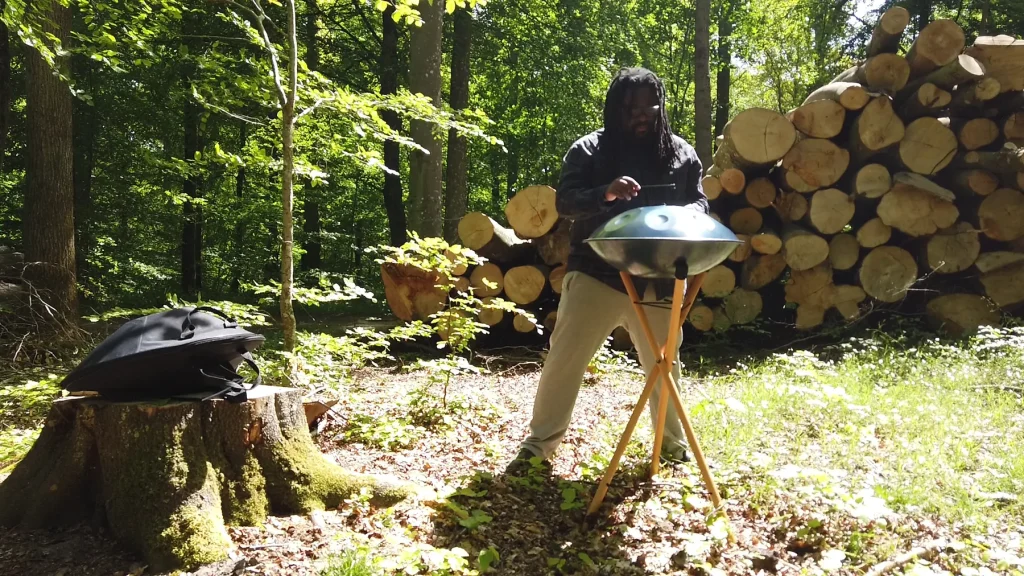
The handpan is a fascinating instrument, accessible even without musical experience. Its melodic and intuitive world is attracting more and more enthusiasts in France. Whether you want to relax, meditate, or create unique sounds, this instrument offers endless possibilities.
This guide takes you step by step through your learning journey. Having trained more than 38,000 students, the MasterTheHandpan method, recommended by David Charrier, delivers rapid results. Student testimonials confirm its effectiveness.
We will cover choosing an instrument, basic techniques, and resources for making progress. Ready to explore this vibrational art?
Introduction to the handpan: an accessible and enchanting instrument
Discover a unique world of sound with the handpan, a captivating melodic instrument. Made of steel and featuring notes tuned to a specific scale, it produces harmonious sounds that feel like an invitation to be creative.
What is a handpan?
Created in the 2000s as an evolution of the Hang Drum, the handpan is distinguished by its structure: a central note (the ding) surrounded by peripheral tone fields. Unlike traditional percussion instruments, it requires no musical experience to produce immediately pleasing melodies.
For tighter budgets, tongue drums provide an alternative, but the handpan remains unmatched for its harmonic richness. A video testimonial even shows a student playing a coherent melody after only two weeks.
Why choose the handpan as your first instrument?
95% of beginners create harmonious melodies in their first week. No knowledge of music theory is required: intuition and immediate enjoyment take center stage.
According to a University of Montpellier study, playing it significantly reduces stress. In addition, 78% of players report improved concentration. Ideal for relaxing or meditating, this instrument fits easily into everyday life.
Explore our beginner models to find the one that suits you.
Choosing the right handpan for beginners
Finding the right instrument is crucial for getting off to a good start. A poor choice can hold back your progress, while a suitable model makes the experience intuitive and enjoyable.

Essential criteria: scale, number of notes, and frequency
The scale determines the musical mood. Beginners often favor D Kurd or Celtic Minor for their universal harmony. A clearly defined central note makes improvisation easier.
Choose 8 or 9 notes to avoid feeling overwhelmed. As for frequency, 432 Hz provides a soothing sound that is ideal for meditation, while 440 Hz blends better with a group.
Our recommended beginner models
Among the more accessible instruments, the Sela Melody D Kurd SE220 (€799) offers excellent value for money. For a larger budget, the Rav Vast Drum (€1,490) provides professional-grade durability.
Discover other beginner models from certified makers such as Zenapan. Avoid counterfeits on Amazon, which are often poor quality.
“A well-chosen handpan is a companion for years.”
Finally, get a protective case and store it somewhere with humidity below 60%. These precautions preserve the richness of its sounds.
First steps: position and handling
Mastering the right position and handling is essential for starting out with confidence. A comfortable setup lets you focus on the sounds rather than discomfort.
The ideal seated posture
Choose a low camping-style chair that positions your knees above your hips. Tilt the instrument slightly at a 30° angle toward your torso so you can reach the notes naturally.
Beginners often overlook these details:
- Plant your feet firmly on the floor for optimal stability
- Relax your shoulders to avoid muscle tension
- Synchronize your breathing with your strikes to achieve a natural rhythm
How to hold and position your handpan correctly
Cup your hands around the curve of the instrument. Your thumbs provide support, while your other fingers produce the notes.
If you are left-handed, simply reverse this technique without changing the angle. A visual tutorial shows how to position each finger to produce clear tones.
“The first 15 minutes determine the quality of your session. Favor short but regular sessions.”
These technical tips will help you avoid common mistakes and accelerate your progress. After applying them for two weeks, your movements will become instinctive.
Basic techniques for producing beautiful tones
Producing harmonious melodies on the handpan relies on precise techniques. A gentle, controlled approach lets you harness the full potential of the instrument.
The gentle strike: brush rather than hit
The secret lies in a light touch. Use your fingertips like a paintbrush, brushing the notes 2 cm from the edge of the tone fields. Excessive pressure muffles the sounds.
Try this exercise: sustain each note for 5 seconds to control the resonance. Then compare it with a forceful strike to feel the difference.
Using your fingers: thumbs, index fingers, and middle fingers
Each finger has a role:
- The thumbs stabilize the instrument and produce the bass notes.
- The index finger and middle finger create melodies with varied nuances.
Advanced techniques, such as the finger roll, add fluidity. A metronome set between 60 and 80 BPM helps you maintain a steady rhythm.
Where to strike for each note
Each note corresponds to a specific area on the tone fields. A simplified anatomical diagram shows the best points for producing clear sounds.
Warm up for 5 minutes before playing. For beginners, improvising on a pentatonic scale provides a simple framework. Discover other methods for beginners to develop your playing further.
“The subtlety of each strike transforms an attempt into music.”
Practical exercises for making rapid progress
Structured practice is essential to mastering the handpan. With 20 hours of training, you will reach a satisfactory level. Divide your time as follows: 70% for technique and 30% for creativity.

Ascending and descending scales
Start by exploring each note from bottom to top, then work your way back down. This exercise sharpens your accuracy and listening skills. Alternate hands to develop balanced coordination.
Use a metronome at 60 BPM. Gradually increase the speed after several repetitions. This method strengthens muscle memory.
Playing harmonious chords
Combine two or three notes to create soothing melodies. D Kurd is ideal for beginners. Here is a table of effective combinations:
| Notes | Effect |
|---|---|
| D + A | Soothing |
| E + C | Energizing |
| G + B | Meditative |
Learning a simple rhythm
Incorporate body percussion to mark the tempo. Tap your foot on the strong beats. This exercise naturally develops your sense of rhythm.
Try the 30-day challenge with a video recording. Compare your progress using our weekly progress chart.
“Consistency matters more than duration. Fifteen minutes every day is better than two hours occasionally.”
For variety, try improvising with only 3 notes. Set limits to stimulate your creativity. Audacity lets you record and analyze your sessions.
Learning methods: self-taught or guided?
Exploring different approaches is crucial for making effective progress. Each method has its advantages, depending on your goals and pace.

The advantages of online courses
Online courses, such as MasterTheHandpan, provide a clear structure. With innovative visual notation and an included e-book, they accelerate progress.
Statistically, students progress 300% faster than self-taught players. Here is a comparison of popular platforms:
- MasterTheHandpan: unlimited access, personalized support
- Zenopan Academy: live classes, active community
- Handpan Basics: lower cost, themed modules
Free resources: tutorials and sheet music
YouTube tutorials and freely available sheet music are a useful complement to courses. Here are some certified French-language channels:
- Handpan France
- Melodiscovery
- SoundWaves Academy
“I tried three methods before finding the one that suited me. Consistency changed everything.”
The importance of regular practice
The amount of time invested matters less than frequency. The Pomodoro technique (25 minutes of playing, 5 minutes of rest) optimizes practice sessions.
Create a practice journal to track your progress. An 8-week calendar can give your training structure.
Avoiding common beginner mistakes
Making rapid progress means identifying and correcting bad habits from the outset. 90% of those who give up do so because of preventable physical pain. Here is how to avoid it.

Excessive force: a pitfall to avoid
Striking too hard muffles the sounds and tires your hands. Brush the notes lightly to produce clear sounds. One useful exercise is to play while whispering and match your intensity to your voice.
Risky postures and solutions
Uncomfortable positions cause lower-back pain and tendinitis. Here is the professionals’ advice:
- Avoid raising your shoulders
- Keep your back aligned with a lumbar cushion
- Change positions every 10 minutes
Making the best use of your practice time
Three 20-minute sessions per week are better than one hour of intensive practice. Here is a comparison of the results:
| Frequency | Progress after 1 month |
|---|---|
| 3 × 20 min | +40% accuracy |
| 1 × 1 hr | Only +15% |
“Consistency overcomes obstacles better than intensity.”
After each session, stretch your wrists and forearms for 5 minutes. Protect the instrument from moisture with silica-gel packets placed inside its case.
Conclusion: your musical journey begins now
Your musical adventure is about to come alive. Remember these five principles: a light touch, consistency, relaxed posture, active listening, and enjoyment above all.
To get started, download our free guide, which includes 10 scores suitable for beginners. It also comes with a personalized practice schedule to structure your sessions.
Join the MasterTheHandpan community to connect with other enthusiasts. Record your progress: comparing your first and latest videos will be a source of pride.
As David Charrier says: “Music is born where the instrument and intuition meet.” Your unique experience starts here.