
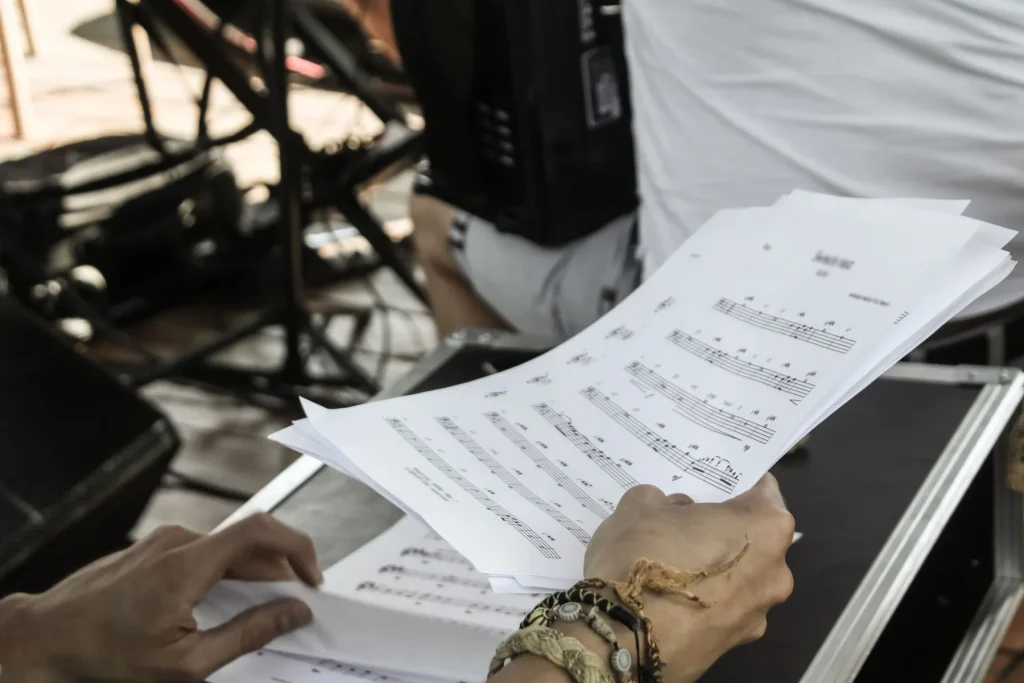
The handpan is a unique instrument, captivating listeners with its spellbinding sounds. To get off to a good start, it is essential to understand a few key principles.
A relaxed posture and good coordination between your hands and the instrument are essential. This allows the full melodic richness of the handpan to emerge.
Rhythm and fluid movement play a major role. To progress quickly, consult our complete beginner’s guide.
Whether you are a complete beginner or already learning, these tips will help you fully explore the possibilities of this fascinating instrument.
Introduction to the handpan and its melodic world
Immerse yourself in the melodic world of the handpan, an instrument that captivates with its harmonic richness. Its crystal-clear notes and deep resonances make it an ideal companion for exploring intuitive music.
What is a handpan?
The handpan instrument consists of two hammered half-shells made from nitrided steel, creating 7 to 9 tone fields. A central Ding surrounded by outer notes makes it possible to create complex melodies, while the Gu hole adds percussive nuances.
Developed from the Hang Drum in 2001, this instrument relies on unique acoustic mechanics. Vibrations in the steel, which is 1.5 to 2 mm thick, interact with the musician’s bodily resonance.
Why master the basic techniques?
68% of beginners give up because of a poor approach. Learning the fundamental techniques protects the instrument and unlocks its sonic potential. The D minor scale, found on 90% of beginner models, makes learning easier.
Playing the handpan instrument simultaneously develops your musical ear and fine motor skills. Suitable movements transform each note into a vibration that seems to come from the entire world.
The ideal posture for playing the handpan
Adopting the right posture is essential for unlocking the sonic potential of the handpan. Precise body alignment helps protect the instrument and improves the quality of its vibrations.
Whether you prefer to play sitting or standing, each position offers distinct advantages. The important thing is to find a balance between comfort and expressiveness.
Sitting or standing: a strategic choice
Sitting gives you greater stability, making it ideal for long sessions. A 30° angle between the thighs and torso prevents lower-back tension. The “anchored pelvis” technique ensures optimal spinal alignment.
When standing, the handpan instrument becomes an extension of the body. This posture encourages fluid movements but requires more control. A height-adjustable stand, set at around 42 cm for someone who is 1.70 m tall, is recommended.
Optimizing instrument placement
When resting it on your lap, use a memory-foam cushion to prevent unwanted vibrations. Keep the handpan away from belts or seams that could interfere with its resonance.
A curved wooden stand provides an ergonomic solution. As our beginner’s guide explains, never cover the Gu hole, so that its percussive nuances are preserved.
Take the time to test several configurations. Your body shape and playing style will guide your final choice.
Hand position: the key to a harmonious sound
The precision of your movements directly affects the quality of the sounds produced. Suitable technique unlocks the handpan’s full acoustic richness.

The role of the fingers and palms
The fingers act like natural hammers. Strike 5 mm from the edge of the tone fields to obtain a clear timbre. The pads of the fingers provide gentle nuances, while the fingernails create a percussive effect.
The “open hand” method prevents tension. Distribute the weight evenly, as though you were holding a clementine weighing about 80 g.
Hand angle and pressure
A 45° angle optimizes resonance. If the hand is too vertical, the sound becomes muffled; if it is too horizontal, the sound loses power.
| Striking area | Ideal pressure | Sound produced |
|---|---|---|
| Edge of the tone fields | 80 g | Clear notes with long resonance |
| Center of the Ding | 50 g | Rich harmonics |
| Gu hole | 30 g | Percussive nuances |
To develop proprioception, try exercises with resistance bands. A warm-up in 7 positions prepares the hands to play without fatigue.
Fundamental striking techniques
Exploring the sonic nuances of the handpan begins with mastering the art of striking it. Every movement affects the resonance of the notes, creating a unique sound palette.
For balanced playing, adjust your speed and pressure. A free fall of 3 to 5 cm produces delicate pianissimos, while 0.3 seconds of contact preserves the harmonics.
Fingertip strikes
Your fingers are your main tools. Use the pads to obtain gentle sounds and the fingernail to produce high harmonics. The finger rolling method makes arpeggios more fluid.
Using the palms and thumbs
The palms produce deep bass sounds, ideal for marking the rhythm. The thumbs, using one-third of the total pressure, balance melody and percussion.
Brushing or striking: finding the right balance
A brushing touch reveals subtle notes, while a firm strike increases the volume. Consult this table to adapt your playing:
| Intensity | Sound effect | Emotional use |
|---|---|---|
| Light brushing touch | Crystal-clear notes | Calm atmospheres |
| Medium strike | Rich harmonics | Narrative melodies |
| Firm strike | Percussive accents | Dynamic rhythms |
The Swiss Handpan School identifies 5 types of strike. Experiment with them to discover your signature sound.
Understanding and mastering rhythm
Mastering tempo on a handpan opens up unexpected creative possibilities. This instrument responds to the subtleties of rhythm, transforming simple patterns into complex soundscapes.

Beginner 4/4 rhythm exercises
Begin with exercises based on 4/4 time, which is ideal for developing consistency. The “3-2-1” method breaks patterns down progressively:
- 3 notes on the Ding, 2 on the tone fields, 1 rest
- Alternate between the left and right hands every 4 measures
- 72 BPM for natural assimilation
A metronome with a pulsing light helps you visually synchronize the beats. Fifteen minutes a day for 21 days is enough to establish these reflexes.
Incorporating the Gu hole for percussive nuances
The Gu hole adds a percussive dimension to scales. Use it as an accent every 4 beats or on the offbeat to create dynamic effects.
| Technique | Effect | Frequency |
|---|---|---|
| Light strike | Sharp click | Weak beats |
| Brushing touch | Muffled resonance | Offbeats |
| Alternating pressure | Timbre variation | Every 2 measures |
Combine these approaches with finger snaps or foot taps to enrich the rhythmic texture. The Bounce Metronome Pro app offers modes designed for the handpan.
Practical exercises for rapid progress
Steady progress on the handpan depends on well-structured exercises. By combining discipline and creativity, you will develop an intuitive relationship with your instrument.

The “Pantheon” method, used by champions, offers a balanced program:
- 10 minutes of warming up
- 20 minutes of technical practice
- 15 minutes of free expression
Ascending and descending scales
Begin by exploring ascending and descending scales. This exercise improves coordination and finger precision.
For an additional challenge, try sustaining a note for 2 minutes. This builds endurance while refining your listening skills.
“Consistency matters more than duration. Fifteen minutes every day is better than 2 hours occasionally.”
Playing chords and repeating patterns
Melodies become richer with well-placed chords. Alternate between simple patterns and complex combinations.
The mirror technique helps correct asymmetries. Record yourself to analyze and improve your movements.
For greater variety, use backing tracks suited to your level. Our complete guide provides free resources.
A digital progress journal with AI analysis will help you measure your improvement. Set realistic goals and celebrate every small victory.
Common mistakes beginners should avoid
One beginner in three makes mistakes that impair the sound of their instrument. These missteps slow progress and can damage the handpan. Here is how to anticipate them.

Striking too hard or too softly
40% of repairs result from a poor approach. Excessive pressure creates dents, while a timid touch muffles the harmonics.
The right balance? It is like typing on a computer keyboard:
- 50 to 80 g of pressure for melodic notes
- 30 g maximum for the Gu hole
- A 45° angle for optimal resonance
“Aggressive players knock their instrument out of tune three times faster. Gentleness controls resonance, not force.”
Neglecting to warm up your hands
A 7-minute warm-up is essential. Without it, cold muscles limit dexterity and increase the risk of tendinitis.
Recommended protocol:
- Wrist rotations (2 min)
- Finger stretches (3 min)
- Slow scales (2 min)
5 actions you should always avoid:
| Mistake | Consequence |
|---|---|
| Striking while wearing a ring | Deep scratches |
| Unstable stand | Falls and cracks |
| Wet cleaning | Accelerated oxidation |
After mishandling the instrument, resting it for 48 hours allows the steel to recover its acoustic properties. Always consult a specialist instrument maker.
Conclusion: toward fluid and expressive playing
Your experience with this unique instrument will evolve naturally over time. The seven essential pillars—posture, listening, consistency, patience, exploration, sharing and enjoyment—form the foundation of successful progress.
Beyond technical choices, let your senses guide you. Every player develops a personal style, transforming notes into emotions. Workshops like those offered by Jilis Lucky accelerate this artistic transformation.
Join the Handpan Masters community to exchange tips and sources of inspiration. Celebrate every small victory: they lead to great achievements.
In this vibrational world, true mastery is born from harmony between discipline and creative freedom. Your musical journey is only beginning.