
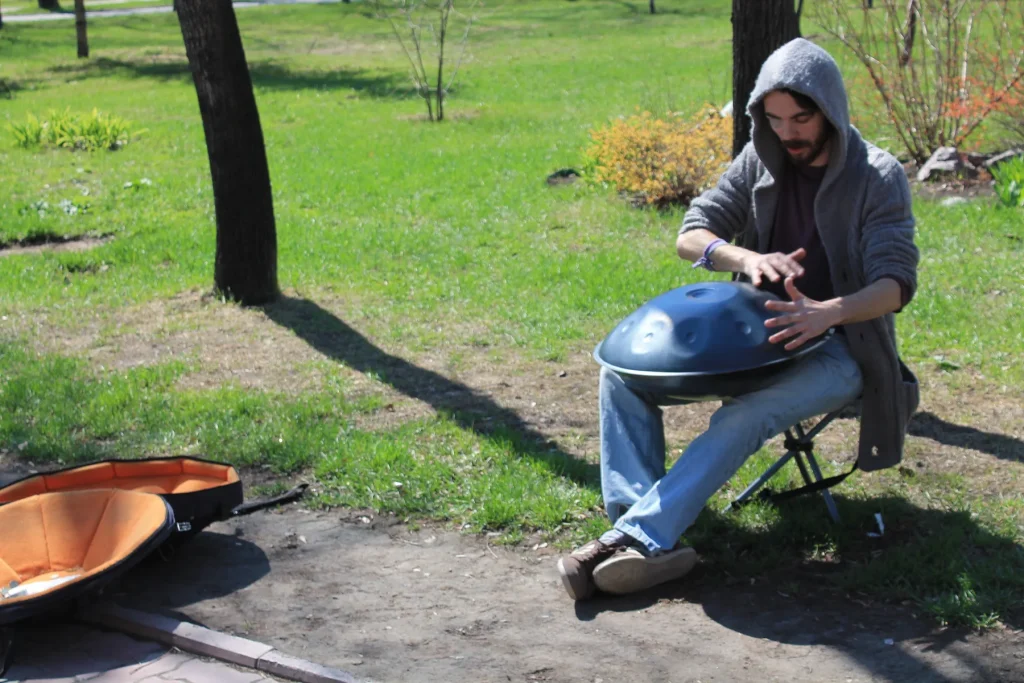
Discover a complete guide to mastering this fascinating instrument. Whether you are a complete beginner or want to improve your playing, this accessible method guides you step by step.
David Charrier, a renowned teacher, shares his expertise through accessible online courses. More than 38,000 musicians have already chosen this fun, progressive approach.
Our innovative system, based on simple visual cues, makes learning easier. Colors and symbols guide every movement, helping you develop your skills naturally.
Try it risk-free with our 14-day money-back guarantee. It is an ideal opportunity to explore the melodic world of the handpan with complete confidence.
Introduction to the handpan
Immerse yourself in the captivating world of a unique instrument, where melody and rhythm blend harmoniously. Ideal for lovers of intuitive music, it offers an incomparable sensory experience.
What is a handpan?
Created in Switzerland in the 2000s, the handpan is often confused with the Hang drum. However, the latter is a registered trademark. Handpan, meanwhile, refers to a family of instruments with a similar structure: a steel shell with tuned notes arranged in a circle.
Why choose this instrument?
Accessible without any knowledge of music theory, it can be played immediately. Its soothing vibrations are used in music therapy. Moreover, its chromatic or diatonic scale suits every style.
Equipment needed to get started
In addition to the instrument, you will need an ergonomic stand and a protective case. The price varies according to the quality of the steel. For maintenance, a soft cloth is enough to preserve its brilliant sound.
Getting ready to play the handpan
The key to a successful experience lies in setting everything up properly. Take the time to organize your space and equipment to encourage concentration and enjoyment.

Choosing the right environment
A quiet place without excessive echo allows you to hear the nuances of your instrument clearly. Avoid rooms that are too cluttered or noisy.
Natural light and a stable temperature improve comfort. Consider the acoustics as well: a rug or curtains will absorb unwanted resonance.
Preparing your instrument
Place your handpan on a stable stand at waist height. Check that every note resonates freely without obstruction.
Carefully adjusting the stand prevents unwanted vibrations. Gently clean the surface with a soft cloth before each session.
A beginner’s mindset
Approach each session with curiosity and patience. Slow breathing helps you center yourself before you begin.
Set simple goals so you can progress without pressure. Regular practice, even for a short time, matters more than the length of each session.
Remember: every great musician was once a beginner. Let yourself be guided by the joy of discovery.
The ideal playing position
Adopting the right position is essential to unlocking your instrument’s full sonic potential. Proper posture improves note accuracy and prevents unnecessary tension.
How to hold your handpan
Place the instrument on your thighs, tilted slightly toward you. The lower notes should be close to your torso. To hold your instrument correctly, consult this detailed guide.
Use a low chair for better balance. Your knees should be slightly higher than your hips.
Body and hand posture
Keep your back straight without being rigid. Relaxed shoulders promote better coordination.
| Position | Advantages | Disadvantages |
|---|---|---|
| Seated | Stable and ideal for beginners | Limits movement |
| Standing | Freedom of movement | Requires a suitable stand |
Common mistakes to avoid
Here are the most common pitfalls:
- Crossing your legs, which unbalances the instrument.
- Tensing your shoulders, which creates strain.
- Neglecting hand alignment, which reduces accuracy.
If you are left-handed, simply reverse the orientation. The goal is to find a position that remains comfortable.
Discovering the notes of your handpan
Exploring the notes of your handpan opens up a unique sound world. Each area of the instrument produces a distinct resonance, creating a harmonious scale. Take the time to become familiar with these sounds and enrich your playing.

Identifying the central note
The central note, often the lowest, serves as an anchor point. Use the “friendly ghosts” method to memorize it visually: associate each note with a color or symbol.
Create a personal map of your instrument. This makes it easier to move between the notes and speeds up learning.
Exploring different tonalities
Handpans offer a variety of diatonic or chromatic tonalities. Try simple arpeggios to discover hidden harmonics.
| Scale type | Characteristics | Recommended use |
|---|---|---|
| Diatonic | Natural notes, gentle melodies | Meditation, improvisation |
| Chromatic | More notes, greater harmonic richness | Complex compositions |
Active listening exercise
Active listening sharpens your perception of subtle differences. Record your sessions and analyze them to identify your progress.
Practice aural recognition games: close your eyes and identify the notes being played. This develops an intuitive connection with the instrument.
Your first handpan rhythms
The magic of the handpan comes from the interaction between melody and pulse. By combining these elements, you create captivating soundscapes. Start with simple patterns to build a solid foundation.

The basic movement
The “eight-beat movement” is ideal for getting started. Divide it into four stages:
- Beats 1–2: central note with your dominant hand
- Beats 3–4: adjacent note on the opposite side
- Repeat while alternating hands
This cycle develops muscle memory. Practice slowly before gradually increasing your speed.
Alternating the right and left hands
Bilateral coordination enriches your rhythms. Try this exercise:
- Play a simple sequence with your dominant hand
- Repeat it with the other hand
- Combine the two with a one-beat offset
This method balances accuracy and fluidity.
Creating your first melodies
Turn your patterns into personal compositions. Add strategic rests to bring your phrases to life.
| Element | Effect |
|---|---|
| Repetition | Creates a recognizable structure |
| Variations | Add an element of surprise |
Our online courses provide guided improvisation frameworks to stimulate your creativity.
Progressive exercises for beginners
Progress is built around key stages that must be mastered. A methodical approach helps prevent cognitive overload while ensuring tangible results.

Warm-up routine
Begin with a five-minute routine combining breathing with circular wrist movements. This warm-up prepares both body and mind for practice.
Include simple vocal exercises to synchronize your breathing and rhythm. Our community organizes monthly challenges to encourage this discipline.
Coordination exercises
Develop your agility with metronome exercises. Begin at 60 BPM, then gradually increase the tempo.
“Consistency matters more than intensity: 15 minutes every day is better than one long weekly session.”
Interactive webinars offer varied exercises for developing hand independence.
Simple patterns to reproduce
First master five fundamental patterns before moving on to more complex ones. Each sequence develops a specific skill:
- Alternating the right and left hands
- Controlling dynamic nuances
- Placing rests accurately
The “1% progress every day” method encourages you to record your improvements in a dedicated journal. This frequency of observation strengthens motivation.
Tips for progressing quickly
Rapid progress rests on three essential pillars: regular practice, relevant resources, and interaction with a supportive community. Together, these elements turn every session into concrete progress.
Ideal practice frequency
Frequency matters more than duration. A typical 30-day program of 10 to 15 minutes per day produces better results than one long weekly session.
Our proven method:
- Technical warm-up (3 min)
- Practice a new pattern (7 min)
- Free improvisation (5 min)
The unlimited pass provides access to masterclasses for exploring each topic in depth. Daily reminders help you maintain this routine.
Resources for continuing to learn
Our exclusive selection includes:
- An e-book with 30 progressive exercises
- A list of approved external tutorials
- Monthly themed workshops
The evolving training program adapts to your level. The mentoring system allows students to exchange tips.
Joining a community of players
Virtual happy hours create connections between members. Receive personalized feedback during live sessions.
Key benefits:
- Sharing exclusive sheet music
- Meeting instrument makers
- Motivating challenges with rewards
This active community turns learning into a shared experience. Beginners find support and inspiration there.
Conclusion
This musical journey begins with a single note and grows into a lasting passion. You now have the foundations you need to explore this instrument with complete confidence.
As Léa, a student for three months, says: “Progress comes quickly when you follow the method consistently. The community helps me stay motivated.”
Take advantage of our 14-day free trial. Join thousands of musicians who share the joy of playing.
Your adventure is only just beginning. Every session reveals new creative possibilities. Now it is your turn to play!