

Bowls originating in the Himalayas fascinate people with the purity of their sound. They serve as simple guides for daily meditation.
One small instrument is enough: a suitable mallet and a few minutes each day. The practice creates a space of calm in a life that is often too fast-paced.
Each bowl is unique in its shape and quality. Its harmonious sounds soothe the mind and promote well-being during every session.
This article presents the main benefits, usage tips and helpful comparisons. To put them into perspective alongside other Zen instruments, see this instrument comparison, which illustrates their frequencies and uses in meditation.
Understanding the Tibetan singing bowl: between tradition and relaxation
When a bowl is struck, vibrations travel through the body and soothe the mind.
The Tibetan singing bowl is an instrument that produces sound vibrations capable of influencing our inner state. Rubbing or striking its rim with a mallet creates sounds that resonate for a long time.
These vibrations travel through the body. They help release tension accumulated during the day. The practice is easy to incorporate into modern meditation to regulate the nervous system.
“Tibetan singing bowls turn every session into a moment of deep reconnection.”
- Action: vibration changes bodily perception.
- Tool: a suitable mallet helps control sound intensity.
- Effect: a calmer mind and better stress management.
| Element | Role | Result |
|---|---|---|
| Sound vibrations | Stimulate the nervous system | Muscle relaxation |
| Mallet | Controls the timbre | Long-lasting, harmonious sounds |
| Session | Framework for practice | Reconnection and mental calm |
Origins and traditional craftsmanship of singing bowls
Evidence of the use of these sound-producing objects can reportedly be found more than five thousand years ago in the Himalayan regions. Their history dates back to a time when metalworking was beginning to spread.
Ancestral expertise
The manufacturing process relies on techniques handed down through generations. In Nepalese and Tibetan workshops, each piece is hammered while hot. Final polishing ensures the sound quality that characterizes the instrument when it is played.
Seven-metal composition
The traditional recipe uses an alloy of seven metals, each symbolically associated with a celestial body and a day. This composition influences the vibrations and tone color.
To make a bowl sing, artisans and users alike rely on a suitable mallet. This simple gesture releases the vibrations held within the metal structure.
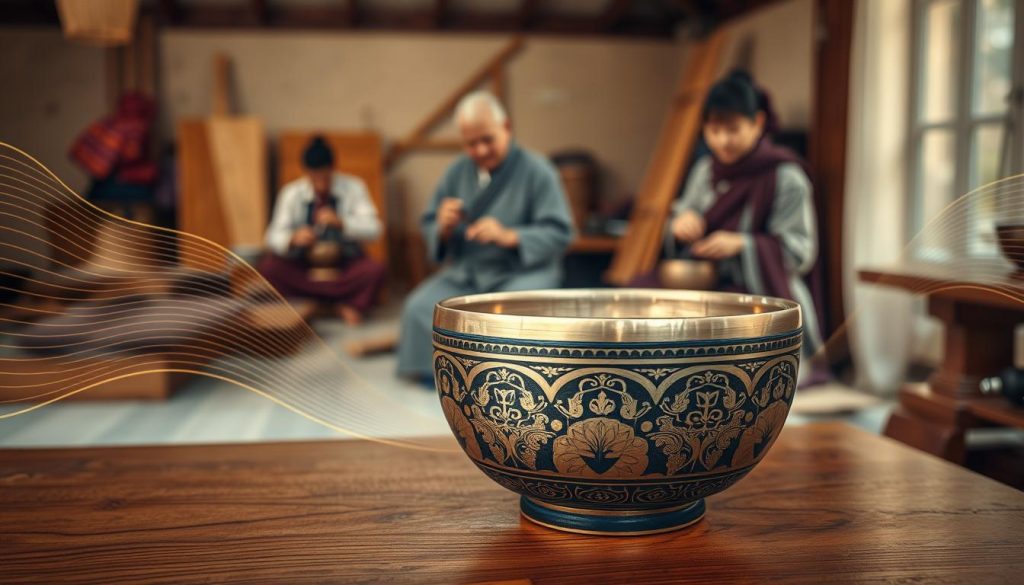
“These singing bowls have endured through the centuries to become recognized tools for practice.”
- Origin: archaeological traces reportedly dating back more than 5,000 years BCE.
- Technique: hammering, polishing and acoustic tuning.
- Materials: a seven-metal alloy producing rich sounds.
To learn more about choosing and using a model, see this guide to singing bowls.
The scientifically supported benefits of Tibetan singing bowls
Several recent studies support the impact of sound vibrations on sleep quality.
Improved sleep
Observations conducted over several decades suggest that Tibetan singing bowls can improve sleep quality. The sounds produced during a session make it easier to fall asleep and promote more restorative rest.
Clinical findings and personal reports support this effect, particularly among people with mild insomnia.
On September 30, 2016, a University of San Diego study involving 62 participants found that sound meditation significantly reduced tension.
Research published on May 1, 2014, involving 51 people found that using a Tibetan singing bowl reduced stress during meditation sessions.
Additional effects
A 2008 German study involving 54 people found that the vibrations emitted helped relieve chronic back pain. A University of Nice thesis published in 2019 highlights the potential value of music therapy for Alzheimer’s disease.
These findings suggest that sounds and vibrations produced with a suitable mallet can be used to support mental well-being and deep relaxation.
“Sound vibrations can help the body return to a calmer state conducive to rest and concentration.”
To learn more about practical use and recommended models, see this detailed resource.
Associated energetic and spiritual benefits
Sound resonance lies at the heart of energy practices.
Tibetan singing bowls are often used to harmonize the chakras. Depending on its size and metal composition, each instrument produces a note associated with a specific center.
The bowl can be placed on the body to rebalance energy. This method is based on the resonance of the seven metals and the direct transmission of the vibrations emitted.
Chakra harmonization
The mallet produces sounds said to stimulate each chakra. The vibration is believed to encourage energy to flow more freely throughout the body.
Although this approach has not been scientifically validated, it remains central for people seeking better mental and physical balance.
“Regular practice helps maintain a balanced state and strengthens the connection with the mind.”
- Targeted stimulation: each note is directed at a specific chakra.
- Placement on the body: direct resonance through the metals.
- Regularity: maintaining lasting balance.
| Practice | Action | Expected effect |
|---|---|---|
| Low note | Root chakra stimulation | Grounding, stability |
| Mid-range note | Opening the heart | Emotion and compassion |
| High note | Crown chakra activation | Clarity and transcendence |
For more detailed instructions and help choosing a suitable model, see this practical resource.
Criteria for choosing the right instrument
Choosing an instrument begins by listening to its sound quality, not merely examining its appearance.
Alloy and thickness: the quality of the metals and the thinness of the wall determine the purity of the note. A carefully made alloy produces long, stable resonance.
Manufacturing history: favor pieces from workshops known for traditional craftsmanship. Origin influences quality and longevity.
Try before you buy: strike or rub the bowl with a suitable mallet to check its acoustic signature. Each bowl has a unique timbre that influences its benefits and the balance of the chakras.
Durability for regular practice: if you plan to practice often, choose a heavy, well-polished instrument. It should retain its pure sound despite frequent handling.
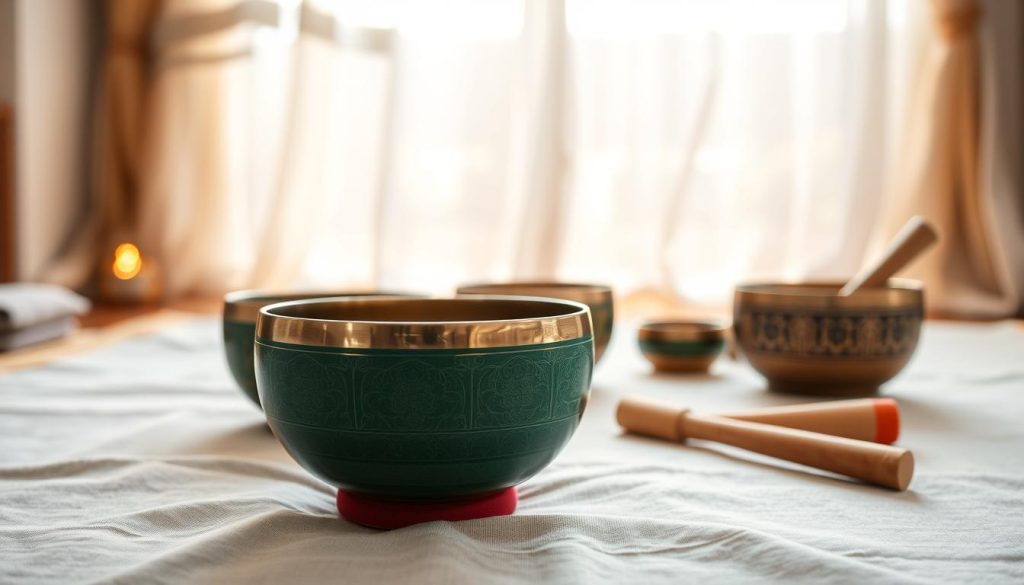
| Criterion | What it indicates | How to test it |
|---|---|---|
| Metal composition | Purity of the timbre | Ask about its origin and strike the bowl |
| Thickness | Resonance duration | Listen to how long the note is sustained |
| Weight and finish | Durability in use | Handle the bowl and check it for wear |
Techniques for making your bowl sing
Learning to make a bowl sing requires patience and precise movements.
The striking method
Place the instrument on a stable cushion or in your hand so that the vibrations can travel freely. Use a firm mallet to strike the rim gently. A well-controlled strike produces a short, gong-like sound that is useful for marking the beginning of a session.
The rubbing technique
To create continuous sound vibrations, move the mallet around the rim. Maintain even pressure while slowly increasing the speed.
Balancing pressure and speed is essential for making the object sing without roughness or breaks in its timbre.
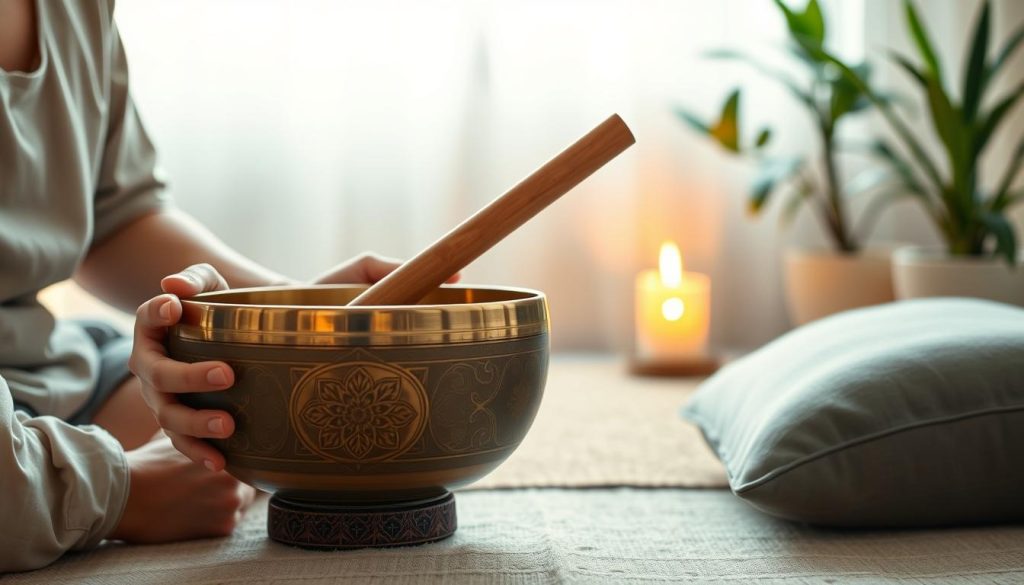
- Begin the session with light strikes, then move on to rubbing.
- Keep your hand relaxed to preserve the sound quality and the condition of the surface.
- Focus on the sounds and vibrations: this promotes mental concentration and deep relaxation.
“Gentle movements preserve the instrument and maximize its effects on the body and mind.”
To learn more about how to make a bowl sing and choose a suitable mallet, see this guide.
Daily rituals to promote well-being
Starting the day with a few minutes of sound brings clarity and presence.
Incorporating a Tibetan singing bowl into your morning routine can reduce stress and prepare the mind for a peaceful day.
Make the instrument sing for 5 to 10 minutes: begin with a few strikes, then rub it gently with the mallet. This gesture creates a moment of calm that helps reconnect the body with the breath.
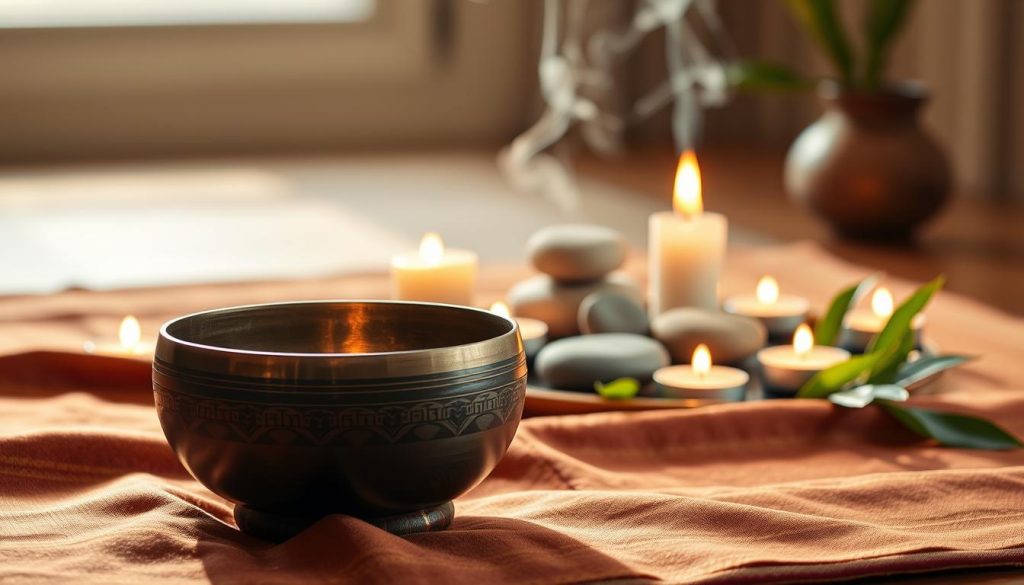
These simple rituals cleanse the living space and help harmonize the chakras. Regular practice turns Tibetan singing bowls into companions for well-being.
“Five minutes each morning is enough to establish a lasting state of balance.”
- Use the mallet with intention to ground your practice.
- Follow the recommended duration to maintain the effect on the body.
- Treat this practice as an anchor in your day.
Integration into meditation and yoga
Adding a sound-producing instrument to a session often transforms the quality of attention.
The Tibetan singing bowl can mark the beginning and end of a yoga session. A brief chime serves as a cue for breathing and transitions between poses.
Supporting relaxation sessions
During meditation, the sounds promote concentration. They help the mind return to the present when thoughts begin to wander.
Sound vibrations resonate through the body and help release stress-related tension. Placing the bowl near the practitioner heightens this feeling of grounding.
Between poses, making the bowl sing with a mallet prolongs the relaxing effect. This simple gesture stabilizes inner balance and supports physical practice.
“A sound signal guides attention, makes it easier to enter a calm state and strengthens the connection between body and mind.”
- Beginning and end of a session: a clear cue.
- Supports concentration during meditation.
- Resonance throughout the body for overall well-being.
Precautions and contraindications
Certain medical conditions require particular caution before using a Tibetan singing bowl.
Seek medical advice if you have a pacemaker, a history of epilepsy or psychological vulnerability. If you have a serious heart condition, using Tibetan singing bowls may be inadvisable.
These instruments may support well-being, but they must never replace medical treatment for serious conditions. If in doubt, follow the advice of a healthcare professional.
Avoid playing too intensely or too close to the ears. Excessive volume may cause auditory discomfort or other adverse effects.
Always use a suitable mallet and adapt the session to your body’s comfort. Respect your limits; never push yourself mentally or physically.
“The resulting sense of well-being should remain a gentle experience that never exceeds your limits.”
| Risk | Recommendation | Potential consequence avoided |
|---|---|---|
| Pacemaker and heart conditions | Consult a cardiologist | Electrical interference, cardiac stress |
| Epilepsy and psychological vulnerability | Seek neurological advice | Risk of a seizure or worsening symptoms |
| Excessive volume or proximity to the ear | Reduce the intensity and move the bowl farther away | Auditory discomfort, headaches |
Conclusion on using Tibetan singing bowls
Ultimately, incorporating a singing bowl into your routines can transform your relationship with silence.
Accessible use: this instrument offers a simple way to improve physical and mental well-being in daily life. The bowls, often made from high-quality metals, produce harmonious sounds that promote deep relaxation.
Whether you use a mallet or the palm of your hand, every singing bowl opens the way to more peaceful, balanced meditation. We have presented the main benefits and usage tips here. To explore further, see this guide to the benefits.