

Choosing an instrument that truly resonates requires more than intuition. You need to observe the length of the note, its timbre, and the power it produces.
For centuries, these bowls have been used to calm the mind and harmonize a space. Their origins sometimes remain mysterious, but their therapeutic use is well documented.
Frequencies vary widely depending on size and thickness. They often range from 33 Hz to 988 Hz. Learning to hear these nuances requires patience and practice.
Acoustic physics meets tradition when modern tools such as spectrum analyzers are used. They make it possible to visualize what the ear perceives and refine your choice.
To learn more about evaluating the sound quality of antique bowls, consult this practical guide: evaluate the quality of an antique bowl.
Understanding the sound characteristics of singing bowls
The material speaks. Each instrument is born from a specific alloy: the seven traditional metals (gold, silver, mercury, copper, iron, tin, and lead) shape the color of the note. In tradition, each metal is also associated with a planet, which influences the harmonic richness.
The role of metals
- A varied alloy produces denser overtones and a distinct fundamental frequency.
- Adding silver or copper changes the brightness and duration of the note.
- Handcrafting creates differences in shape and thickness that give each singing bowl its character.
Vibration in three dimensions
Vibration travels as waves across the surface, through the body, and into the surrounding environment. A simple example: when the instrument is filled with water, the waves can be seen forming patterns. This shows how a single frequency and its overtones interact with the body and chakras during a relaxation session.
To explore sound practice and tuning techniques in greater depth, discover a sound massage training course and a guide to tuning a handpan.
Tibetan singing bowl sound: how can you recognize a beautiful vibration?
A good instrument reveals itself when its note smoothly envelops the space. To determine whether a singing bowl produces a beautiful vibration, listen to how its timbre fills the room and supports your breathing.
Clarity and overtones: the main note should remain distinct. The overtones should follow one another without dissonance and extend the timbre long after the strike.
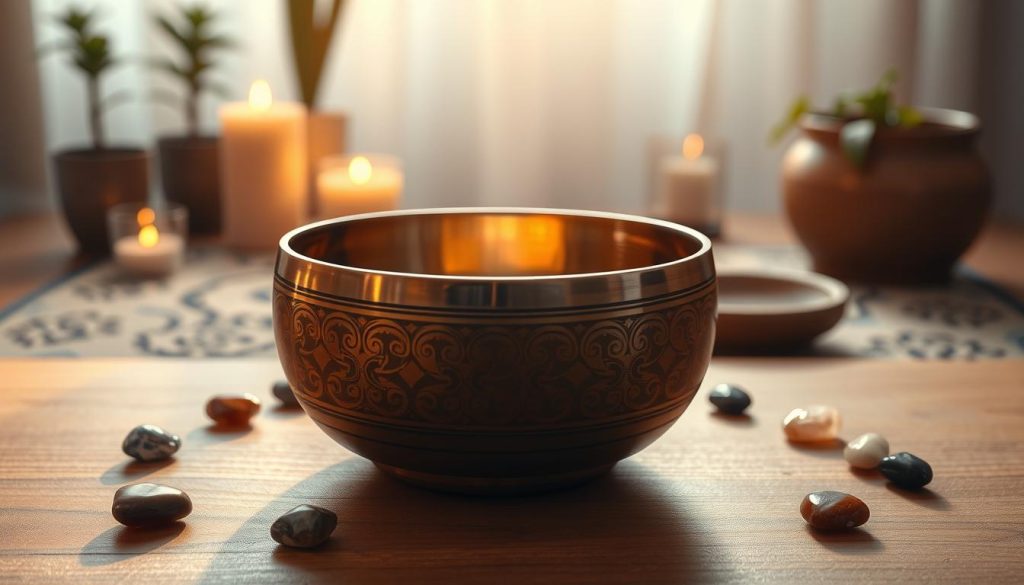
Physical sensation matters as much as hearing. A powerful frequency can massage the body and open a targeted chakra. Test several bowls; each instrument has a signature linked to its alloy and craftsmanship.
- Vary the striking force to hear changes in the note.
- Favor sounds that last and blend harmoniously.
- Develop your ear by comparing different Tibetan singing bowls.
| Criterion | Indicator | What it means |
|---|---|---|
| Note clarity | Distinct fundamental | No muddiness; a relaxed ear |
| Overtones | Dissonance-free progression | Richness and depth |
| Persistence | Duration after striking | Better resonance through the body |
To explore the practical aspects of selection further, read a guide on choosing a bowl and compare sound configurations using resources such as this configuration guide.
The technical criteria for a rich sound signature
The sound signature can be analyzed using several parameters that are easy to observe and measure. These criteria make it possible to compare singing bowls and assess their ability to accompany a relaxation session or a harmonized set.
Note length
Sustain is often the first sign of quality. A 1,800-gram Full Moon model generally offers long sustain, indicating a well-worked alloy.
The fundamental note should endure without breaking apart. This promotes relaxation and helps the body absorb the frequencies.
Rhythmic pulsation
Pulsation, or the yo-yo effect, appears as a sinusoidal variation in decibels. When it is slow, it creates a soothing floating sensation.
A fast pulsation creates a sense of energy. Testing with felt or wooden mallets reveals these differences.
The instrument’s timbre
Timbre can be visualized with an oscilloscope or spectrum analyzer. It distinguishes one singing bowl from another, just as a flute is distinguished from a guitar.
Overtones and octave form the signature: the fundamental note should remain clear, supported by rich overtones.
“The richness of the overtones often defines an instrument’s audible and felt quality.”
- Bowl size affects frequency: a large model produces lower notes than a 388 g bowl.
- A soft mallet emphasizes low tones; a firmer strike brings out high overtones.
- Spectral analysis confirms note accuracy and harmonic balance.
To go further and choose according to practical criteria, consult this buying guide about a singing bowl.
How physical characteristics influence the note
Size and shape often determine the pitch and color of a note.
Size remains the decisive factor: a large bowl produces lower frequencies. For example, a model weighing nearly 2 kg, sometimes containing silver, produces deep notes suited to the lower octave.
Thickness works differently: thinner metal tends to offer a lower fundamental than a thicker equivalent. Hand hammering increases harmonic richness and sound quality.
Shape also influences resonance. A wide opening favors low notes, while a more closed shape raises the pitch toward higher frequencies.
- Alloy composition plays a role, but a trace of gold or silver does not significantly alter the note.
- For a set of seven bowls, a frequency tolerance of 1% to 2% is acceptable, especially in the third octave.
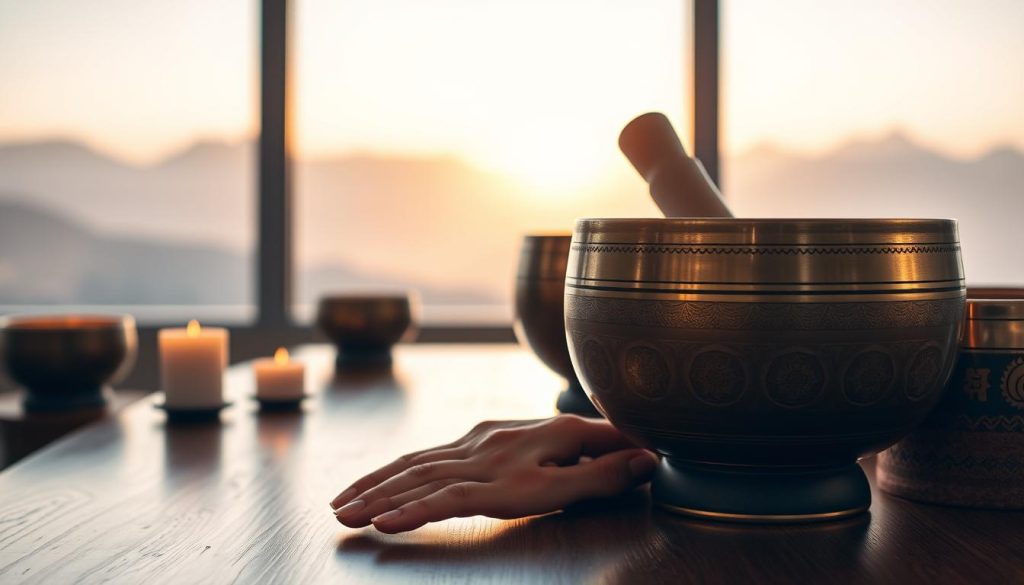
| Characteristic | Effect on the note | Practical consequence |
|---|---|---|
| Size | Larger → lower | Choose according to the therapeutic goal |
| Thickness | Thicker → higher | Test with different mallets |
| Shape | Open → low / closed → high | Consider how it feels in the body |
To learn more about selecting a note and assembling a coherent set, consult this practical guide on choosing a bowl’s note.
Using technology to analyze frequencies
Simple apps turn your smartphone into an analysis tool for singing bowls. This approach helps assess note quality objectively and compare several instruments quickly.
Choosing the right analysis tools
Recommended apps: Soundscoreset (Android and iOS), Spectroid (Android), and Tuner Pro (iOS). These tools capture the spectrum and display the fundamental frequency and overtones.
Using a smartphone with Spectroid makes it possible to identify the frequency of a 16 cm bowl made from seven metals. Clear peaks appear, each corresponding to a precise frequency.
- Take measurements in a quiet place to avoid unwanted noise.
- Use a spectrometer rather than a basic tuner to analyze the richness of the frequencies.
- Compare a small bowl with a 1,800 g Full Moon model: the latter’s sustain and overtones are more visible and powerful.
Good to know: results obtained with a smartphone may vary, but they provide a reliable basis for classifying bowls by note and function within a set. Technology complements active listening; it does not replace it.
The relationship between the fundamental and overtones
Overtones follow a mathematical pattern that structures every note produced.
The fundamental forms the base: it provides the main pitch and energy. Around it are overtones that define the bowl’s tonal color.
Practical measurements show that the first major overtone is close to 2.89 times the fundamental.
The second major overtone is around 5.48 times the base frequency.
A small hidden overtone can also be observed at around 1.98 times the fundamental. These ratios occur in different bowls, including one specific example: a 1,700 g Lingam bowl.
This structure remains constant regardless of the instrument. Even a metal salad bowl reveals similar multiples.
In music, these proportions create the sound signature that helps in choosing harmonious sets.
Practical application: for sound massage and chakra work, understanding these ratios helps pair complementary notes.
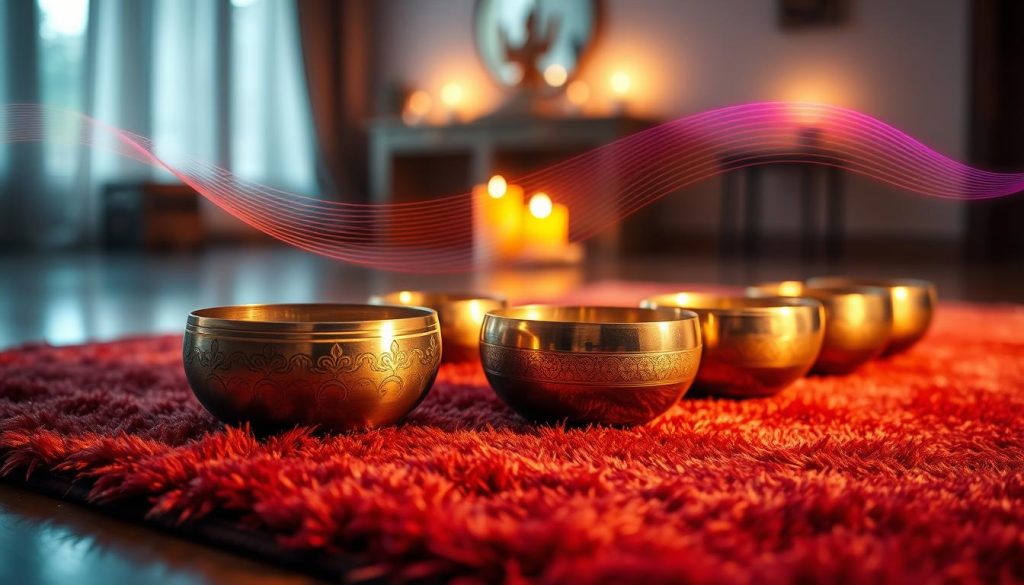
To explore the science behind the phenomenon, consult this guide to the science of singing-bowl sound.
Debunking misconceptions about composition
The truth about the alloy is less mystical and more physical than people think.
The presence of trace amounts of gold or silver (less than 0.01%) does not affect sound quality. When present in infinitesimal quantities, these metals remain symbolic and do not determine the frequency.
The so-called “seven-metal” alloy is primarily a tradition. Historically, it represents the seven planets and seven chakras. Each metal does not emit its own note: the alloy vibrates as a coherent whole.
Handcrafting in Nepal or Ladakh shapes the tonal color. However, hammering, size, shape, and thickness are the main factors defining the fundamental frequency and overtones.
- A bowl made from five or twelve metals may exist, with no guarantee of better quality.
- Sound richness depends more on the artisan’s skill than on the number of metals.
- The function of these instruments has evolved: once utilitarian objects, they have become meditation tools.
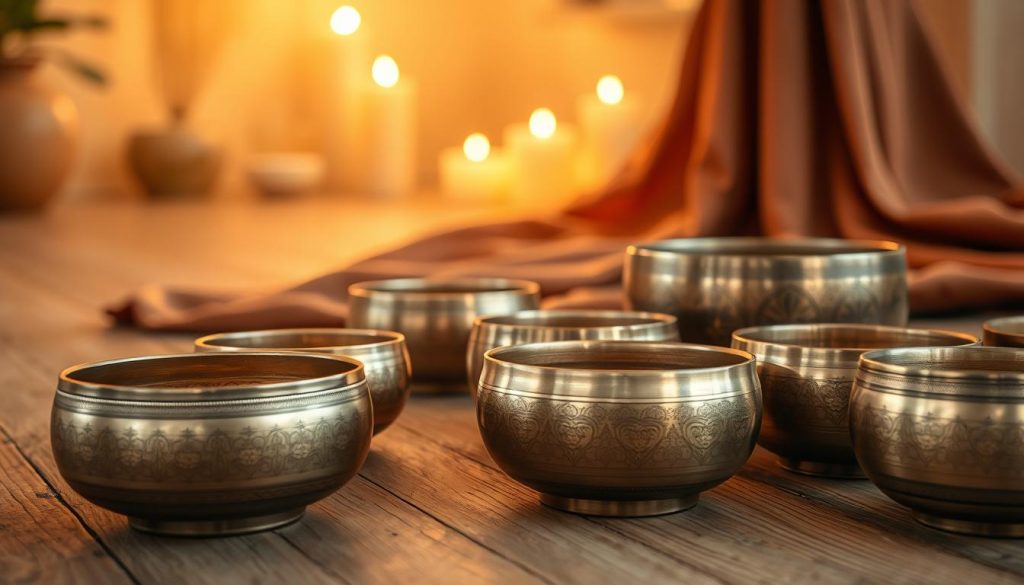
| Misconception | Reality | Practical consequence |
|---|---|---|
| Gold or silver improves the note | Present only in trace amounts | Do not pay solely for rarity |
| Each metal has its own frequency | The alloy vibrates as a whole | Assess shape and thickness to anticipate the note |
| More metals = better sound | Quality depends on hammering and finishing | Test sustain and overtones |
“A bowl’s quality is measured by its ability to produce overtones, not by the rarity of its metals.”
Practicing active listening to feel the vibration
Make yourself comfortable. Sit upright with your hands relaxed. Let the singing bowls fill the air without intervening.
Focus on the note and frequency. Hold the stick like a pen to maintain steady pressure. This grip improves the note’s sustain and intensity.
The human body contains approximately 65% water, which facilitates wave transmission. Bringing the bowl closer to the body creates the sensation of a subtle cellular massage.
The sounds often induce alpha waves, which support deep relaxation. Active listening helps distinguish the fundamental from the overtones.
- Record the session with a smartphone to analyze the frequencies afterward.
- Observe the rhythmic pulsations: they reveal the bowl’s signature.
- Regular practice improves the perception of quality and physical sensation.
| Step | Action | Effect |
|---|---|---|
| Positioning | Sit upright and breathe | Initial state of calm |
| Grip | Hold the stick like a pen | Stable, continuous note |
| Observation | Bring the bowl closer to the body | Perception of waves and cellular massage |
| Analysis | Record with a smartphone | Check the frequency and overtones |
“Active listening reveals dimensions of sound that are hidden at first.”
Conclusion
Learning to listen to an instrument requires as much practice as it does a good ear.
To assess a singing bowl, combine observation of the note and overtones with direct experience. Test the frequency, sustain, and effect on the body.
Technology helps: a smartphone or spectrum analyzer can identify frequencies and octaves more precisely. Physical sensation remains central to harmonizing the chakras.
Each bowl has its own signature, linked to its size, thickness, and shape. Practice regularly, compare several singing bowls, and let your hand follow the rhythm.
In summary: measure, listen, and then choose the sound that moves you.