
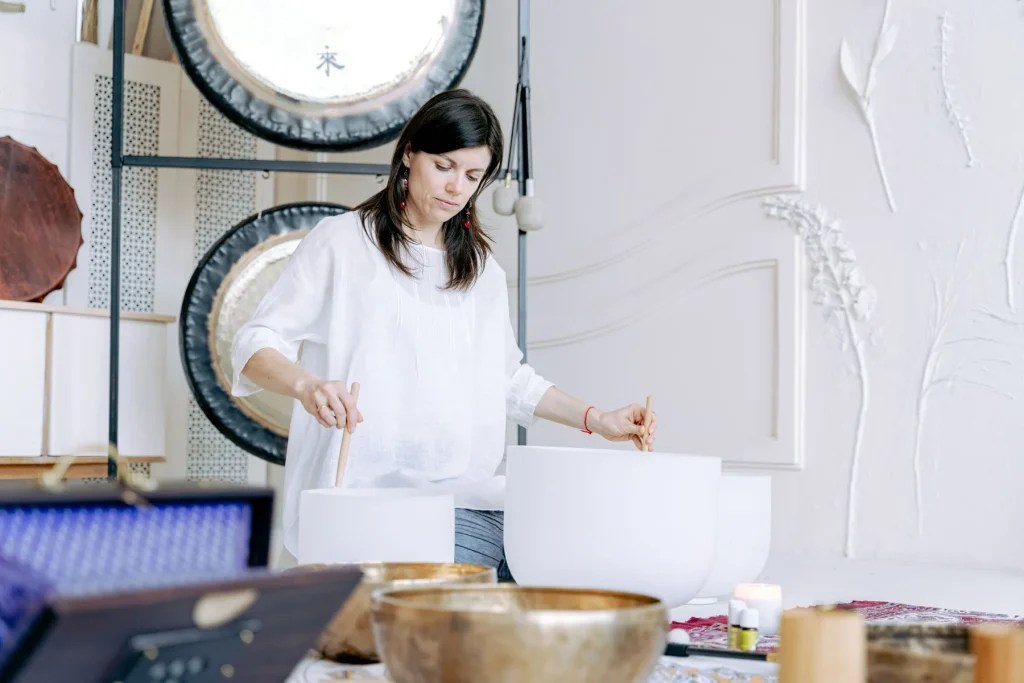
Brief introduction: this article provides a clear guide to choosing between two major categories of singing bowls. Their origins are far apart: the alloy instrument dates back more than 5,000 years in the Himalayas, while the quartz bowl appeared around 1945 during research into quantum physics.
Here we explain the essential points: manufacturing, tone, therapeutic uses, and care. You will find practical guidance to help you tailor your choice to meditation or energy healing.
What you will learn: why an alloy bowl offers rich harmonics and why a quartz bowl produces purer notes. We will also discuss their fragility, price, and sound effects.
For a complete overview and technical comparisons, read our feature on Crystal Tibetan Bowl: Differences from a Metal Bowl.
Origins and heritage of singing bowls
Born in the mountains, these singing bowls carry an ancient vibrational memory. Tibetan bowls appeared in the Himalayan regions around 5,000 years ago.
This history explains their central place in tradition and meditation. Each piece reflects centuries of practice and expertise passed down from generation to generation.
Crystal bowls, by contrast, are a more recent creation: their use dates to around 1945 and is associated with research into quantum physics. This innovation marks a major technological development in the world of sound instruments.
Each instrument retains a unique imprint. Used to slow the perceived passage of time, they provide valuable grounding in our overloaded lifestyles.
“These resonances allow the mind to recenter and the body to recover its rhythm.”
To explore the history and practices associated with these traditions in greater depth, read our complete guide to everything you need to know about singing bowls.
Crystal Tibetan bowl: differences from a metal bowl in composition
The material determines an instrument’s voice and its history. Here, the composition explains why some sounds are rich while others are purer.
Traditional metal alloy
Handcrafted bowls are often made from an alloy of 3 to 7 metals. This metal alloy creates complex harmonics and a wide variety of timbres.
The purity of fused quartz
By contrast, a crystal bowl consists almost entirely of pure quartz (99.98%). The quartz is melted at 4,000°C to produce homogeneous glass. Each note then depends on this purity.
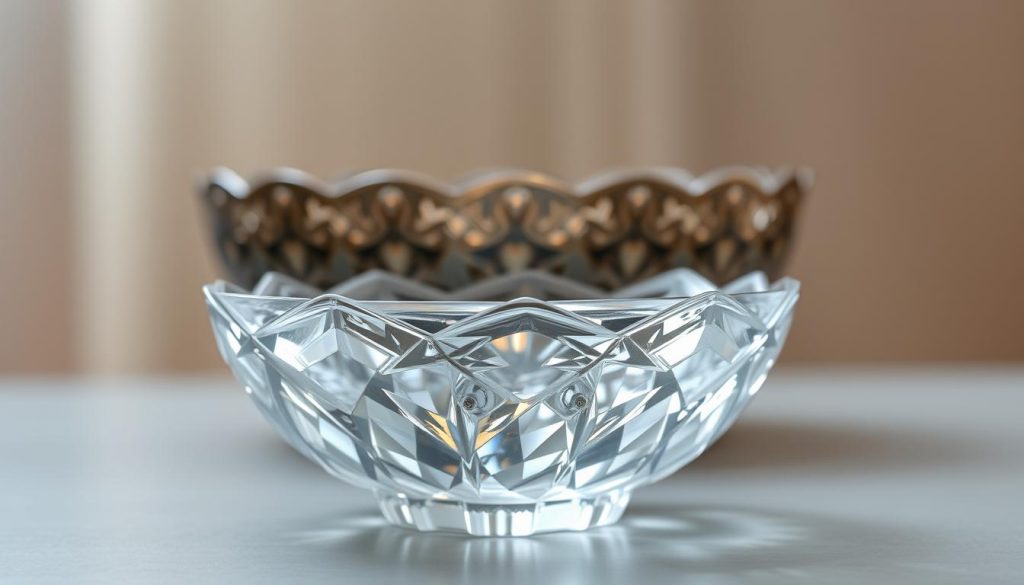
“The material composition determines the instrument’s resonance and durability.”
- Complex alloy: harmonic richness.
- 99.98% quartz: tonal precision and note purity.
- Crystal-bowl production has become standardized since the 1980s, while singing bowls are still often hammered by hand.
| Characteristic | Alloy (traditional) | Quartz (pure glass) |
|---|---|---|
| Composition | 3 to 7 metals | Approximately 99.98% quartz |
| Manufacturing temperature | Cold working and hammering | Melting at 4,000°C |
| Sound | Rich harmonics | Pure, precise note |
Analysis of sound and harmonic properties
Examining frequencies helps explain why some sounds surround the listener while others are more targeted. This section compares the vibrational character and sound quality of each instrument.
The richness of complex harmonics
Traditional bowls produce rich harmonics thanks to a metal alloy. These harmonic layers create a sound texture that evolves over time.
Mass and thickness affect the note and resonance time. A heavier piece sustains frequencies longer and provides an immersive experience.
Precision and dominant frequency
The crystal bowl, made from quartz, emits a very pure dominant frequency. This “sound light” allows precise targeting during a session.
Comparison of uses: the crystal bowl produces a clear frequency. The Tibetan bowl favors an organic, enveloping resonance.
“An instrument’s energy depends as much on its material as on the way it is played.”
To learn more about the relationship between size, note, and tuning accuracy, read our guide on how to identify a bowl’s note.
Vibrational impact on the body and mind
Each resonance acts like an invisible massage that relaxes the tissues and recenters awareness. The vibrations penetrate the muscles and promote rapid relaxation. The body responds by releasing tension within minutes.
The combination of metals produces rich harmonics that resonate with the body. These sound layers provide an immediate feeling of well-being and grounding. During a session, some Tibetan bowls help stabilize one’s mental posture.
By contrast, the quartz bowl uses high frequencies that target the subtle body. The sounds propagate multidimensionally and align energy. This effect calms the mind and facilitates expanded awareness.
Regular practice: a few minutes a day are enough to maintain balance between body and mind. Each instrument, whether made from alloy or glass, profoundly influences one’s inner state.
| Action | Alloy / metals | Quartz / crystal |
|---|---|---|
| Type of resonance | Rich, enveloping harmonics | Pure, targeted dominant frequency |
| Main effect | Grounding and muscle relaxation | Energy alignment and mental calm |
| Propagation | Local and bodily | Multidimensional and subtle |
| Recommended use | Relaxation, sound massage | Intensive sessions, energy work |
“Vibrations transform one’s inner state within minutes.”
Therapeutic and meditative uses
Each instrument has its place in practice: relaxation, targeted treatment, or cleansing a space. Approaches vary according to the practitioner’s intention and the nature of the chosen sound.
Sound massage and relaxation
For relaxation, Tibetan bowls offer a texture rich in harmonics. They facilitate rapid muscle release and deep grounding.
The practice brings calm and relaxation to the body. During a session, combining several notes creates a gentle, continuous immersion.
Targeted chakra work
Crystal bowls produce a precise note that targets a specific chakra. Each note corresponds to a frequency used to rebalance the body’s energy level.
This targeted work makes the therapy much more effective for certain centers in particular.
Cleansing spaces
Tibetan bowls are recommended for cleansing a room: their harmonics travel through the space and encourage subtle purification.
In addition, the crystal bowl is preferred for cellular work and for promoting mental clarity during meditation.
“Using these instruments together enables a comprehensive therapeutic approach that combines power and precision.”
| Use | Alloy / Tibetan bowls | Quartz / crystal bowls |
|---|---|---|
| Relaxation | Rich harmonics, immersion | Moderate mental clarity |
| Chakra | Overall work | Precise targeting by note |
| Space cleansing | Wide propagation | Targeted cellular cleansing |
Selection criteria based on your needs
Choosing an instrument first requires assessing its intended use and the desired sound quality.
Weight and alloy influence the richness of the harmonics. A heavier model often provides a longer, warmer resonance.
For work on a chakra, make your selection according to the note: crystal bowls target a precise frequency. Test the fundamental note before buying.
Size alters depth: large bowls produce low notes that are ideal for deep relaxation.
Tibetan bowls are often chosen for their versatility. Crystal bowls are suitable if you are looking for frequency precision.
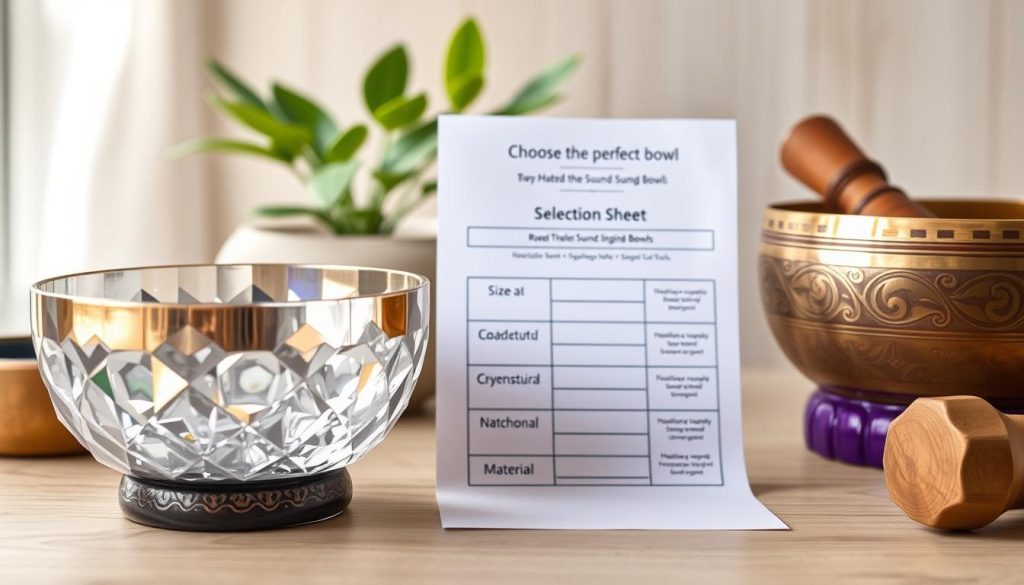
“Investing in a quality instrument ensures greater longevity and a superior sound experience.”
- Test the resonance and tuning according to your intention.
- Prioritize manufacturing and finishing quality for greater durability.
- Follow this guide to identify the instrument suited to your meditation practice.
Caring for and preserving your instruments
Proper care extends your instruments’ sound life and preserves their timbre. Maintain them regularly to preserve the quality and clarity of their notes.
Precautions for silica glass:
Quartz makes a crystal bowl sensitive to thermal shock. Avoid sudden temperature changes and mechanical impacts.
Store your crystal bowls in padded cases to protect their fragile composition and maintain their resonance.
- Cleaning: use a soft, dry cloth for alloy pieces; do not use hot water on glass.
- Storage: keep metal bowls in a dry place to prevent the alloy from oxidizing.
- Handling: always support the base; avoid harsh rubbing that can impair sound quality.
For detailed care advice, read our guide to caring for singing bowls and our recommendations on how to preserve their harmonies.
| Risk | Recommended action | Result |
|---|---|---|
| Thermal shock | Avoid sudden temperature changes | Preserves the quartz structure |
| Moisture | Store in a dry place | Protects the alloy and sound quality |
| Friction | Use soft cloths | Maintains resonance and tuning |
The place of quartz in our contemporary era
Quartz now occupies a central place in contemporary sound practices.
An iconic mineral, it is used in both technology and spirituality. Its ability to stabilize frequencies explains its use in electronics and in certain modern instruments.
According to Dr. Luc Bodin, we are undergoing a vibrational transition in which this mineral acts as a catalyst.
“New vibrations are emerging on Earth, and quartz is contributing to this transformation.”
The human body contains approximately 8 grams of silicon. This presence promotes a natural resonance with the sounds produced by crystal bowls during meditation.
The high frequencies they emit help align energy and clear the mind. They act like a kind of inner light that soothes emotions.
Integrating quartz into our sound tradition means combining history with recent discoveries. To explore this topic further, read our feature on whether the crystal bowl is more powerful.
| Aspect | Role of quartz | Impact |
|---|---|---|
| Technology | Stabilizes frequencies | Precision and reliability |
| Human body | Natural resonance (silicon: approximately 8 g) | Energy alignment |
| Tradition | Bridge between ancient and modern | Ritual and science brought together |
Tips for beginning your sound practice
A sound practice begins first and foremost with listening and simplicity. To get started, choose a Tibetan bowl if you want great versatility and an instrument that is easy to use for daily meditation.
If your goal is precise work on a chakra, choose a crystal bowl. Its clear note makes it easier to target frequencies and helps beginners identify a fundamental note.
This guide explains how to make each instrument sing: strike it gently, then rub its rim with a suitable mallet using a steady circular motion.
Its vibrational nature requires attention to sensations. Adjust the pressure and speed to obtain stable harmonics and soothing sounds.
By practicing for a few minutes each day, you will learn to feel the frequencies emitted by quartz and promote deep relaxation and greater mental clarity.
Practical tip: start with three minutes, then gradually increase the duration. Sound quality always depends on your intention and the gentleness of your movements.
To continue learning, read our complete guide to singing bowls and find useful frequency reference points in our article about scales and frequencies.
Conclusion
In conclusion, this article brings together the key information needed to choose between two families of sound instruments: the tradition of the Tibetan bowl and the purity of the crystal bowl.
Whether you are looking for a rich texture produced by metals or a more precise note, each instrument promotes relaxation and supports the energy of the body.
Always test the instrument before buying it. Listen to the note and feel the vibrations and frequencies that resonate with you most.
By combining Tibetan bowls and crystal bowls, you create a complete sound environment for meditation and harmonizing the mind.
This guide hopes to help you choose the ideal bowl to accompany you on your journey toward a more harmonious life.