
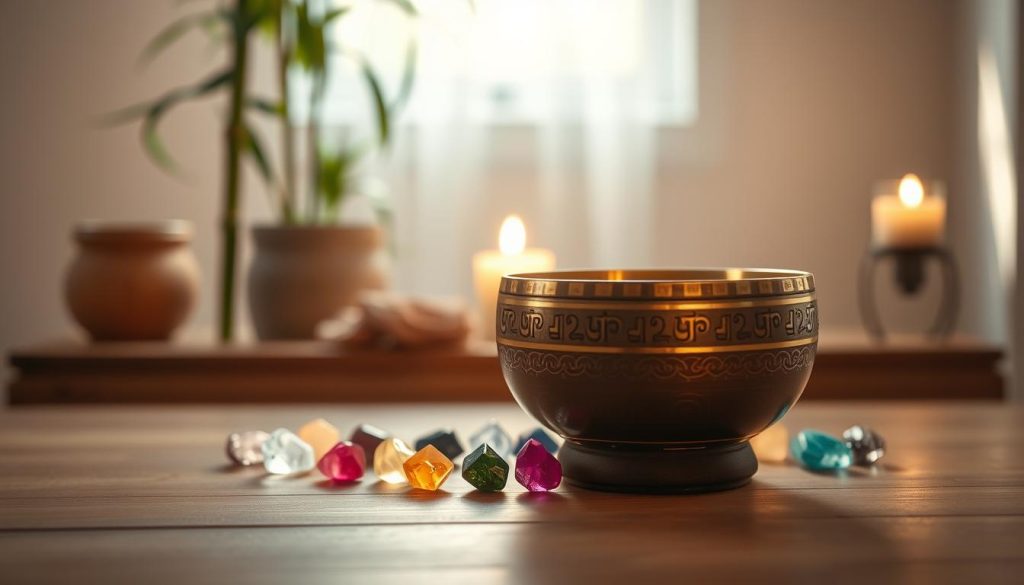
Practicing meditation with a singing bowl helps you explore unique sound frequencies. These sounds promote inner well-being and relaxation.
Each bowl is an instrument with its own vibrational signature. This signature directly influences the benefits experienced during meditation sessions.
Choosing the right instrument requires an analysis of your personal needs. A suitable Tibetan singing bowl can harmonize the body and mind.
To explore the subject further and discover the correspondences between notes and chakras, consult this dedicated guide.
In summary: your choice of bowl influences the quality of your sessions. Test, listen, and let the music guide your meditation.
Understanding How Singing Bowls Work
For thousands of years, these instruments have resonated through Himalayan valleys, accompanying rituals and daily life. Their use has evolved: today, they often mark the beginning and end of a meditation session.
Origins of Singing Bowls
Origins and purpose: the first bowls were used as offering vessels. Traditional production involves an alloy of seven metals, each associated with a planet and an energy point.
The Role of Singing Bowls in Meditation
In practice, the sound produced by a Tibetan singing bowl influences the body and mind. Its size, composition, and type—metal or crystal—determine its notes and the effect experienced.
To learn more about correspondences between notes and energy centers, consult this practical guide.
Tibetan Chakra Bowl: How Do You Choose the Right Note?
Start by determining which energy you want to harmonize. Identify the center you wish to target before listening to instruments. This will guide your choice of pitch and timbre so that they resonate as effectively as possible with your body.
Each pitch produced by a bowl has its own frequency, which resonates with different centers. This relationship helps direct chakra work and optimize your sessions.
An instrument’s pitch cannot be changed after it has been made. Once its frequency is established, it remains fixed. You should therefore consider your choice beforehand and test several pieces.
Singing bowls are powerful tools. When chosen carefully, they harmonize the chakras and improve overall well-being. Understanding the correspondence between pitch and energy center helps you select a suitable instrument.
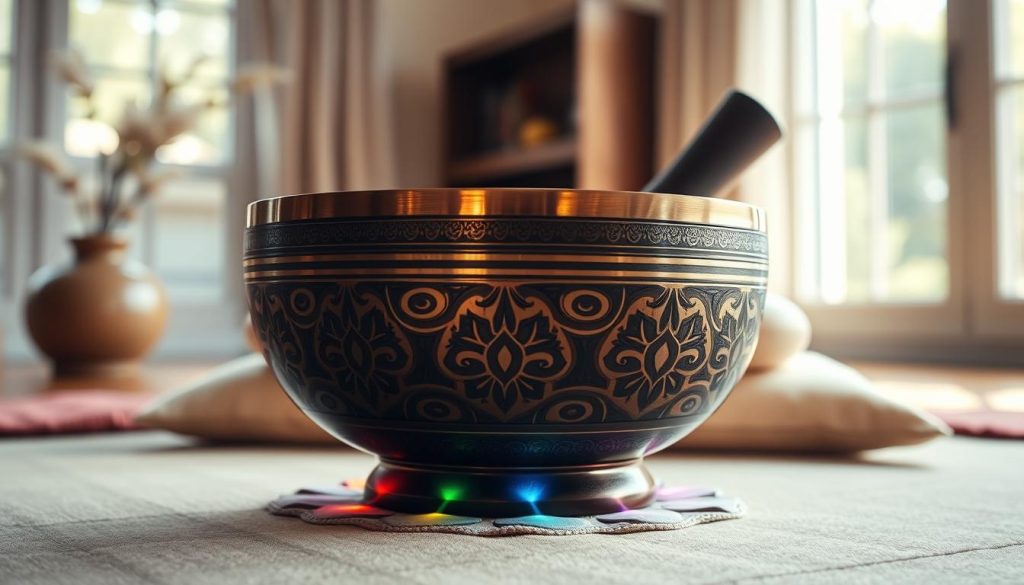
- Identify the center that needs balancing.
- Listen before you buy.
- Remember that once the bowl has been made, its pitch is permanent.
The Physics of Vibrations and Sound Frequencies
Understanding hertz connects auditory perception with measurable reality. Frequency, expressed in hertz, defines the pitch of a sound: the higher the value, the higher the perceived pitch.
The physics of vibrations shows that every sound wave has its own frequency. This frequency shapes how our ears and brain interpret a note.
The Role of Hertz in Sound Perception
Since 1975, ISO has standardized the musical note A at 440 Hz. This reference makes it easier to tune instruments and compare notes.
A singing bowl produces vibrations that travel through the air and are then partially absorbed by the body. The body acts somewhat like a sponge for these waves, amplifying certain relaxation effects.
- Frequency depends on the instrument’s design and size.
- Every note, whether higher or lower, results from a precise vibration of the air.
- The frequencies of Tibetan bowls help induce a relaxed state conducive to meditation.
Different Approaches to Correspondences Between Notes and Chakras
Several traditions associate sounds with energy centers according to different systems.
Vedic System and Western Approach
The Vedic system connects the musical scale with the body’s centers.
In this widely used framework, the root chakra corresponds to C.
This method is easy to incorporate into modern musical practice.
Traditional Himalayan Approach
Himalayan practice follows a different order.
Nepalese therapists draw on the Yantra effects described by Santa Ratna Shakya.
Here, the correspondence focuses more on energetic function than on purely musical equivalence.
Planetary Approach and Cosmic Frequencies
Planetary singing bowls are inspired by the work of Hans Cousto.
The rotational frequencies of the planets are used to define sounds considered useful for meditation.
Each metal alloy affects the fundamental frequency and the targeted energy.
- Vedic system: a conventional, accessible musical order.
- Himalayan tradition: a functional, ritual approach.
- Planetary approach: based on cosmic frequencies and the music of the spheres.
| Approach | Basis | Example Association | Advantage |
|---|---|---|---|
| Vedic | Conventional scales | Root = C | Easy to incorporate into music |
| Himalayan | Yantra, tradition | Specific order based on effect | Suitable for rituals and healing practices |
| Planetary | Planetary frequencies | Notes linked to rotations | Vibrational precision for meditation |
To explore these correspondences further, consult a comprehensive guide to note–chakra correspondences.
How Materials Influence Vibrational Quality
The material of the vessel largely determines the color and duration of its resonance.
Traditional alloys play a major role. A classic model contains seven metals: lead, tin, iron, copper, mercury, silver, and gold. This alloy creates a harmonic richness appreciated for chakra harmonization.

Hand-hammered bowls have a unique signature. Density and shape influence the depth, duration, and frequency of their vibrations.
Quartz and crystal offer another option. Made from heated silica, these instruments produce higher and purer sounds. They are useful for targeting specific chakras precisely.
- The vibrational function of a metal instrument is often lower-pitched.
- Quartz produces crystalline, high frequencies.
- Size and alloy determine the fundamental frequency and harmonics.
| Material | Characteristic | Benefit for the Chakras |
|---|---|---|
| Seven-metal alloy | Rich in harmonics | Complete sound experience |
| Hand-hammered metal | Unique signature | Depth and duration |
| Quartz (silica) | High, clear sounds | Precision for specific centers |
To learn more about their use in healing practices, consult a practical guide to energy healing. Considering the material and frequency will help you choose the right bowl for your intended purpose.
How Bowl Size Affects Pitch
An instrument’s circumference directly affects its pitch and timbre.
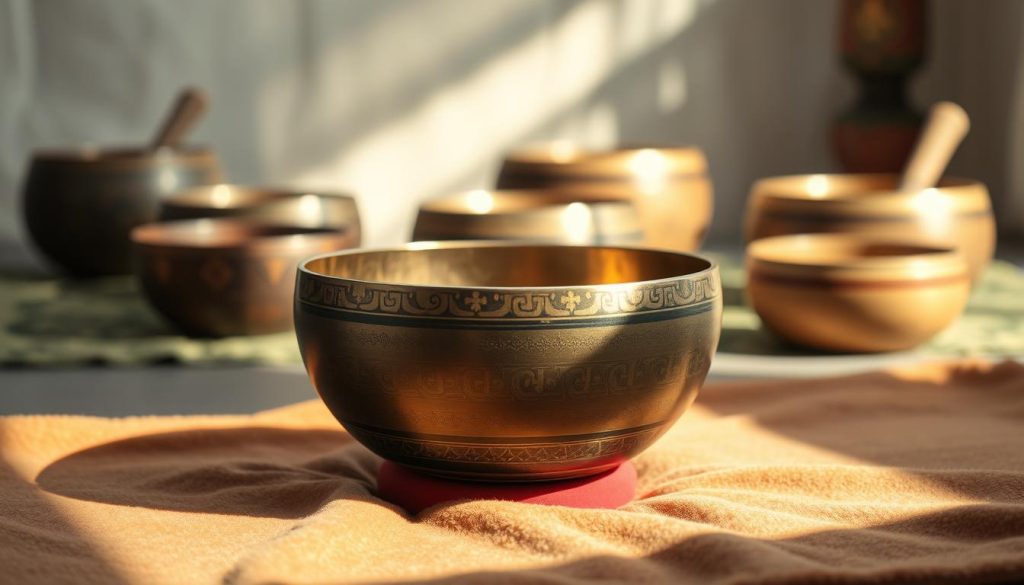
Singing bowls range from 11 to 55 cm in diameter. Smaller bowls produce delicate, crystalline sounds.
Conversely, a large bowl generates lower notes. These bass tones promote grounding and often target the root chakra.
Thickness and hand hammering also change the frequency. Two bowls with the same diameter can therefore produce different notes.
- Size remains a decisive factor in pitch and vibration duration.
- A wide bowl offers a deeper note that is useful for grounding.
- A small model promotes elevation and the opening of the upper chakras.
| Size (cm) | Sound Characteristic | Common Use |
|---|---|---|
| 11–20 | High notes, crystalline timbre | Elevation, upper chakras |
| 21–40 | Midrange, rich harmonics | General work and meditation |
| 41–55 | Low notes, long resonance | Grounding and root chakra |
To create a harmonious set covering all the chakras, consider combining several sizes. A guide to notes can help you select the right intervals.
Why the Reference Frequency Is Essential
The chosen frequency establishes the harmonic architecture of your instrument and guides the effect you experience.
The reference frequency defines the foundation from which all derived notes are calculated. This tuning affects the tone color, range of harmonics, and way the body responds.
Many practitioners prefer 432 Hz. This value is associated with natural ratios and the golden ratio, and it is often perceived as gentler for relaxation.
Choosing between 432 Hz and 440 Hz shifts the entire set of frequencies. This difference changes the instrument’s vibrational function and its effect on the chakras targeted during meditation.
Size and frequency work together. A large circumference with a low reference pitch reinforces grounding. A small diameter tuned to 432 Hz helps open the upper centers.

- Harmonic foundation: the reference frequency guides every note.
- 432 Hz: a frequency perceived as natural and relaxing.
- Practical impact: size + frequency = a coherent experience.
Using Accessories to Modulate the Sound
Accessories transform how an instrument responds and sounds.
A felt mallet reduces unwanted noise and emphasizes the fundamental note. It produces a rounded, stable sound that is ideal for grounding sessions.
A hardwood stick emphasizes high harmonics. It brings out timbres that open the upper centers and provide clarity during targeted work.
- Choice of accessory: a decisive factor in the note you want to produce.
- Pressure and speed: adjusting these parameters influences the vibration and sustain.
- Versatility: bowls respond differently depending on the implement, enriching the practice.
Mastering these techniques lets you explore your instrument’s full range of sound.
| Accessory | Effect | Recommended Use |
|---|---|---|
| Felt mallet | Enhanced fundamental note | Grounding, relaxation |
| Hardwood stick | Emphasized high harmonics | Opening, energy work |
| Leather-covered stick | Balance between the fundamental note and harmonics | Versatile sessions |
Tips for Building a Harmonious Set of Bowls
Creating a coherent set requires balancing sizes, timbres, and frequencies. First consider the range you want to cover, from grounding to elevation.
A set of seven quartz crystal bowls lets you target each center precisely, from the root chakra to the crown chakra. This type of crystal produces pure frequencies that are useful for targeted work.
Seven-metal alloy sets are heavier and richer than five-metal models. Their depth of sound primarily serves the lower chakras, as well as centers such as the solar plexus and throat.
Choose hand-hammered bowls: traditional craftsmanship provides better vibration and a noticeable therapeutic effect during meditation.
- Choose the size according to its purpose (small = high, large = low).
- Combine quartz and metal to obtain a complementary range of frequencies.
- Use each note for a specific center to harmonize the body.
A varied set creates a symphony of frequencies that supports the balance of the major chakras.
Conclusion
One final moment of listening lets you feel the frequencies’ impact on the body.
Choosing an instrument remains a personal decision and can provide real benefits for chakra balance and meditation. By understanding the correspondence between each frequency and the energy centers, you can harmonize the body from the root chakra to the crown chakra.
Whether you are working with the sacral chakra, throat chakra, heart chakra, or third eye, frequency guides the practice. Every instrument is unique and transforms your routine through its soothing vibrations.
Investing in a quality piece extends these effects. To better understand the limitations of these correspondences and the risks of interpretation, consult an article about notes and chakras.