

Discover a space of calm: this article explains how these ancient sounds can transform your daily life. They offer a simple refuge for calming the mind after a busy day.
Stress reduction: the practice is accessible to everyone. The vibrations help reduce stress and promote more restorative sleep.
Here, we present scientific foundations and practical advice. You will learn how to incorporate these sounds into your routine for lasting well-being.
To learn more about the protocols and studies, read our comprehensive guide to singing bowl practice. Every reader can try short daily sessions and quickly experience their benefits.
Understanding how a Tibetan singing bowl works
Understanding what happens when a sound rings out makes it easier to incorporate moments of calm.
The role of mechanical vibrations
Vibrations move the air and create a tangible sensation. They form a wave that can be felt in the body.
Sound as a mental anchor
Some instruments use these waves to induce a state of relaxation. By devoting a few minutes to attentive listening, you may notice your muscles gradually relaxing.
Sound becomes an anchor for attention. It limits wandering thoughts and helps the nervous system move out of hypervigilance.
- Listening to a sound arise and fade develops present-moment awareness.
- The timbre’s regular structure provides a stable framework for meditation.
- Short sessions are enough to experience genuine relaxation.
| Aspect | Immediate effect | Recommended duration |
|---|---|---|
| Bodily vibrations | Muscle relaxation | 2 to 10 minutes |
| Attention anchoring | Reduced rumination | 5 minutes |
| Sound structure | Reduced hypervigilance | Variable |
To explore these practices further and find ideas for guided listening, discover a useful selection here: soothing playlists.
Tibetan singing bowl music: scientifically validated effects on relaxation
Recent clinical studies provide measurable evidence of sound’s impact on the body and mind.
Key evidence:
- Dr. Jayan Marie Landry (2014) observed a 9.6 mmHg reduction in systolic blood pressure among 51 participants.
- A 12-minute exposure to the singing sound, followed by 20 minutes of guided relaxation, resulted in a 6.3 bpm reduction in heart rate.
- A University of San Diego study involving 62 participants aged 21 to 71 confirmed a significant decrease in tension and signs of stress.
These data show that brief sessions lasting just a few minutes can enhance the effect of a longer relaxation session.
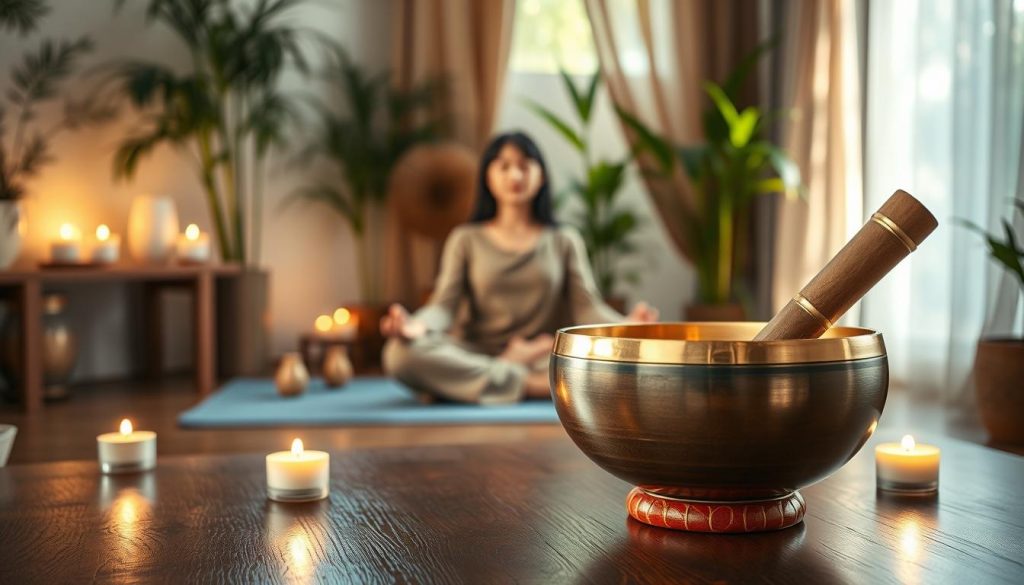
| Study | Participants | Intervention | Key result |
|---|---|---|---|
| J. M. Landry (2014) | 51 | Sound exposure (12 minutes) | 9.6 mmHg reduction in systolic pressure |
| Combined protocol | Variable | 12 min of exposure + 20 min of relaxation | 6.3 bpm reduction in heart rate |
| University of San Diego | 62 (aged 21 to 71) | Guided sound meditation | Significant reduction in tension and stress |
These results support using this instrument as a complementary tool for reducing daily stress. To explore the benefits further and choose a suitable instrument, read our practical guide to its benefits and uses.
Differences between metal and crystal bowls
The materials used profoundly influence the tone and reach of the sound.
Metal instruments offer a warm, rich timbre. They generate multiple harmonics that create an enveloping atmosphere. This promotes a more grounded, earthy sensation.
By contrast, quartz crystal models produce a purer, higher-pitched sound. Their character is vertical and bright. They often provide immediate mental clarity.
- Metal: depth, multiple harmonics, warmth.
- Quartz: purity, stable pitch, clarity.
- The choice depends on your intention: gentle immersion or a more incisive vibration.
- Many practitioners combine both to enrich a session.
| Material | Characteristic | Recommended use |
|---|---|---|
| Metal | Warm harmonics | Grounding meditation |
| Quartz | Pure, high-pitched sound | Mental clarity |
| Mixed | Broad sound palette | Group sound baths |
For a more detailed comparative analysis, read our crystal-versus-metal comparison.
Essential criteria for choosing your instrument
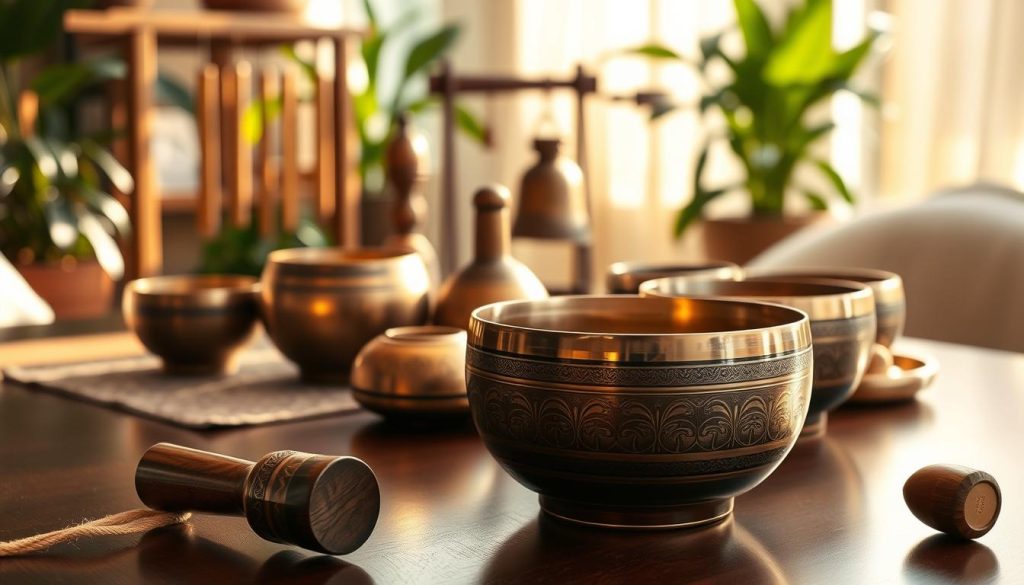
A good instrument choice depends on sound quality and how comfortably you can handle it. Try several pieces before buying to identify the one that speaks to you.
Size and sound depth
Size directly influences the depth of the note. Larger models produce lower frequencies and a more immersive sense of relaxation.
A bowl that is too large may be heavy for a beginner to handle; prioritize ease of use so that you can maintain a regular practice.
The importance of the mallet in resonance
Your choice of mallet completely changes the sound’s sustain. A felt-covered accessory softens the strike and makes continuous singing easier.
Try several materials (felt, leather, wood) to find the attack that suits your touch.
Craftsmanship and authenticity
How it is made affects the stability of the harmonics. Good craftsmanship ensures rich, lasting resonance.
Test the instrument’s response and choose the one that resonates with your sensitivity.
For a practical guide and recommended models, discover our buying guide.
Basic techniques for making your bowl sing
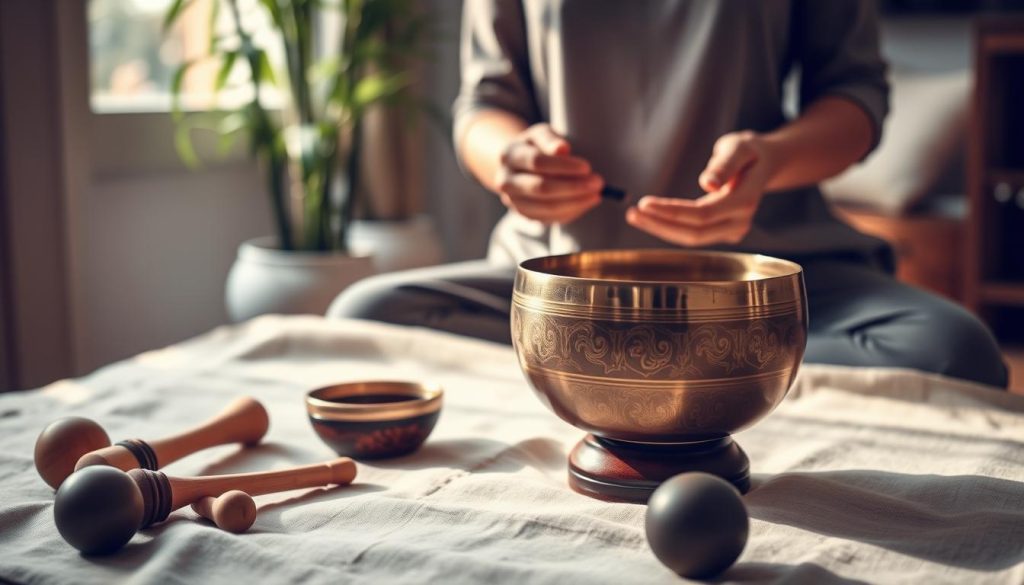
The key lies in the precision of the movement, not in force. Spend a few minutes repeating a smooth, steady motion around the outer rim. This makes the sound more stable and pleasant.
Begin with a soft, gentle strike. Wait until the sound has completely faded before producing it again. This rhythm teaches the body and mind to remain present.
To produce a continuous singing tone, maintain steady pressure from the mallet against the rim. Avoid sudden changes that interrupt the vibration and scatter your attention.
Hand position directly influences the transmission of vibrations. Place the bowl on a cushion or hold it flat in your hand, depending on your comfort. Adjust your grip to find a natural, tension-free position.
- Patience: practice slowly, without tensing up.
- Consistency: a few minutes each day is enough to make progress.
- Observation: listen to the harmonics and adjust your movement.
For detailed instructions and guided exercises, discover our instructions for use.
Incorporating vibrations into your daily rituals
A few minutes devoted to sound before bedtime act as a calming signal for the brain.
An evening ritual to promote sleep
Create a 10-minute ritual every evening. This brief moment is enough to mark the transition between day and night.

Sound becomes a cue that tells the body it is time to slow down. By repeating this ritual, you train your mind to associate the vibration with rest.
- Make yourself comfortable and focus on the sound’s sustain for a few minutes.
- Breathe slowly and release accumulated stress.
- Repeat the practice three to four times a week to establish the habit.
This routine improves sleep quality and strengthens a lasting sense of relaxation. Over time, just a few minutes will be enough to prepare for sleep and release physical tension.
Using bowls to deepen meditation
Using resonance as a marker of time makes the practice simpler and deeper.
Begin with a 10-minute session. A short period is enough to stabilize attention and establish lasting concentration.
The vibrations invite you to return to bodily sensations. They facilitate rapid mental relaxation, which is useful for beginners and experienced practitioners alike.
Sound serves as a guide for structuring time. By focusing on the note’s sustain and disappearance, you gradually reduce stress.
Turning seated meditation into a sensory experience helps you maintain your posture without struggling against restlessness. Observing the harmonics after each strike often opens the way to deeper states of awareness and noticeable emotional calm.
To explore this method further and choose a suitable instrument, read everything you need to know.
Precautions and contraindications you should know
Certain medical conditions require clear precautions before any sound session.
Always seek medical advice if you have a pacemaker or a history of epilepsy. These devices and conditions may be sensitive to waves and vibrations.
A German study conducted on June 20, 2008, involving 54 participants, showed a reduction in back pain. However, the researchers noted that a placebo effect could not be entirely ruled out and that these approaches do not replace medical treatment for a health condition.
A thesis presented at the University of Medicine in Nice on May 16, 2019, confirms that music therapy helps treat certain behavioral disorders. Nevertheless, it emphasizes that this method remains complementary to conventional care.
Best practices:
- Never place the instrument directly on a wound or painful area.
- Practice gently and with appropriate supervision to avoid overstimulating the nervous system, especially during periods of stress.
- If you are receiving treatment, do not change anything without consulting your healthcare professional before trying sessions.
To read additional information and detailed contraindications, consult our guide before beginning any practice. This will help you protect your health while enjoying the benefits of relaxation.
Creating a sound space conducive to relaxation
Setting out a cushion and blanket creates a physical anchor for your daily break. This small, dedicated corner helps you reserve a few minutes for yourself, away from obligations.
Choose a quiet moment without a phone or notifications. This seclusion becomes the starting point for a regular practice.
Setting an intention before playing promotes immediate recentering. Mentally stating your goal reduces stress and directs your listening.
- Choose an uncluttered space so you can hear the harmonics more clearly.
- A few minutes are enough: consistency matters more than duration.
- Turn this place into a sanctuary you can access at any time of day.
“A simple, intentionally chosen place invites the mind to find calm again with ease.”
| Element | Action | Benefit |
|---|---|---|
| Dedicated corner | Cushion + blanket | Makes the habit easier |
| Time | Choose a quiet time slot | Reduces distractions |
| Intention | Set a brief goal | Reduces stress |
| Atmosphere | Uncluttered and quiet | Improves harmonic listening |
Conclusion
In summary, incorporating a few minutes of regular practice can transform your routine and deliver genuine well-being. This article offers simple suggestions and clear information to guide your first steps.
The studies cited, involving many participants, confirm that these instruments help reduce tension and stress. Brief sessions are enough to observe improvements.
Practice thoughtfully: follow medical precautions and adapt the duration to your comfort. Begin gently and lengthen your sessions if that suits you.
We encourage you to try this approach. A few minutes a day can establish lasting calm and better emotional regulation.