
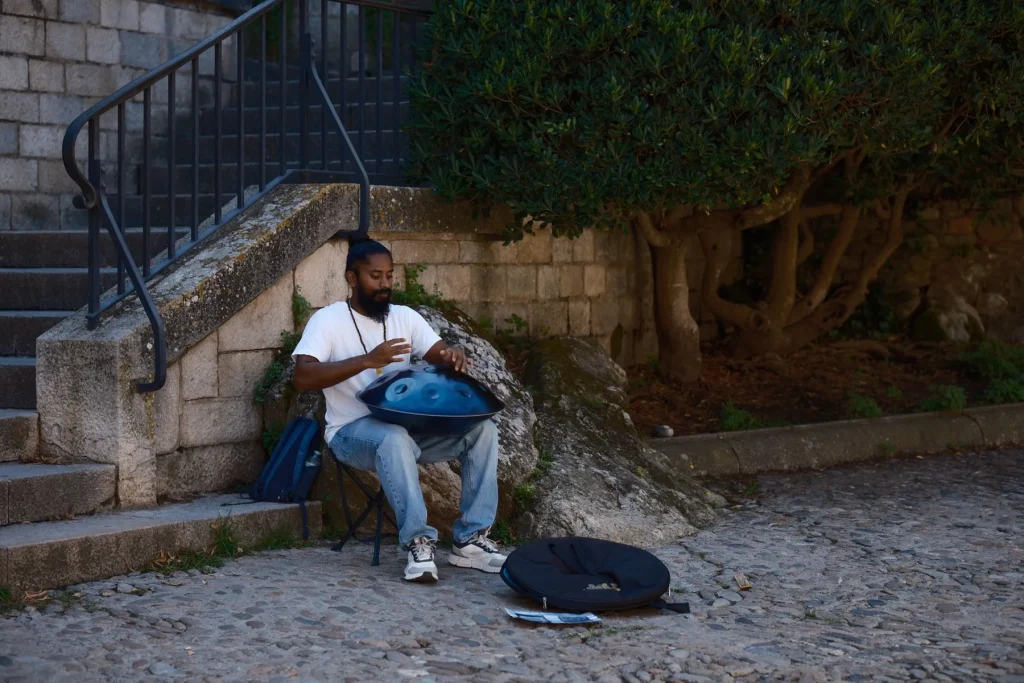
The handpan appeals to players with its simplicity and enchanting sounds. This unique instrument requires no knowledge of music theory, making it ideal for beginners. Its design prevents wrong notes and makes it intuitive to play.
Several approaches can help you master this instrument. Self-directed learning through tutorials or platforms such as Master the Handpan suits some people. Others prefer private lessons with specialist teachers.
Models such as the Sela Melody or the Rav Vast are perfect for getting started. To deepen your knowledge, discover all our advice on choosing and caring for one.
Whether you are an experienced musician or a beginner, the handpan offers a unique musical experience. Its creative possibilities are endless, provided you have the right resources.
Introduction to the handpan: a unique instrument
From the very first notes, the handpan captivates with its sleek design and hypnotic sounds. This modern instrument, created in the early 2000s, stands out for its accessibility and therapeutic benefits.
What is a handpan?
Made from two shells of hammered steel, the handpan instrument has a central Ding surrounded by 8 to 9 notes. These form a pentatonic scale, ideal for creating harmonious melodies without wrong notes.
Unlike other percussion instruments such as the hang drum, its design makes it immediately approachable. The dimples formed on its surface naturally guide the fingers toward the areas to strike.
Why choose to learn to play this instrument?
Several reasons explain its success:
- Intuitive playing: no musical knowledge required
- Soothing effects: ideal for meditation or relaxation
- Rapid progress: simple melodies within a few weeks
According to data from hang-instrument.com, more than 12,000 students have already started with models such as the D Kurd, which is perfect for beginners.
What makes the handpan suitable for beginners
Its specific tuning eliminates dissonance and offers a unique sensory experience from the very first touch. Here is what makes getting started easier:
- No music theory required
- A repertoire adaptable to every skill level
- Immediately rewarding sounds
“The first time I touched a handpan, I felt a mixture of calm and creativity. It was magical.”
Whether you are looking for a creative hobby or a wellness tool, this instrument will surprise you. Its crystalline notes and balanced scale make it an ideal companion.
Taking your first steps with your handpan
Before producing your first melodies, a few fundamentals are essential. Proper handling and correct posture improve comfort and sound quality.

How to hold the instrument correctly
While seated, place the instrument on your lap and keep your back straight. Use your fingertips, rather than your palm, to strike the notes. This technique provides better resonance, approximately 80 dB compared with 65 dB.
Avoid any tension in your shoulders. Fluid playing depends on relaxed muscles. For help, consult our complete beginner’s guide.
Proper positioning and posture
- Sit comfortably with the handpan resting flat on your thighs.
- Keep your elbows slightly apart to maintain good freedom of movement.
- Warm up your hands for 5 minutes before playing by rotating your wrists and stretching.
Discovering the notes and scale
Begin with the central Ding, then explore the surrounding notes. Here is a typical exercise: play Ding → note 1 → note 2 in a 4/4 rhythm.
“The colors of the notes make them easier to remember. Associate each area with a color to progress faster.” — Thierry Bleton
Compare scales such as the D Kurd (ideal for beginners) and the Celtic Minor (more complex).
Methods for learning the handpan
Several paths are available for mastering this uniquely sounding instrument. Each approach offers specific advantages depending on your budget, availability, and learning preferences.
Self-directed learning: advantages and limitations
This method suits independent learners. Free YouTube tutorials and specialist blogs allow you to progress at your own pace. The shadow playing technique, which involves copying the movements shown in videos, is particularly effective.
However, the lack of personalized feedback can slow your progress. One study shows that self-taught learners take 30% longer to master the basic techniques.
Private lessons with a teacher
An experienced teacher can immediately correct your posture and striking technique. Rates range from €15 to €45 per hour on platforms such as Superprof.
Here is what a good mentor should offer:
- Professional equipment (microphone, HD camera)
- A structured program suited to your level
- Detailed feedback after every session
Specialist online course platforms
Websites such as Master the Handpan offer 120 progressive lessons. Their main advantage is personalized video feedback, which, according to their data, makes progress four times faster.
| Method | Average cost | Average time to reach an intermediate level |
|---|---|---|
| Self-directed learning | Free | 12 to 18 months |
| Private lessons | €30/hour | 6 to 9 months |
| Online platforms | €149 to €450 | 3 to 5 months |
“After trying three platforms, I chose Zenapan for its teaching approach. The promotional code saved me €50 on my course.”
To explore other learning methods, consult our complete guide. David Charrier’s program is ideal for anyone who wants to explore advanced rhythm in greater depth.
Fundamental techniques to master
Beautiful sounds depend on well-controlled movements. To explore your instrument’s full potential, adopt precise techniques and targeted exercises.

The basics of finger playing
Use your fingertips to produce clear notes. Avoid using your palms, as they dampen the resonance. Here are the 5 essential strokes:
- Tap: a light, quick strike
- Slap: a sharp, percussive strike
- Glissando: a fluid connection between notes
Controlling rhythm and dynamics
A steady rhythm is developed with a metronome. The Korg TM-60 model (€29) is ideal. Start at 60 BPM, then increase the tempo gradually.
Practice alternating between your left and right hands on triplets to develop their independence.
Exercises to improve dexterity
Devote 15 minutes a day to these exercises for 21 days:
| Level | Exercise | Duration |
|---|---|---|
| 1 | Ding → note 1 sequence | 3 min |
| 2 | Triplets with alternating hands | 5 min |
| 3 | Reproduction of Spiral Dance | 7 min |
“The Handpan BPM Trainer app helped me improve in just 2 months.”
Beware of tendinitis: stretch your hands before every session. With a little practice, natural harmonics will enrich your playing.
Resources for improving at the handpan
A wealth of educational material awaits enthusiasts who want to refine their playing. From specialist videos to interactive apps, these tools are ideal complements to traditional learning.

Recommended video tutorials and channels
PANStream (250K subscribers) offers themed master classes, particularly on circular striking techniques. Its “First Rhythms” playlist has accumulated 1.2 million views.
Handpan Academy (180K subscribers) stands out for its step-by-step tutorials. Its rhythm-decomposition method helps players absorb complex patterns.
“I made more progress in 3 months with PANStream’s progressive exercises than I did in a year of self-directed learning.”
Apps and digital tools
The Handpan Tuner app (rated 4.8/5 on the App Store) can analyze tuning in real time. Its smart metronome module adapts to the user’s level.
Soundbrenner offers advanced features for working on tempo. Its tactile vibration system helps players internalize complex rhythms.
- BPM Trainer: refining sequences
- Tone Grid: creating melodies intuitively
- Harmonix: visualizing scales
Networks for connecting with other players
The Handpan.org forum (45K members) brings together technical discussions and event announcements. Its “Find a Partner” section helps local players meet one another.
Virtual cyphers on Discord make it possible to organize online jam sessions. Experienced moderators host monthly themed workshops there.
To discover other handpan learning methods, explore our complete selection. These additional resources accelerate progress while enriching the musical experience.
Moving to the next level
Progressing toward expert-level playing requires a methodical and creative approach. According to professionals, 73% use 432 Hz tuning to obtain warmer sounds. Reaching this level requires specific techniques and a willingness to experiment.

Advanced playing techniques
Ghost notes (muted strikes) add rhythmic texture. Combined with rolls (rapid sequences), they create hypnotic effects. Here is how to practice them:
- Position your hand at a 45° angle for ghost notes
- Start at 60 BPM before speeding up
- Alternate your left and right hands to maintain balance
Improvisation and musical creation
The Dorian mode (D-E-F-G-A-B-C) inspires contemporary melodies. Try this progression:
- A rhythmic foundation on the central Ding
- Four-bar phrases with carefully placed rests
- Dynamic variations (piano → forte)
“Improvisation means knowing how to listen to what the instrument wants to play through you.”
Playing with other instruments
Combining the handpan with the udu, an African percussion instrument, creates fascinating rhythmic dialogues. To synchronize with an electronic drum kit:
| Element | Solution |
|---|---|
| Tempo | Use a shared click track |
| Sonic space | Reserve the low frequencies for the drums |
Studio recording requires a large-diaphragm microphone such as the AKG C414, positioned 1.5 m away at a 30° angle. To play with other instruments, choose festivals such as HangOut USA or the Bern Handpan Festival.
Conclusion: your handpan learning journey
Your musical journey with this unique instrument begins here. In 50 hours of practice, you will master the fundamentals and discover captivating melodies.
Some players progress to professional composition. “My first project began after six months of learning,” says Julien, now an accomplished musician.
Beware of counterfeits. Choose TÜV-certified models, such as the Sela handpan, for guaranteed quality.
Try our advice at a discovery workshop. The next master classes will take place in September in Paris and Lyon.