
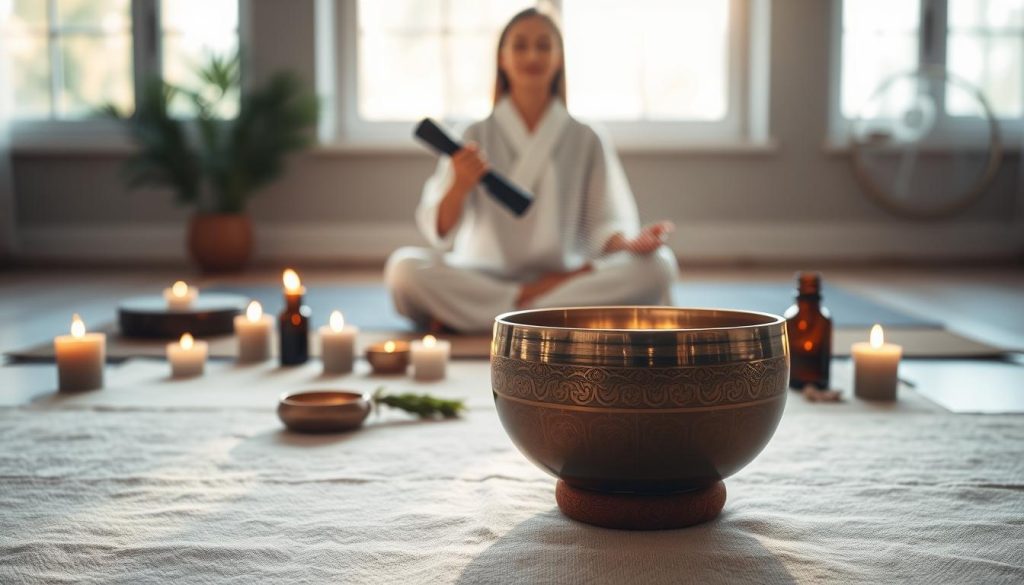
This guide offers a clear introduction to the world of Himalayan instruments used for well-being.
The bowl is an ancient tool that opens the way to a genuine inner journey. Through targeted vibrations, it helps restore calm, presence and grounding.
In this article, you will find simple methods for making your instrument sing and benefiting from its effects. The practice requires patience, respect for the equipment and precise movements.
This guide also explains how to preserve the object’s sound and physical structure. To deepen your practice, discover the workshops and introductory sessions offered by Mont Blanc Bien-Être on its dedicated page.
Understanding the origin and nature of Tibetan singing bowls
The origins of Himalayan bowls lie in ancient traditions. These objects have accompanied ritual practices since around 5000 BC. Their original use was often connected with worship and shamanism.
Himalayan heritage
The bowls come from the Tibetan arc: Tibet, Nepal and Bhutan. This geographical region shaped their form and social role.
Evolution of materials
Over time, craftspeople replaced wood and stone with metal to improve resonance.
- Ancient origin: ritual use from 5000 BC.
- Manufacture: traditional seven-metal alloy for a rich sound.
- Modern practice: many people use these instruments for inner work.
Mont Blanc Bien-Être offers handmade bowls composed of the seven traditional metals to ensure optimal vibrational quality. To learn more, visit our dedicated page.
Tibetan singing bowl therapy: procedure, sounds and precautions
The vibration generated by a traditional instrument invites immediate relaxation. During a session, the method involves striking or rubbing the instrument to produce an enveloping resonance.
This sensory experience soothes the nervous system. Sessions serve as transitions, marking the beginning or end of a period devoted to calm.
Choosing your instrument takes time. You should test several pieces to find the one that resonates with your energy. A suitable frequency maximizes the therapy’s effect.
- Strike or rub the bowl to trigger vibration.
- Begin with short sessions, then extend them according to your sensitivity.
- Practise regularly to establish lasting emotional balance.
| Stage | Action | Suggested duration |
|---|---|---|
| Welcome | Comfortable positioning and breathing | 5 to 10 min |
| Activation | Gentle striking followed by rubbing | 10 to 20 min |
| Closing | Silence and a gradual return | 5 min |
Therapeutic benefits for body and mind
The frequencies emitted during a session quickly modulate brain activity and guide it towards a state of calm. These frequencies encourage the production of alpha waves, which are associated with deep relaxation.
Stress reduction
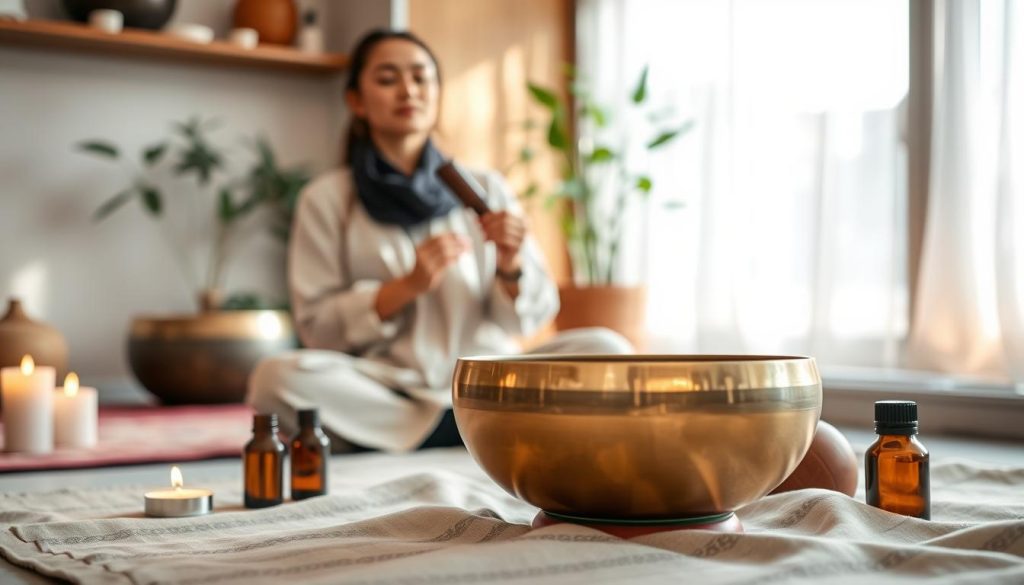
Tibetan singing bowls help reduce stress by inviting the brain to slow down. Sound stimulation facilitates relaxation and reduces muscle tension.
Sleep and calm
Sound massage often improves sleep quality. The vibrations affect the water in the body, helping to harmonize biological systems and promoting a more peaceful transition into sleep.
Emotional balance
Regular use during meditation can release suppressed emotions. The instruments also act on the chakras to restore a sense of inner flow.
- Promotes relaxation and reduces stress.
- Releases tension and helps combat sleep disorders.
- Rebalances emotions and reduces accumulated fatigue.
| Benefit | Mechanism | Observed effect |
|---|---|---|
| Relaxation | Generation of alpha waves | Immediate stress reduction |
| Sleep | Vibrations affecting the water in the body | Easier transition into sleep |
| Emotions | Guided meditation and resonance | Release of emotional memories |
For a more medically focused overview of the practice, see this sound-therapy fact sheet.
Choosing an instrument for your needs
Choosing an instrument often begins with an immediate attraction to one piece among many.
Personal attraction guides the choice of Tibetan singing bowls: take time to listen and feel. Test several pieces to determine whether the vibration produces a sense of auditory and physical well-being.
Small pieces often stimulate the mind. Large ones produce a deep resonance that calms the body. Choose handmade bowls to maximize the benefits associated with resonance quality.
- Select the one that attracts you, the one that calls to you.
- Try several instruments if the first does not produce positive sensations.
- Mont Blanc Bien‑Être supplies a suitable stick or mallet with every purchase.
| Size | Recommended use | Expected effect |
|---|---|---|
| Small | Mental meditation and concentration | Clarity and alertness |
| Medium | Mixed practices | Balance |
| Large | Grounding and physical relaxation | Deep calm |
The symbolism of metals and frequencies
Each metal in a traditional instrument carries symbolism associated with celestial bodies and energy centres.
The seven-metal composition connects Tibetan singing bowls with the seven visible celestial bodies. This tradition gives each piece a fundamental frequency. The vibrations emitted directly influence one’s mental state during practice.
Here are some traditional correspondences that can help you choose a bowl according to the intention of your practice.
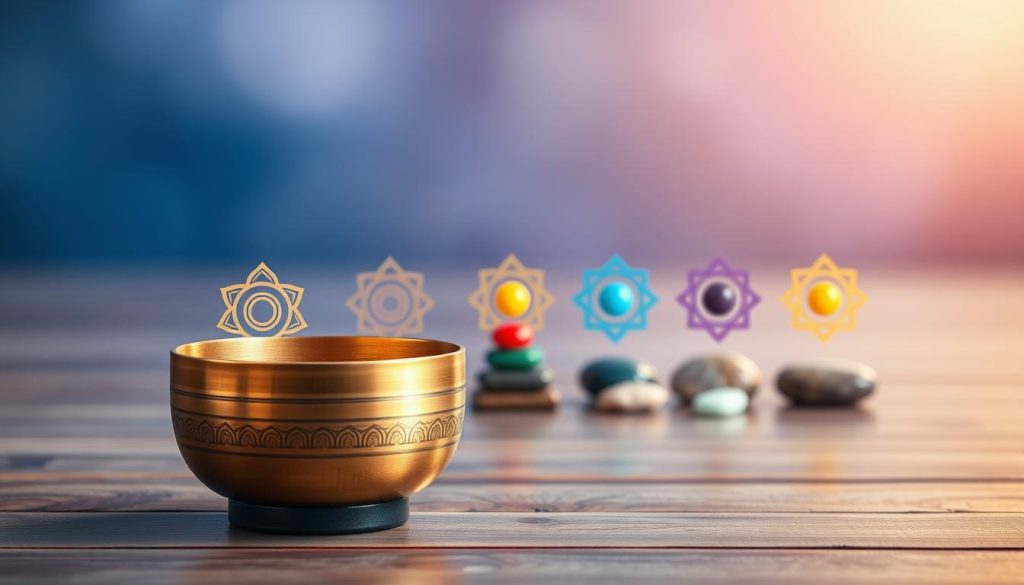
- Gold — Sun: solar plexus (third chakra).
- Silver — Moon: sacral chakra (second chakra).
- Iron — Mars: root chakra.
- Mercury — throat; tin — Jupiter; copper — Venus (heart); lead — Saturn.
| Metal | Celestial body | Chakra | Observed effects |
|---|---|---|---|
| Gold | Sun | Solar plexus | Grounding, confidence |
| Silver | Moon | Sacral chakra | Emotions, fluidity |
| Copper | Venus | Heart chakra | Openness, harmony |
| Iron / lead / mercury / tin | Mars / Saturn / — / Jupiter | Root / — / throat / — | Stability, structure, expression |
Understanding this symbolism helps you direct your sessions more effectively. By choosing a suitable bowl, you can work on specific energy areas and optimize the therapeutic effects.
Mastering striking and rubbing techniques
Mastering simple movements allows you to draw out a pure, lasting vibration.
To strike the bowl, gently tap its outer rim with a soft mallet. This method awakens a clear resonance. Allow the vibration to fade before striking again.
To rub the bowl, angle the mallet at 20 to 30 degrees and apply steady pressure. Maintain a slow, consistent movement so that the tone rises smoothly.
Place the instrument on your palm or on a cushion to achieve optimal resonance. The palm contains reflex points connected to the body, strengthening the connection during sound massages.
- Strike gently to produce an intense vibration.
- Rub at an angle of 20 to 30 degrees with steady pressure.
- Respect each person’s sensitivity and the area being treated.
Rubbing around the bowl calms the mind and induces a profound sense of relaxation. The method requires time and experience to adjust speed and pressure to the recipient.
Incorporating the singing bowl into your daily routine
Starting the day by making your instrument vibrate creates a simple and powerful ritual.
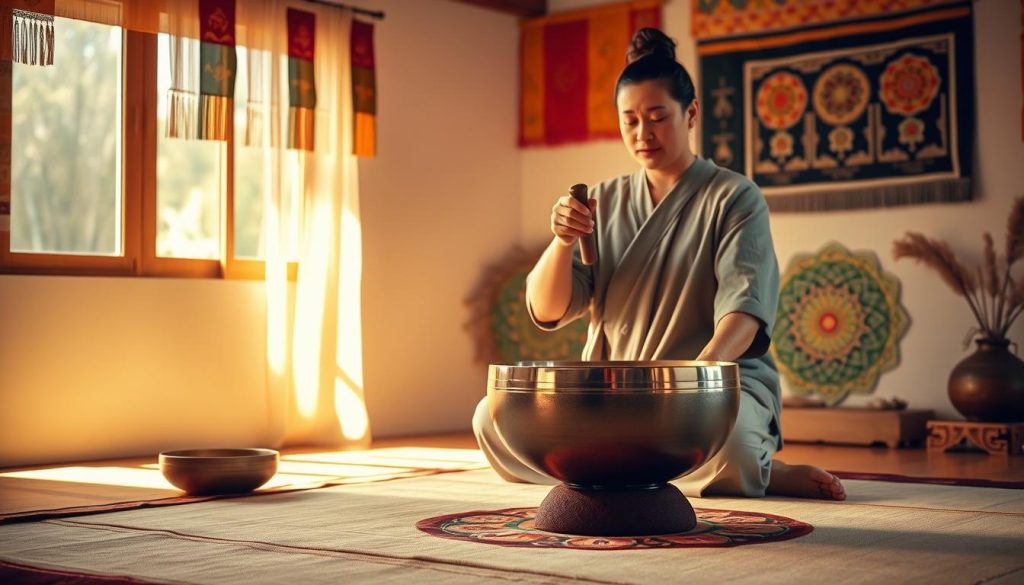
Incorporating Tibetan singing bowls into a morning routine helps manage stress. Take a few minutes upon waking to make the bowl sing. This action maintains its sound and prepares you for the time ahead.
Meditation accompanied by a clear sound creates a pause between tasks. It serves as a marker and helps you step back from daily demands.
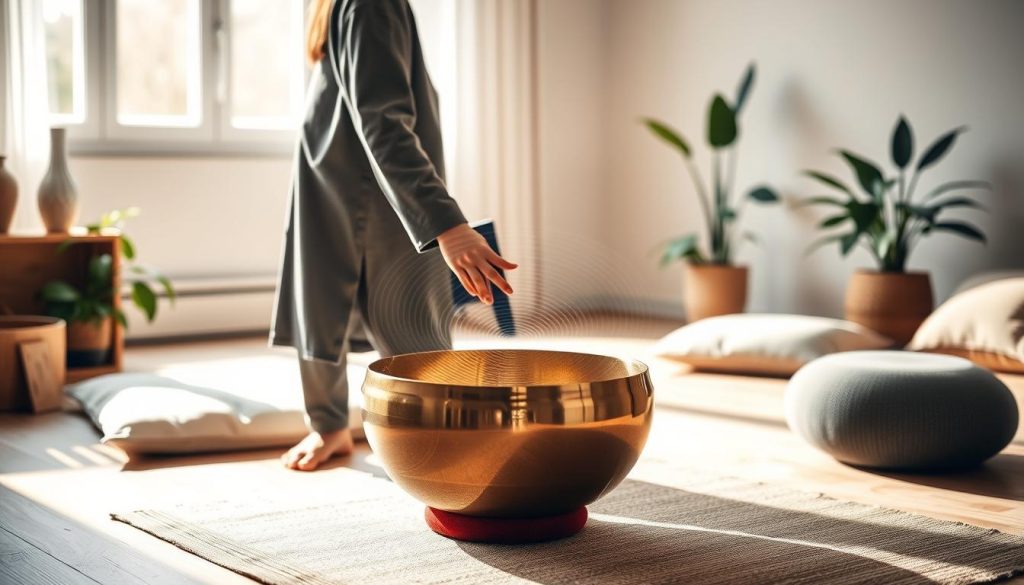
“A small daily ritual is enough to teach your nervous system to regulate itself.”
- Make your bowls sound every morning, even if only for one minute.
- Use the instrument as a signal to slow down during the day.
- Regular practice improves the quality of the vibration and strengthens your personal relationship with the object.
These brief moments are essential for preserving inner balance amid modern pressures. Adopt this habit and observe its effects on your concentration and well-being.
Practising sound meditation for deep relaxation
A simple sound can become a cue that brings the mind back to the present.
Mindful listening
Begin by placing the instrument on a cushion or in the palm of your hand. Listen to the first vibration without judgement.
Follow the tone from beginning to end. This sustained attention calms the mind and improves concentration.
Grounding through vibration
The vibration travels through the body, creating sensations of grounding and release. Repeat the exercise several times to deepen relaxation.
During sessions, the vibration also serves as a guide for the chakras and helps release blockages. This practice is suitable for beginners who find it difficult to remain still.
- Focus on the harmonics rather than your thoughts.
- Use the resonance as a signal to return to the present.
- Practise regularly to incorporate the experience into your daily life.
| Goal | Technique | Expected effect |
|---|---|---|
| Calm the mind | Listen until the sound ends | Rapid reduction in the flow of thoughts |
| Physical grounding | Bowl on a cushion or in the palm | A feeling of stability and relaxation |
| Presence | Focus on the harmonics | Better inner awareness |
To explore this practice and its applications in greater depth, visit the page devoted to sound therapy.
The role of bowls in sound massage
Sound massage is based on the propagation of harmonics through the body. The vibrations emitted by the bowls allow the tissues to relax gradually and promote inner harmony.
During a session, the practitioner may place the bowl directly on the body to transmit a targeted mechanical vibration. This method often releases localized muscle tension.
Sound massages use several instruments simultaneously. The therapist creates a sound bath that envelops the person and amplifies the relaxing effects.
Some participants experience a sense of lightness and a rebalancing of the chakras. The method requires gentleness and care to respect each individual’s sensitivity.
“Gentle contact and the quality of the harmonics guide release without forcing the body.”
- Sound massages use Tibetan singing bowls to diffuse vibrations through the body.
- When placed on specific areas, the bowls facilitate immediate and lasting muscle relaxation.
- By combining several bowls, the practitioner creates an immersive soundscape conducive to letting go.
To learn more about the tradition and techniques of Tibetan massage, read this article, which describes the practices and effects observed during sessions.
Precautions and contraindications
Safety always comes first. This section explains the limits that should be observed to keep the practice beneficial.
Never place the bowl upside down on a person’s head to make it sing. This can create uncomfortable pressure and unwanted effects.
People with epilepsy or neurological disorders, as well as those with a pacemaker, should consult a healthcare professional before any session. Likewise, seek medical advice if you have a heart condition.
- Adapt the method in cases of extreme fatigue or psychological vulnerability to avoid overstimulation.
- Vibrations can worsen tension if applied too close to a painful area.
- Avoid direct contact with water: the metal may rust and lose its qualities.
- Always respect each person’s condition and limits; sound massage complements medical treatment.
“When in doubt, the safest course is to consult a healthcare professional.”
Maintaining your bowl to preserve its sound
Regular care ensures that your instrument remains vibrant and expressive over the years.
Clean your bowls with a soft, slightly damp cloth. Avoid prolonged contact with water: copper and iron can rust quickly.
For stubborn stains, apply white vinegar or lemon juice to a cloth, then wipe without rubbing vigorously. This natural method preserves the patina without damaging the metal.
Always handle the instrument gently. A fall or excessive pressure can crack the wall and alter its resonance.
- Make the bowl sound regularly: use maintains its vibrational quality.
- Store it in a dry place protected from impacts to preserve its metal structure.
- When in doubt, clean it gently and allow it to dry completely before storing it.
“A gesture as simple as wiping it with a soft cloth is often enough to extend the life of your instrument.”
Creating a space conducive to practice
A carefully prepared space helps the body receive the vibrations.
Set up a dedicated corner with a comfortable cushion and a blanket. This arrangement makes practice simpler and more regular.
Choose subdued lighting to soothe your attention. A gentle atmosphere helps the body relax and receive the vibration more fully.
Use a stable cushion for your bowls: stability prolongs resonance and facilitates any targeted massage.
- Allow enough space to move around the person during a massage.
- Leave a few minutes of silence at the end of the session so that the energy can settle in the body.
- Store and display the instrument attractively to encourage regular practice.
| Item | Purpose | Practical advice |
|---|---|---|
| Cushion | Stability | Choose a firm, non-slip model |
| Lighting | Calm | Soft lamp or candle |
| Storage | Motivation | Clean, visible stand |
Conclusion
In summary: to conclude, regular practice transforms simple listening into profound inner work. This guide helps you incorporate Tibetan singing bowls into your daily life to manage stress more effectively and promote relaxation.
Whether used for meditation or massage, every experience is unique. By following the advice in this article, you will know how to choose and maintain your instrument so that it becomes a lasting ally.
Focus on the sound, respect the person and practise gently. Take time to listen, using a cushion if necessary, to deepen relaxation and concentration.
We hope this guide will calmly accompany you through your discovery and future sessions.