
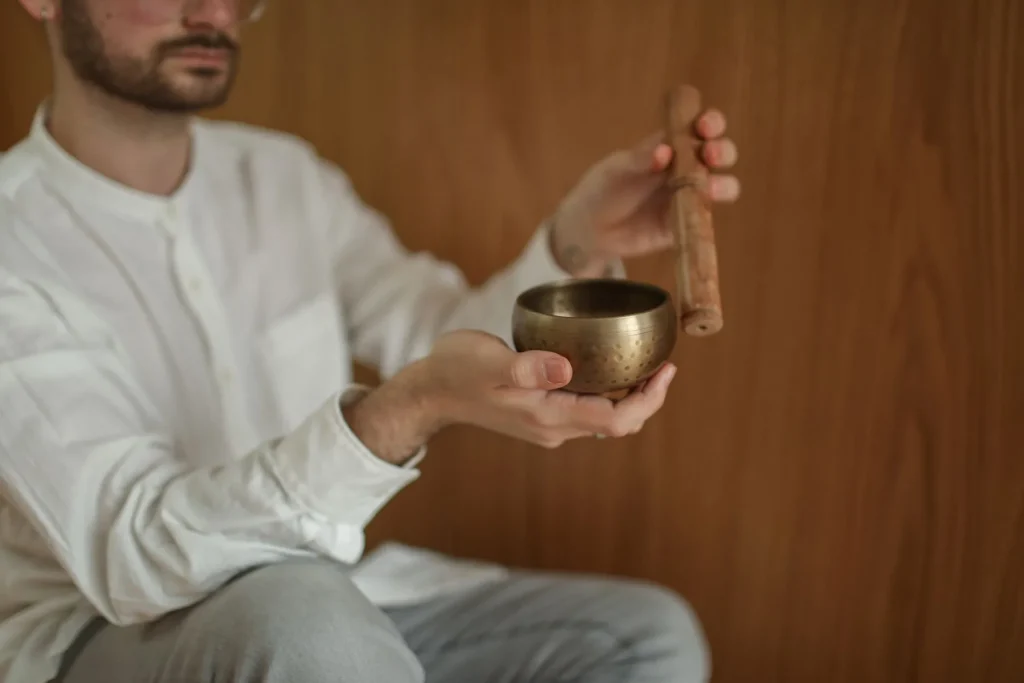
This short article provides a clear, practical introduction to the Tibetan singing bowl and its role in everyday well-being.
Simple in appearance, this beautiful object produces vibrations that promote relaxation. Each bowl can become a useful instrument for calming the mind.
We will explain how to incorporate these bowls into a sleep or meditation routine. You will discover practical uses and easy approaches to try at home.
If you would like to explore the research and practical applications further, consult this dedicated resource to learn more: complete guide to the Tibetan singing bowl.
As an English-speaking reader, you will find a useful, verifiable overview here to help you understand why this bowl is more than a decorative object.
Origins and history of singing bowls
This instrument has its roots among Mongolian peoples more than 5,000 years ago. Its earliest uses were associated with shamanic practices, in which vibrations supported rituals.
The instrument subsequently travelled through Tibet and then Nepal, where artisans refined its manufacture. These regions transformed a simple object into a recognized cultural and spiritual tool.
- Mongolian origins: shamanic use to produce long-lasting resonance.
- Spread: Tibetan and Nepalese artisans refined the forging technique.
- Role: the singing bowl works through resonances that influence the human body.
“Each bowl was shaped to emit a precise frequency that was useful in rituals.”
Today, the modern Tibetan singing bowl retains this heritage. It remains an instrument steeped in history and appreciated throughout the world.
Tibetan singing bowls: benefits, sounds and uses
A bowl’s vibration depends as much on its material as on the way it is played.
Composition: the traditional form combines seven metals associated with celestial bodies. This alloy affects the harmonics and range of tones produced by each Tibetan singing bowl.
If you pour a little water into the object, cymatic patterns become visible: geometric shapes form under the effect of the waves. This simple experiment shows how vibrations act through space.
The nature of vibrations and sound
Resonance changes according to the pressure applied to the mallet. A gentle movement develops long harmonics. A firmer strike emphasizes higher frequencies.
Differences between metal and crystal
A metal bowl envelops the room in a warm sound. A crystal bowl offers purer clarity. Your choice depends on your sensitivity to vibrations and the type of relaxation you seek.
- Unique: every bowl is a distinctive object whose resonance varies.
- Practical: only a few uses may be enough to experience a sense of calm.
- Advice: to learn more, consult the complete guide to the Tibetan singing bowl.
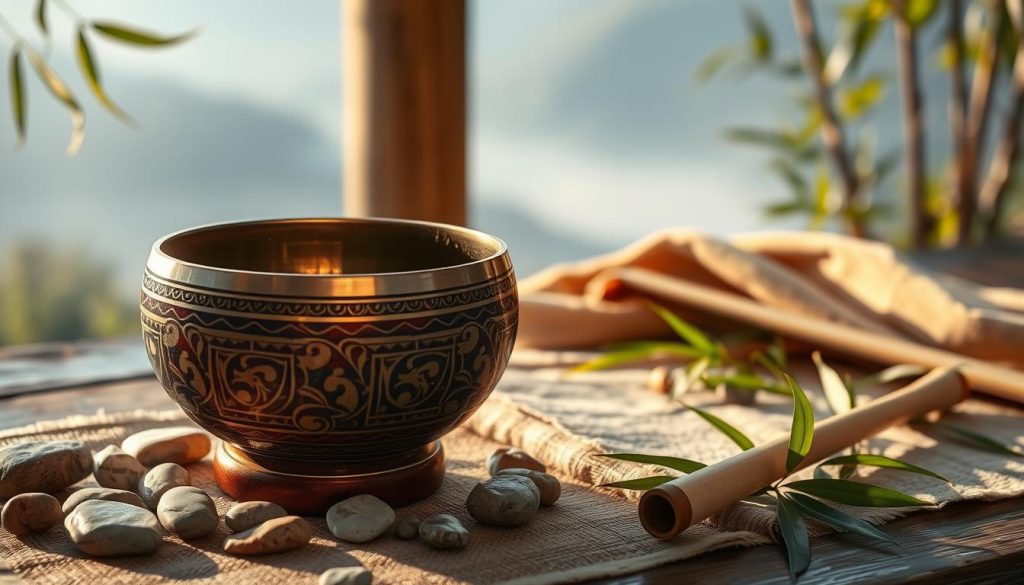
“Understanding the physics of sound helps you use the instrument more effectively and maximize its soothing effects.”
Effects supported by scientific research
Several clinical studies have measured the impact of these instruments’ vibrations on sleep and anxiety.
Sleep and deep relaxation
A study published on September 30, 2016 at the University of San Diego and involving 62 participants found reduced stress after listening sessions. A few minutes each day may be enough to improve rest and concentration.
Pain management and stress reduction
On June 20, 2008, a German study involving 54 people reported substantial relief from back pain. In addition, a study published on May 1, 2014 and involving 51 participants found lower blood pressure after regular sessions.
Support for serious illnesses and cognitive disorders
A University of Nice thesis dated May 16, 2019 indicates that music therapy involving Tibetan singing bowls can support people with cognitive disorders as a complement to conventional care.
“Through vibration, the body can enter a state of deep relaxation that promotes restorative sleep.”
| Study | Date | Participants | Key result |
|---|---|---|---|
| San Diego | 30/09/2016 | 62 | Reduced stress |
| Independent | 01/05/2014 | 51 | Lower blood pressure |
| Germany | 20/06/2008 | 54 | Less back pain |
| Nice (thesis) | 16/05/2019 | Clinical studies | Support for cognitive disorders |
Practical note: a sound massage or short sessions with a Tibetan singing bowl may ease muscle tension and give the body a noticeable sense of well-being. For listening suggestions, consult this relaxation playlist.
Debated energetic and spiritual benefits
Tradition connects the bowl’s composition with the body’s energy centers. According to ancient teachings, the seven metals correspond to the seven major chakras.
Targeted harmonization:
Each bowl may be used to rebalance a particular chakra. The crown chakra, or Sahasrara, is often targeted to encourage a deeper spiritual connection.
At the other end, the root chakra (Muladhara) responds to the instrument’s low vibrations, which ground energy at the perineum.
Cleansing spaces:
Many practitioners also use the bowl to cleanse a space. Although this remains empirical, the method is popular for dispelling tension and negative impressions.
Regular use: by working with each chakra, practitioners hope to release emotional blockages. Enthusiasts report a stronger energy field around the body during extended meditation.

To recognize an example and make a more informed choice, consult this guide to the Tibetan singing bowl.
“Aligning the energy centers remains a personal practice grounded in experience and tradition.”
Techniques for making your instrument sing
Learning to make your bowl sing begins with paying attention to how you hold it and to your posture.
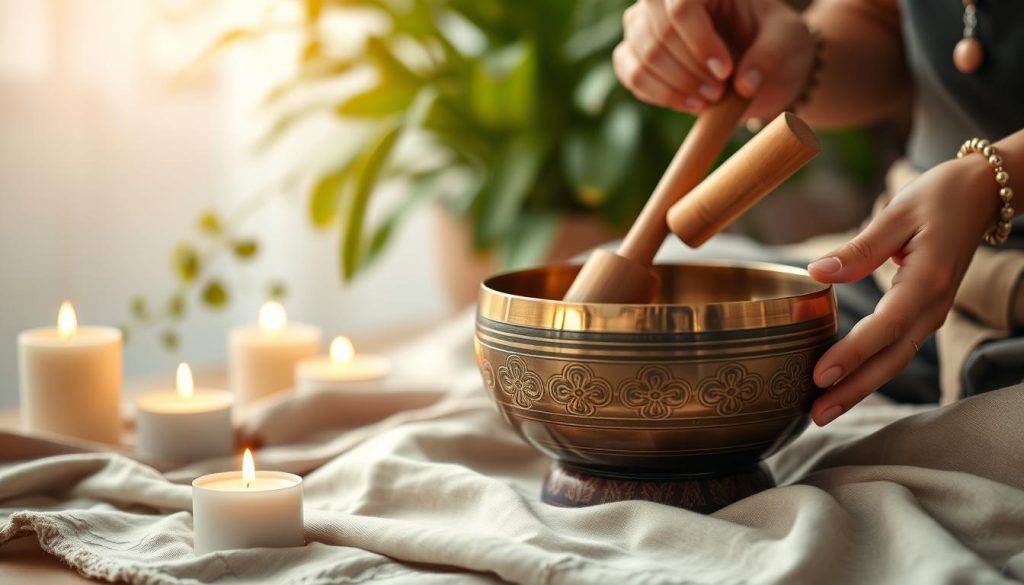
Hold the object in your open palm. Do not press your fingers against the metal. A relaxed grip allows the vibrations to circulate.
Rub the outer rim gently with a steady movement. This creates continuous vibrations that soothe the body.
Use a suitable mallet to vary the strike. Adjust the force to explore the Tibetan singing bowl’s tonal range.
Sound massage involves placing the bowl on the body. The tissues receive the vibration directly, promoting deeper relaxation.
You can pour a little water into the bowl to observe cymatic patterns. This visual experiment demonstrates the power of sound.
- Patience: every instrument responds differently according to pressure and speed.
- Repetition: once you have mastered the technique, make the bowl sing several times a day.
- Care: handle the object carefully so that it lasts.
| Action | Position | Effect | Advice |
|---|---|---|---|
| Holding | Open palm | Free resonance | Relax your fingers |
| Rubbing | Outer rim | Continuous vibrations | Maintain a steady rhythm |
| Striking | Mallet | Variety of tones | Vary the force |
| Massage | Placed on the body | Tissue relaxation | Monitor comfort |
“Repetition and gentleness remain the best guides to mastering the technique.”
Incorporating bowls into your daily rituals
A simple morning sound ritual often changes the quality of your attention for the entire day. Begin with a brief 30-second sound to set an intention. This supports concentration and prepares the body for activity.
Morning and evening wellness rituals
In the morning, sound the bowl once before beginning your tasks. This action creates a sense of grounding and encourages concentration.
In the evening, devote a few minutes to relaxation. A few minutes of listening can be enough to release stress and prepare the body for sleep.
Meditation guided by sound and presence
Use the bowl as an anchor to remain in the present moment. Let the vibration guide your breathing.
A quick sound massage for the neck or shoulders can release tension from the body after a long day.
- Mark transitions: a single chime signals the shift from work to relaxation.
- Regular ritual: practicing a few times a week promotes lasting well-being.
- Presence: learning to listen to the vibration until it fades into silence improves concentration.
| Time | Duration | Purpose | Practical advice |
|---|---|---|---|
| Morning | 30 to 60 seconds | Concentration | A brief sound before starting the day |
| Evening | 3 to 10 minutes | Relaxation | Listen while lying down and breathing slowly |
| Meditation | 5 to 20 minutes | Presence | Follow the vibration as an anchor |
“Turning a simple action into a ritual creates a space of calm that is available at any time.”
Resource: to go further, consult this beginner’s guide, which explains how to structure your sessions.
Tips for choosing the ideal bowl
Choosing the right bowl begins with your ears: listen to several examples before buying to determine which one resonates with you.
Size affects the tone: a larger bowl produces deeper notes that are useful for relaxation and grounding the body.
Some people choose a singing bowl tuned to a particular chakra. This approach helps target energy work.
Do not rely on appearance alone: prioritize vibrational quality. A good instrument provides an immediate sense of calm.
Handcrafted models often offer a richer harmonic palette. Do not hesitate to sound several pieces and follow your intuition.
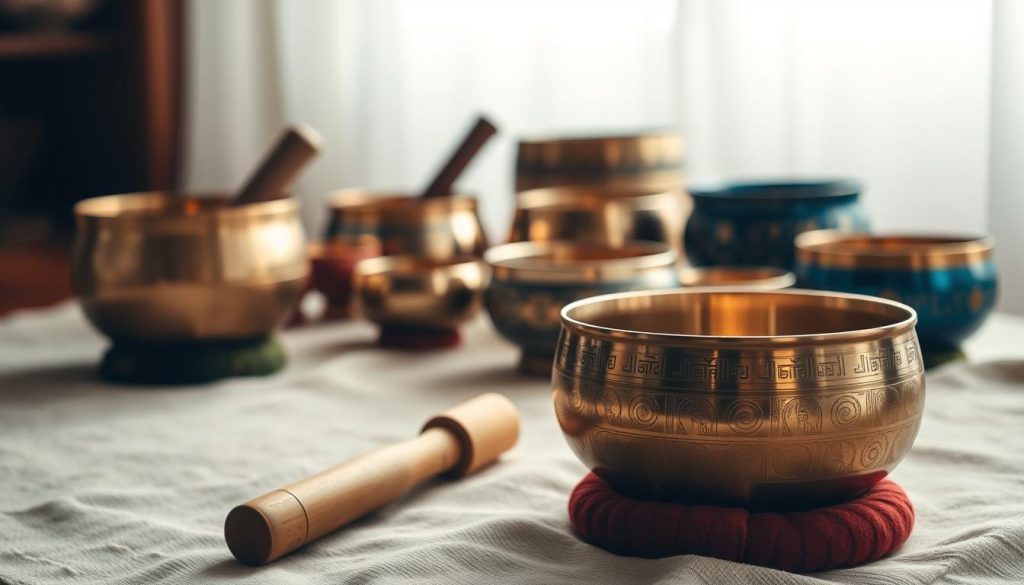
- Test before buying to feel the effect on your breathing.
- Define the intended use: meditation, cleansing or general well-being.
- Choose the resonance that gives you an immediate sense of calm.
| Criterion | Impact | Advice |
|---|---|---|
| Size | Depth of sound | Choose a large bowl for deep relaxation |
| Tuning | Work on a chakra | Choose a targeted note if necessary |
| Manufacture | Harmonic richness | Favor a handcrafted model for more character |
| Appearance | Visual appeal | Do not prioritize it over vibration |
“A good bowl is one that brings you calm and makes it easier to harmonize the chakras.”
Essential precautions and contraindications
Sound massage requires a few simple rules to ensure safe practice.
Before any session, people with a pacemaker should seek medical advice. If you have any concerns about your health, always consult a professional before using a Tibetan singing bowl for therapeutic purposes.
Pregnant women and people with epilepsy should adapt their sessions. Avoid overly intense vibrations and favor a gentle technique.
Do not place the bowl directly on a painful area of the body: this may worsen discomfort instead of relieving it. Handle the instrument carefully to prevent impacts.
During group sessions, monitor the bowl’s volume so that it remains comfortable for everyone. An excessively forceful strike can be unpleasant, especially when several bowls resonate simultaneously.
- Frequency: limit use to a few times a day to allow the nervous system time to integrate the vibrations.
- Technique: favor smooth, controlled movements.
- Special circumstances: seek medical advice if you have a heart or neurological condition.
“Safety comes first: respectful practice extends both the enjoyment and effectiveness of sessions.”
Conclusion
This article shows that the bowl is a simple tool for improving your well-being.
A few minutes of regular practice may be enough to reduce stress and promote relaxation. It strengthens concentration and provides genuine relaxation.
Every bowl has a unique vibrational signature that acts on the body and, depending on your needs, on the targeted chakras. In some cases, incorporating it into a daily ritual turns the effect into a lasting habit.
If you would like to explore the subject further, consult this complete guide to the Tibetan singing bowl. Feel free to explore sound-massage techniques to discover your instrument’s full potential.