
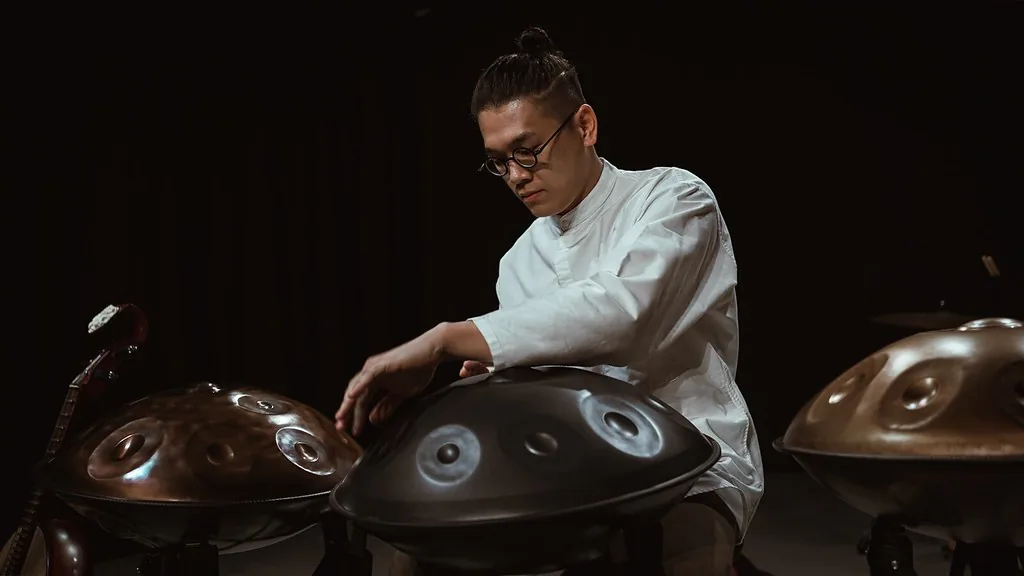
Created in the 2000s, this instrument fascinates people with its design and enchanting sounds. Its shape resembles a flying saucer, with two half-shells made from specially treated steel. Each model produces crystalline notes that resonate for a long time.
Used both to create melodies and for relaxation, it appeals to music lovers and therapists alike. Its handcrafted construction ensures exceptional acoustic quality. Musicians appreciate its rich, intuitive range of sounds.
This instrument offers a rare sensory experience. Its price reflects the expertise required to make it. Around the world, it brings together a community passionate about its unique vibrations.
The fascinating origins of the handpan
The history of this instrument begins in Switzerland at the turn of the 21st century. Two visionary craftspeople, Felix Rohner and Sabina Schärer, launched a musical revolution. In 2000, their PANArt workshop made history with the creation of the Hang, the direct ancestor of the modern handpan.
The Swiss invention by Felix Rohner and Sabina Schärer
During the 1990s in Bern, the pair experimented with different shapes and alloys. Percussionist Reto Weber played a key role by testing the prototypes.
“We were seeking to combine technical precision with artistic expressiveness”
, Rohner explained.
Influences from the Indian ghatam and the steel drum
The design draws inspiration from two traditions. The Caribbean steel drum contributed its hammering technique. The Indian ghatam influenced the musician’s posture and the nuances of playing. This fusion creates a unique sound combining percussion and melody.
The evolution from the Hang to the modern handpan
After PANArt stopped production in 2013, new manufacturers such as Meinl took up the torch. They modernized the techniques while preserving the original spirit. The evolution toward nitrided steel improved durability and the tuning accuracy of the notes.
Today, the handpan has won admirers around the world. To discover how to master this captivating instrument, explore our tips for beginners.
What is a handpan? Anatomy of the instrument
The anatomy of the handpan reveals unique technical characteristics. This instrument combines precision and harmony, with a carefully designed shape that produces immersive sounds.

A structure made from two nitrided-steel hemispheres
The handpan consists of two half-shells made from steel 0.8 to 1.2 mm thick. Nitriding increases its strength and improves resonance. This heat treatment creates a hardened surface that is essential to its acoustic quality.
The role of the dimples and central note
The Ding, the central note, acts as an acoustic anchor point. Around it, 7 to 9 notes are arranged in hammered dimples. These cavities generate standing waves, enriching the harmonies.
The resonance hole and sound projection
The hole on the underside regulates air pressure. It amplifies low frequencies and balances projection. Without it, the sounds would be muffled.
| Manufacturer | Steel thickness (mm) | Treatment |
|---|---|---|
| PANArt | 1.0 to 1.2 | Deep nitriding |
| Meinl | 0.8 to 1.0 | Gas nitriding |
| Spacedrum | 1.0 to 1.1 | Ion nitriding |
Hammering techniques vary among craftspeople. Some favor widely spaced notes for clear melodies, while others use tighter arrangements to create percussive effects.
The handcrafted production of a handpan
Every handpan is the result of a complex and fascinating artisanal process. This instrument requires between 40 and 60 hours of work, combining traditional techniques with modern tools. Its acoustic quality depends on every stage, from hammering to final tuning.
The complex hammering and tuning process
Cold-forming the steel is the first key step. Craftspeople use pneumatic hammers to create the dimples, then refine everything by hand. Work hardening stiffens the structure without affecting its resonance.
Tuning, carried out to a tolerance of ± 2 cents, relies on spectral analysis and an expert ear. “It is a dialogue between the metal and the musician”, one maker explains. This meticulous development ensures perfect harmonics.
The different steel alloys used
The choice of alloy affects durability and tone:
- DC04: a warm, balanced sound that is ideal for melodies
- Stainless steel: acoustic brightness and resistance to oxidation
- Ferritic steel: deep resonance, favored in music therapy
Each type undergoes nitriding to eliminate internal stresses. This crucial step ensures that the notes remain stable over time.
Why every handpan is unique
No two handpans are alike, even when they come from the same manufacturer. Variations in hammering, steel thickness, and manual tuning create distinct sound profiles. Musicians see this as a strength: each piece offers unique creative possibilities.
Quality-control methods, such as resonance testing, confirm this uniqueness. This bespoke production is what makes the handpan an exceptional instrument.
How does the handpan work?
The handpan produces sounds through a unique combination of vibrations and resonances. Each note emits frequencies ranging from 100 Hz to 1.5 kHz, creating immersive melodies. Sound decay lasts from 8 to 15 seconds, providing an enveloping experience.

The principle of vibration and resonance
When a dimple is struck, the steel vibrates and generates standing waves. These vibrations travel between the upper membrane and the lower chamber. This interaction amplifies the natural harmonics and enriches the tone.
The resonance hole regulates air pressure. It balances the low frequencies and extends the duration of the notes. Without it, the sound would be less powerful.
The diatonic scale and its melodic possibilities
Standard scales such as D Kurd and Amara use a diatonic system. This simplifies improvisation while offering a rich palette. Unlike chromatic systems, these tunings encourage spontaneous harmony.
| Scale | Characteristics | Central frequency |
|---|---|---|
| D Kurd | Melancholic and deep | 432 Hz |
| Amara | Bright and joyful | 440 Hz |
| Integral | Balanced and versatile | 444 Hz |
Basic techniques for producing sounds
Three essential methods help you master playing:
- Direct strike: use your fingertips to produce clear notes
- Glissando: slide your hand to create smooth transitions
- Muting: gently rest your fingers on the surface to control resonance
To explore these techniques in greater depth, read our complete guide. Practical exercises help develop an intuitive connection with the instrument.
The different scales and keys available
Exploring a handpan’s scales means discovering a sound world with endless nuances. Each configuration conveys distinct emotions suited to different musical styles and personal feelings. Musicians value this diversity when creating unique melodies.
Major and minor scales
Major scales, such as the famous D Kurd, bring a joyful, bright atmosphere. Minor scales such as Amara, by contrast, evoke melancholy and depth. The choice depends on the desired emotions.
The D Minor scale accounts for 60% of production. Its diatonic tuning simplifies improvisation. It is perfectly suited to beginners and experts alike.
432 Hz tuning and its distinctive features
Although 85% of models use the standard frequency of 440 Hz, 432 Hz is growing in popularity. According to therapists, this so-called “natural” frequency may encourage relaxation.
“432 Hz resonates differently within the human body”, one maker explains. Some people believe it is in harmony with biological rhythms. Psychoacoustic studies indicate that it may have a calming effect.
How to choose a scale for your needs
Several criteria guide the choice:
- Musical style: choose D Minor for meditative atmospheres
- Therapeutic use: 432 Hz is ideal for relaxation
- Group performance: select complementary scales
| Scale | Dominant emotion | Recommended frequency |
|---|---|---|
| D Kurd | Balance | 440 Hz |
| Amara | Joy | 432 Hz |
| Integral | Versatility | 444 Hz |
To learn more about tuning techniques, read this guide to heptatonic and pentatonic scales. Always try the instrument before buying it to make sure you like its tone.
The handpan and other percussion instruments
The handpan stands apart from other percussion instruments through its unique versatility and ergonomics. This instrument combines a relatively low weight (5 to 8 kg) with a rich sound, offering possibilities valued by musicians of every level. Compared with traditional percussion instruments, it can be learned 70% faster.

Comparison with the tongue drum
The tongue drum, often made from cut steel, produces shorter, more percussive sounds. The hand-hammered handpan offers longer resonance and complex harmonics. “The distinction between the two lies in how they are made”, one craftsperson explains. To learn more about the differences from the tongue drum, explore our guide.
Differences from the traditional steel drum
Weighing at least 15 kg, the Caribbean steel drum creates logistical constraints. The more compact handpan is easier to transport and play while traveling. Its intuitive striking techniques contrast with the rhythmic complexity of the steel drum.
Advantages over traditional percussion instruments
- Versatility: ideal for melodies and rhythms, unlike traditional drums.
- Durability: nitrided steel resists oxidation, reducing maintenance.
- Musical integration: it works with jazz, world music, and meditation.
Its maintenance costs, which are lower than those of keyboards, make it a sensible choice for traveling artists. The handpan’s acoustic quality and longevity add to its appeal.
The use of the handpan in modern music
Since it first appeared, the handpan has transformed contemporary soundscapes. This unique instrument appeals to professional musicians and amateurs alike with its enchanting melodies. Its growing success reflects a genuine passion around the world.

The handpan in music therapy and relaxation
Sound-healing techniques increasingly incorporate this instrument. Its soothing vibrations are now used in 45% of sessions. Frequencies of 432 Hz in particular may promote a state of deep relaxation.
Scientific studies indicate an effect on stress. Hospitals use it to reduce patient anxiety. Its acoustic quality provides a unique sensory experience.
Its integration into different musical styles
The handpan stands out for its versatility:
- Electronic music: notable combinations with ambient music and dubstep
- World music: rewarding cross-cultural collaborations
- Cinema: recent film scores that make use of its unique tone
The 2020s saw its widespread adoption by a variety of artists. To discover its potential, read this complete guide to the handpan.
Notable artists who use the handpan
Artists such as Björk and Alt-J have popularized this instrument. David Kuckhermann, a renowned virtuoso, pushes the boundaries of musical creation.
Dedicated festivals and events (Hangout USA, Hang Massive Tour) demonstrate its rise. With sales increasing by 300% since 2015, the handpan has become a cultural phenomenon.
Conclusion: the handpan is far more than a simple instrument
More than an instrument, the handpan provides a complete sensory experience. With annual growth of 12% since 2020, its emotional benefits appeal to 78% of users. Its success now extends to more than 50 countries.
Its acoustic quality and intuitive playing techniques make it a unique tool. Its enchanting melodies transcend musical boundaries. From artistic creation to relaxation, its uses continue to evolve.
Recent years have brought promising innovations. New materials enrich its range of tones. The market is expected to double by 2028, driven by a growing community.
When starting out, choose models suited to your style. Explore educational resources and let your emotions guide you. This unique musical journey will transform your relationship with music.