
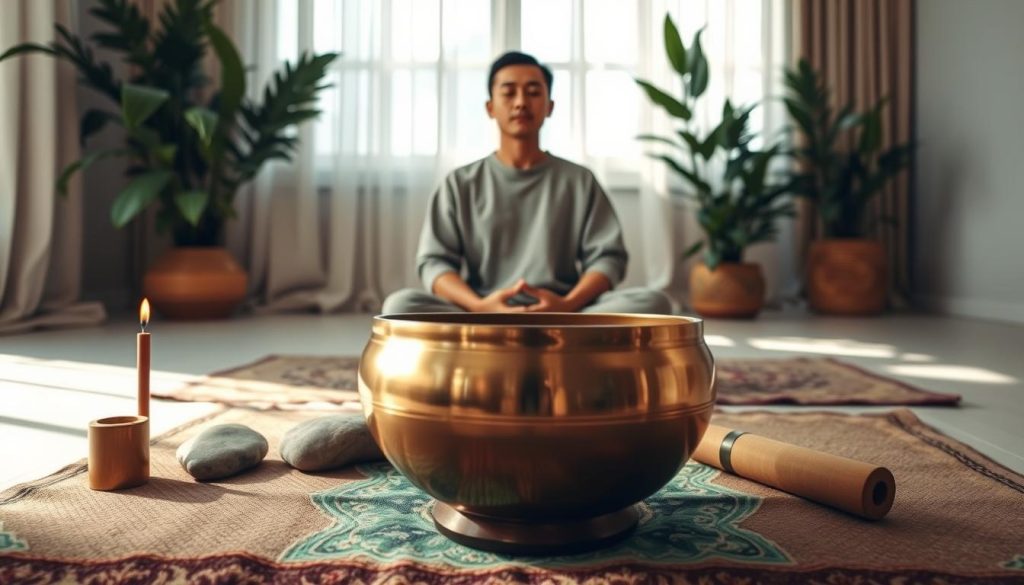
Welcome to this article, designed to transform your wellness routine. I share more than twenty years of practice and concrete experience with this ancient instrument.
In just a few minutes per session, you will learn simple techniques to refocus your mind. This guide provides steps for incorporating a Tibetan singing bowl into your daily practice.
Every minute spent with the bowl strengthens concentration and releases tension. Follow this complete guide to prepare for the session, accompany transitions, and gently conclude your practice.
Ready for your first experience? This article aims to give you simple, safe foundations suitable for beginners and experienced practitioners alike.
Understanding the benefits of sound meditation
Sound acts as a natural regulator. Studies show that targeted frequencies alter nervous-system activity. A University of San Diego study involving 62 participants, published on September 30, 2016, found significant reductions in stress and blood pressure.
Impact on the nervous system
The vibrations emitted by the instruments often range from 110 to 660 Hz. They directly influence the central nervous system and promote a state of deep relaxation.
Harmonizing body and mind
Regular practice helps regulate breathing and improves overall well-being. Complex sounds encourage the brain to produce alpha and theta waves, which support emotional balance.
- Measurable reduction in stress and anxiety.
- Improved concentration after the session.
- Vibrational resonance that soothes the body and clears the mind.
| Effect | Evidence | Frequencies |
|---|---|---|
| Stress reduction | San Diego study (62 participants) | 110–660 Hz |
| Deep relaxation | Influence on the nervous system | 110–660 Hz |
| Emotional balance | Alpha and theta waves | Varies by instrument |
To deepen your mastery of sound and practice, read this beginner handpan tutorial.
Tibetan singing bowl meditation: simple exercises to try
This sound art draws on a tradition spanning thousands of years that touches both body and mind. Singing bowls have their origins in the Buddhist traditions of the Himalayas more than 2,500 years ago.
Each singing bowl is regarded as a sacred instrument. With regular practice, it makes it easier to enter an altered state of consciousness.
By combining breathing techniques with attentive listening, you naturally harmonize your body and mind. The soothing effects are often felt from the very first sessions.
Tibetan bowls are also used to cleanse energy and strengthen concentration, as monks have done for centuries. Learning to use this instrument requires patience, but the experience quickly brings benefits.
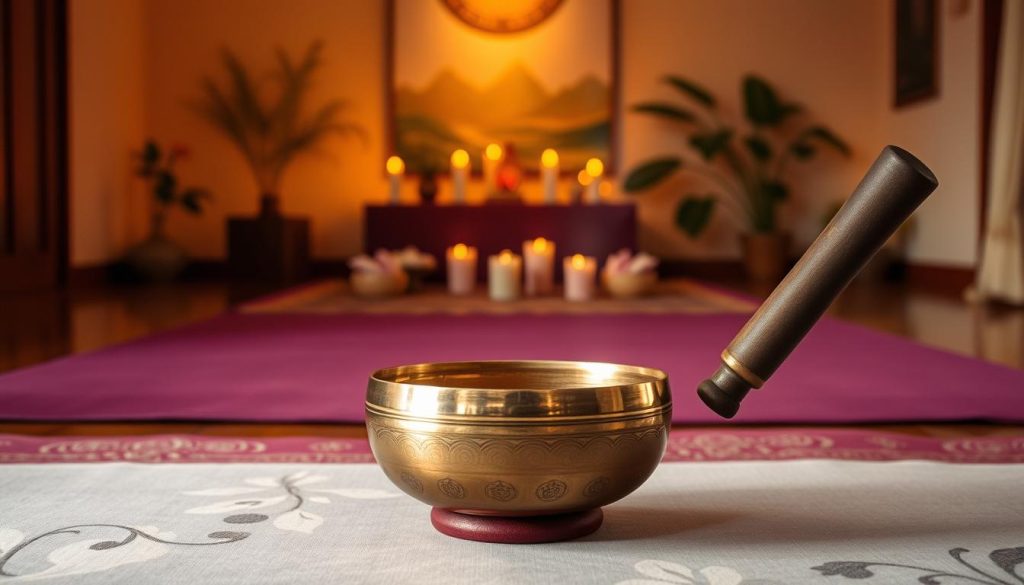
“Sound becomes a guide: it slows the breath and refocuses attention.”
For a practical, progressive approach, see our beginner program.
Preparing your space and mindset
Before every session, create a setting conducive to calm. Choose a room where interruptions are rare. Turn off devices that might vibrate or ring.
Silence creates the conditions for genuine listening. Without distracting noise, the sounds of your singing bowl can unfold and act on your breathing. This makes it easier to balance body and mind.
The importance of silence
Set aside at least 20 minutes for the practice. This gives you time to establish steady abdominal breathing and adjust your posture.
- Sit on a cushion or comfortable chair.
- Eliminate sources of outside noise.
- Breathe slowly before touching the instrument.
“Intentional silence provides the best resonance, making every minute count.”
| Aspect | Recommendation | Effect |
|---|---|---|
| Time | At least 20 minutes | Better immersion and relaxation |
| Posture | Back straight, body relaxed | Optimized breathing and comfort |
| Environment | Silence and soft lighting | Greater concentration and inner peace |
Adopting the ideal posture for relaxation
Keeping your body upright and relaxed is essential for prolonging the instrument’s resonance.
The lotus or half-lotus position encourages an upright back and fluid breathing. It helps stabilize your seated posture for a deeper relaxation session.
Perfect body alignment allows energy to flow optimally. Keep your chest open, your chin in a neutral position, and your shoulders relaxed.
Physical stability prevents tension that could disrupt the practice. An unstable seated position diverts attention and interrupts the bowl’s resonance.
- Choose a cushion to raise your hips if necessary.
- Make sure your spine remains straight without becoming tense.
- Place the instrument on a comfortable support so you can stay focused on your breathing.
“Aligning body and mind creates the best conditions for a deep session.”
| Element | Recommendation | Effect |
|---|---|---|
| Posture | Lotus or half-lotus | Straight back and fluid breathing |
| Alignment | Spine in a neutral position and shoulders relaxed | Optimal energy flow |
| Support | Cushion for the instrument | Better concentration and less tension |
Mastering how to hold the instrument
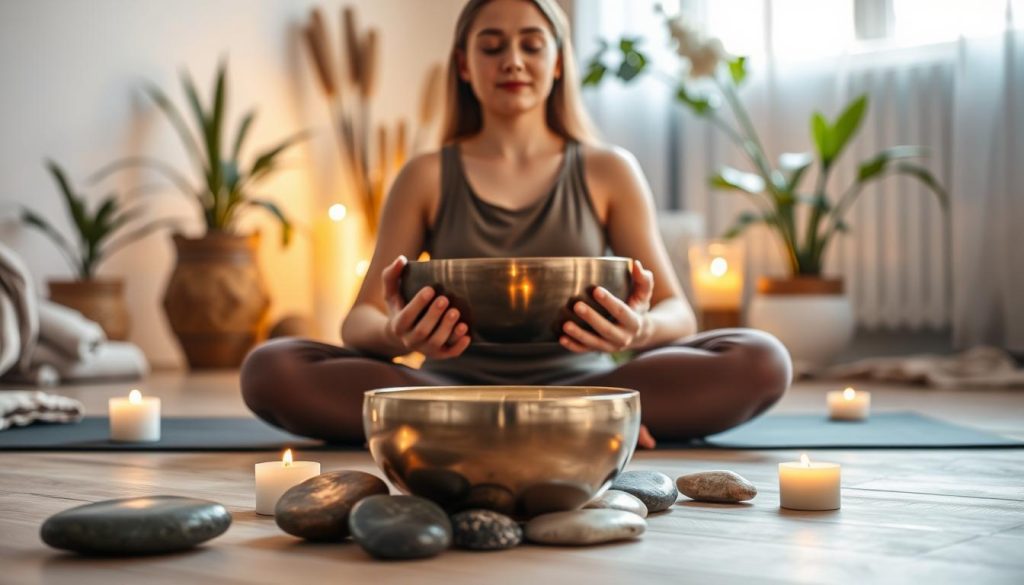
A steady grip transforms every vibration into a tangible sensation in the body. Holding the bowl is a major technical step. It determines the clarity of the sounds and the duration of their resonance.
The open hand
Place the instrument on an open hand, with your palm flat and fingers relaxed. This position avoids hard contact points.
A still hand stabilizes the instrument and lets you feel the vibrations for several minutes. It also helps you adjust the position according to the singing bowl’s size and weight.
Using a cushion
For a large or heavy bowl, use a dedicated cushion. The cushion protects the surface and allows vibrations to spread freely.
Avoid rigid surfaces that muffle the sound. Mastering the position of the hand and cushion makes every session more effective.
“Mastering the grip means feeling the music in your own body.”
| Element | Recommendation | Effect |
|---|---|---|
| Hand position | Open palm, relaxed fingers | Perception of vibrations and stability |
| Surface | Soft cushion | Prolonged resonance |
| Size and weight | Adjust the hand position or use a cushion | Sound duration in minutes |
Learning striking and rubbing techniques
Mastering contact and movement transforms each moment of sound into a space of calm.
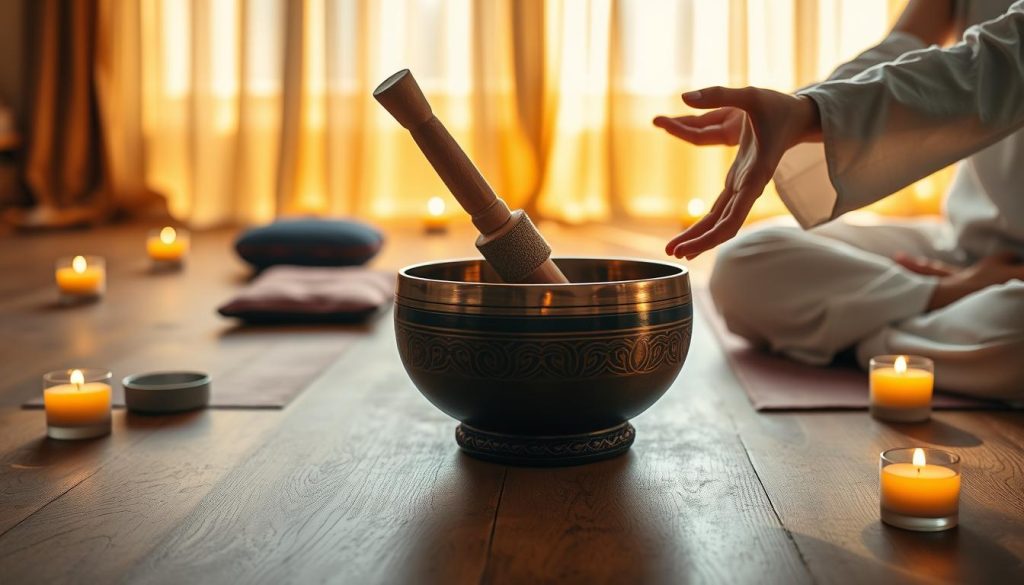
Striking involves gently tapping the bowl’s outer rim. This action immediately releases soothing vibrations. It creates a clear peak of sound that captures your attention.
Rubbing involves moving the mallet steadily around the bowl for several minutes to maintain a continuous, deep sound. This even movement promotes long-lasting resonance.
Both techniques reduce stress and promote relaxation. By focusing on the sounds, you free your mind from distracting thoughts. Your breathing calms and your body returns to a more stable state.
“Every moment spent with the instrument strengthens your ability to reach a lasting meditative state.”
- Begin with a gentle strike, then move on to rubbing for 2 to 5 minutes.
- Hold the mallet without tensing and maintain a steady movement.
- Repeat the practice regularly to amplify its effects.
| Technique | Recommended duration | Effects |
|---|---|---|
| Gentle strike | Instantaneous | Peak sound and focused attention |
| Continuous rubbing | 2 to 5 minutes | Long resonance and relaxation |
| Combined practice | 10 to 20 minutes | Better breathing and physical calm |
To progress, follow this user guide and adjust the duration according to how you feel.
Exploring variations with water and crystal
Adding water or using crystal profoundly changes how vibrations are perceived. Quartz crystal bowls, which appeared in the 1980s, offer a clearer, purer resonance than instruments made from metal alloys.

Using a bowl filled with water lets you see the vibrations: waves appear on the surface, making the experience perceptible. This is a simple technique for observing the effect of sound on body and mind.
The instrument’s diameter influences its frequency. Larger bowls produce lower vibrations. Sessions can last several minutes, allowing the resonance to settle in so you can fully enjoy the experience.
Seven-metal-alloy Tibetan bowls remain a benchmark for anyone seeking a rich, traditional resonance. Exploring these variations helps you choose the instrument best suited to your needs.
“Changing instruments means rediscovering the practice and refining your listening.”
For a progressive protocol that includes these options, consult our practical guide.
Incorporating sound therapy into your daily routine
Incorporating therapeutic sound into your daily life transforms short breaks into genuine moments of self-care. Regular practice helps manage stress and promotes better sleep through soothing vibrations.
A 10- to 20-minute session is often enough to experience benefits for your overall well-being.
Use your Tibetan singing bowl or another instrument three times a week and observe improvements in breathing and energetic balance.
Participants in group sessions report a successful return to calm at the end. This moment eases the transition back to daily activities.
“Regularity transforms a practice into a restorative ritual.”
- Short ritual: 10 to 20 minutes in the morning or evening.
- Stable posture and slow breathing.
- Weekly repetition for lasting effects.
| Duration | Frequency | Expected effect |
|---|---|---|
| 10 minutes | 3 to 5 times per week | Quick relaxation and better breathing |
| 20 minutes | 2 to 3 times per week | Energy balance and improved sleep |
| 30 minutes | 1 to 2 times per week | Greater well-being and perspective on stress |
Choosing the right bowl for your needs
Choosing a suitable instrument transforms every session into an effective and lasting experience.
To begin, consider its size and weight. A diameter between 15 and 20 cm is often suitable for beginners. It provides a good balance between ease of handling and vibration duration.
Traditional Tibetan bowls are made from a seven-metal alloy. The quality of the alloy influences the richness of the sound and the strength of its harmonics.
Weight generally ranges from 175 to 1,500 grams. A bowl that is too light lacks depth. A bowl that is too heavy tires the hand during practice.
Try several pieces and listen to their resonance for a few minutes. Then choose the one whose vibrations best match how you feel.
“A well-chosen instrument becomes a lasting companion in your practice.”
| Criterion | Recommended value | Impact |
|---|---|---|
| Diameter | 15 to 20 cm | Good vibration duration |
| Weight | 175 to 1,500 g | Depth and comfort |
| Alloy and metals | Seven-metal alloy | Rich harmonics |
Conclusion
Here are the keys to transforming short sessions into genuine moments of self-care. This article shows how vibrations and sounds promote relaxation and reduce stress.
Regular practice with this instrument creates a better balance between body and mind. A simple session improves breathing, sleep, and overall well-being.
My experience of more than twenty years confirms these effects and benefits. Make this inward return a ritual. Continue exploring sounds and vibrations to incorporate bowls into your wellness routine.