

Originating in the Himalayan mountain ranges, this instrument has long been used for well-being and personal development. It invites you to take a simple, profound sound break.
The question of how to practice often arises among those seeking to incorporate a bowl into their routine. Understanding its sonic signature helps improve the quality of every session.
Each Tibetan singing bowl emits a unique vibration. These sounds promote relaxation and make it easier to reach a state of calm. The bowls also help reduce tension accumulated during the day.
Incorporating a bowl into your routine creates a bubble of serenity. Used correctly, this ancient tool transforms the atmosphere and supports lasting meditation.
Origins and symbolism of Tibetan singing bowls
These sound-producing vessels appeared thousands of years ago and were initially crafted from wood or stone. The earliest traces date to around 5000 BC and bear witness to a very ancient craft tradition.
Originally, they were used by communities to store food. Then, with the emergence of metalworking, these objects acquired a ritual dimension. Shamans began using them to accompany incantations.
Over time, craftspeople refined their metalworking techniques. This care produced a rich, lasting tone. Today, many people seek this sound to reconnect with their inner selves.
The symbolism remains powerful across the Tibetan Arc—Tibet, Nepal, and Bhutan—where each example reflects knowledge passed down from generation to generation.
- Period of emergence: around 5000 BC
- Original materials: wood, stone
- Development: metalworking and ritual use
| Material | Historical use | Tone |
|---|---|---|
| Wood | Everyday containers and tools | Dry, clear |
| Stone | Practical objects | Low, muted |
| Metal | Rituals and offerings | Rich, resonant |
To explore their history and craftsmanship in greater depth, read everything you need to know about singing bowls.
Tibetan singing bowl meditation: how do you use it?
The resonance of a singing instrument often opens the way to immediate relaxation. A study published on September 30, 2016, involving 62 people, found a significant reduction in stress and signs of depression.
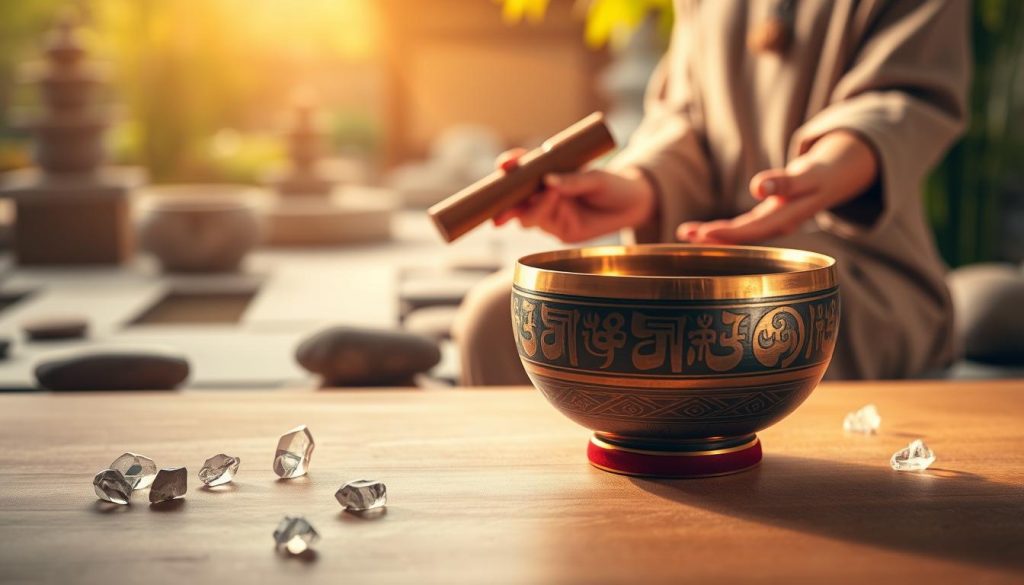
Observed benefits
Regular practice encourages the production of alpha waves, fostering deep relaxation and lasting well-being.
Singing bowls are used to restore harmony in the body: their vibrations pass through the tissues and help each chakra regain balance.
Tangible effects on the body
For example, vibrations may release energetic blockages and stored bodily memories. Many people report reduced insomnia and muscle tension.
“Anyone can experience an immediate soothing effect by listening to a high-quality tone.”
- Using a Tibetan singing bowl generates waves that promote a state of calm.
- Bowls are far more than decorative objects: they offer a genuine therapeutic effect.
- Regular practice makes it easier to reconnect with your deepest self.
Understanding the connection between metals, planets, and chakras
Each alloy is believed to preserve a correspondence between a metal, a celestial body, and an energy center. A traditional Tibetan singing bowl combines seven metals, each associated with a visible planet and a chakra in the human body.
Main associations:
- Gold = Sun → third chakra (solar plexus)
- Silver = Moon → second chakra (sacral)
- Iron = Mars → root chakra
- Mercury = Mercury → throat
- Tin = Jupiter → seventh chakra
- Copper = Venus → heart
- Lead = Saturn → structural influence
When these metals blend, their combination produces a unique vibrational note. This note resonates with the planets and helps align the chakras.
“Understanding this connection is far more than a theory: it is a method for harmonizing each energy center.”
| Metal | Planet | Chakra / Effect |
|---|---|---|
| Gold | Sun | Solar plexus—energy and willpower |
| Silver | Moon | Sacral—emotion and fluidity |
| Iron | Mars | Root—grounding |
| Mercury / Tin / Copper / Lead | Mercury / Jupiter / Venus / Saturn | Throat / Crown / Heart / Structure |
Criteria for choosing the right singing bowl
The ideal purchase begins with an impression: the sense that one bowl seems to call to you among all the others.
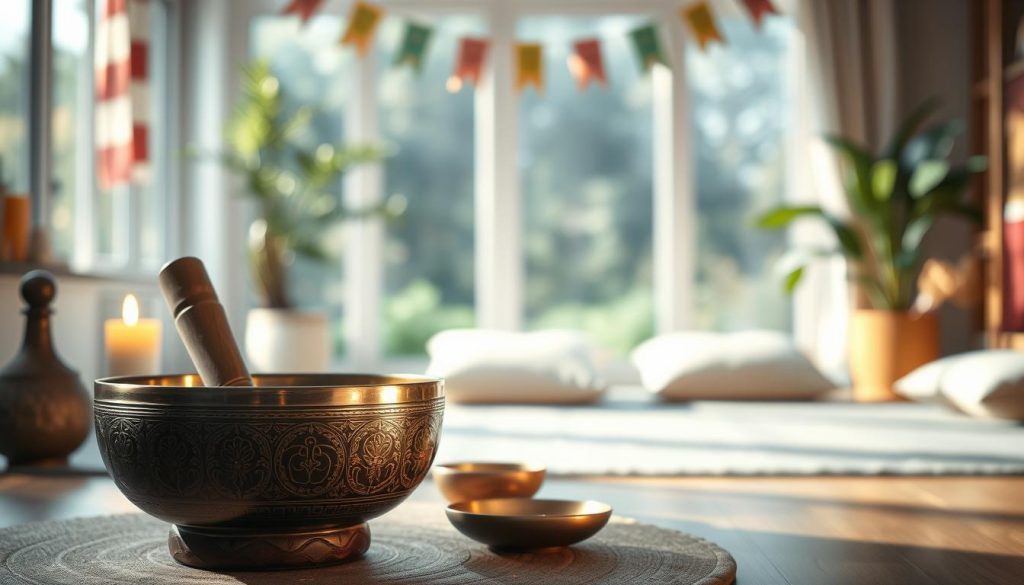
The importance of intuitive attraction
Trust your feelings first. Among several examples, the one that draws your attention often has the vibration best suited to your chakras.
Key points to check:
- The tone varies with size: small bowls are higher-pitched and correspond to the upper chakras, while large-diameter bowls offer low notes for the root chakra.
- Choose a high-quality alloy: many benchmark bowls combine seven metals, each linked to a planet and sometimes to a specific day.
- Test the bowl with a wooden or suede-covered mallet to hear its nuances and feel its effect on your body.
- Consider its appearance and handling: the tactile sensation affects your comfort and the relationship you will develop with the instrument.
“Every bowl is unique: its note changes according to the energy of the person playing it.”
In short, combine intuition with technical criteria. This quick guide helps you choose a singing bowl as a practice companion that will provide benefits suited to your energetic needs.
Preparing the space and adopting the ideal posture
Set up a dedicated, quiet corner to prepare for each sound session. Choose a cushion and a comfortable seated position, such as lotus or cross-legged.
Keep your back straight and your head aligned with your spine. This posture promotes optimal energy flow.
Place the Tibetan singing bowl beside you or on a stable support if you prefer not to hold it. Make sure the surroundings are free from disruptive noise.
Allow about twenty minutes for each session. Begin with a period of silence to relax the body and focus on your breathing.
If you are offering a sound massage, position the person on their stomach or back and make sure they are comfortable before you begin playing. Every instrument and its metals require special attention during setup.
By following these posture and space-arrangement guidelines, you maximize the session’s beneficial effects, whether for relaxation or a sound massage.
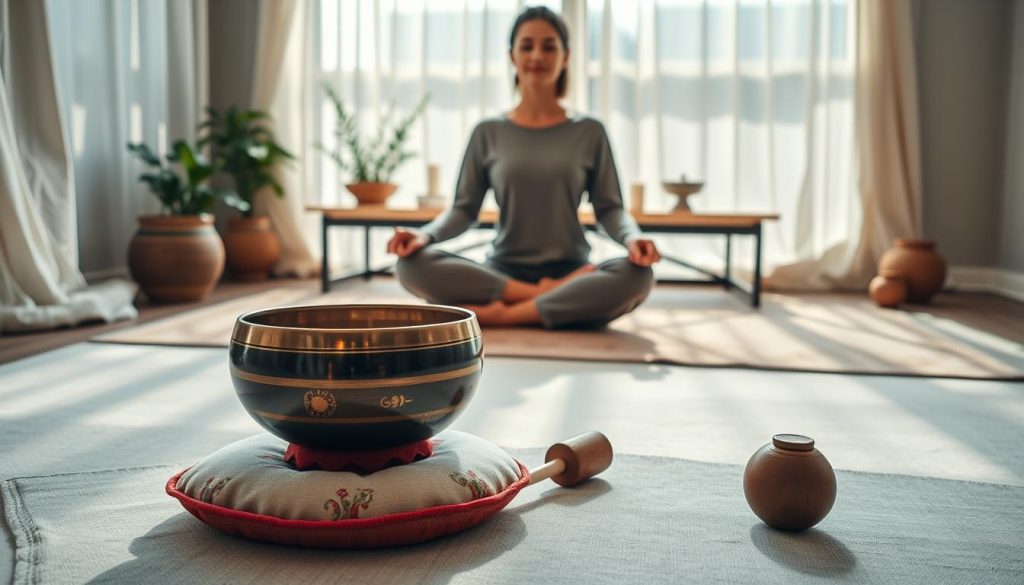
To explore the routine and best practices in greater depth, see this practical guide.
Mastering the striking technique
The precision of your movement determines the length and purity of the note produced. Hold the mallet by its end and gently strike the outer rim of the Tibetan singing bowl. Keep your hand open and flat so that you do not block the vibrations.
For a rich tone, strike the upper section near the rim. Avoid letting your fingers touch the side, as they would dampen the note.
Each bowl has a precise point on its side that produces a longer note when struck. The way you strike changes the pitch and sustain of the note according to the metal and size.
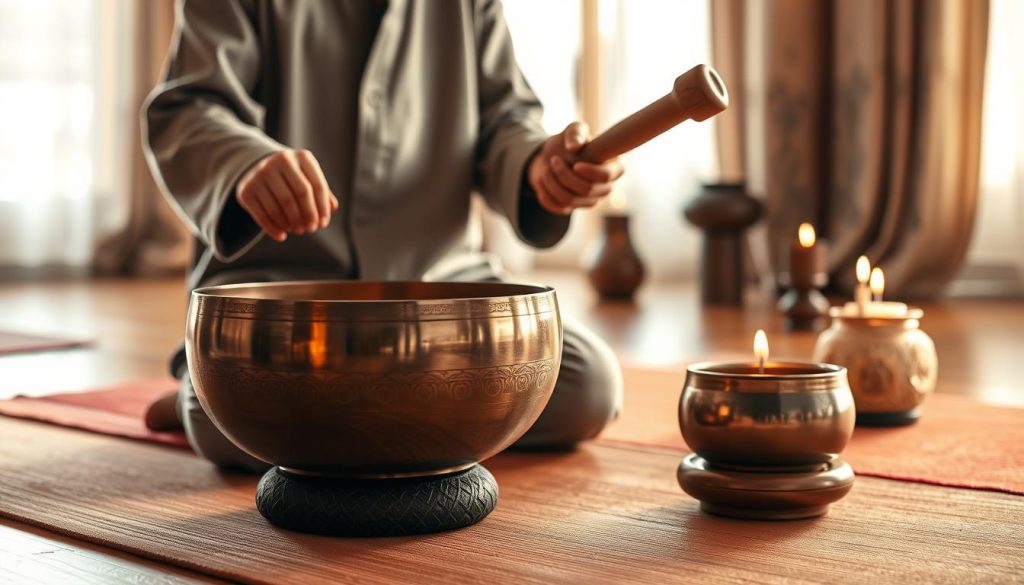
If you are offering a sound massage, strike once per area and wait for the sound to fade before continuing. This technique is perfect for beginners because it allows you to feel the vibrations and the singing bowl’s soothing effect quickly.
This technique requires time and patience, but it remains an essential foundation. To explore the striking technique and equipment selection in greater depth, read our guide.
Learning to make the bowl sing by rubbing it
The song produced through friction arises from a circular movement and controlled angle. This technique promotes stable vibrations and a sustained note.
To succeed, move the mallet in even circles around the outside rim. Never rub toward the inside of the bowl.
Choosing a wooden mallet
The wooden part of the mallet is recommended for beginners. The wooden side produces a higher-pitched tone and makes it easier to set the metal vibrating.
Maintain an angle of 20 to 30 degrees. Apply constant pressure and keep a steady speed until you obtain an even singing tone.
Using suede
Suede produces a much deeper, more enveloping sound. It is suitable for long sessions and gently stimulates each chakra.
With practice, vary the pressure and speed to target different chakras. Making the bowl sing then becomes automatic, allowing you to explore subtler notes and effects.
“A consistent movement transforms a vibration into a sustained song.”
To explore the striking technique in greater depth, follow progressive exercises and devote time to practice.
Variations for deeper sound relaxation
Explore sound variations that enrich relaxation and renew your practice. To intensify the vibrations and improve the session’s quality, occasionally fill your bowl with water: the liquid’s movement creates visual patterns that enhance the sonic effect.
Guided meditation is another effective technique. A practitioner leads the session and allows participants to let go effortlessly. Quartz crystal bowls, meanwhile, offer a different, rich tone favored by crystal-healing enthusiasts.
Varying your choice of instruments and position changes the experience: lying down with a bowl placed on the body enables a deep sound massage. Try these variations to find the one that brings you the greatest calm.
“Diversifying sound stimuli opens the way to deeper well-being.”
To learn more about a guided sound-massage session, follow this step-by-step guide. Incorporating these methods enriches the practice and multiplies its benefits for everyday balance.
Recommended frequency for regular practice
Prioritize consistency: five ten-minute sessions per week provide far more than a single one-hour session. This practice supports progressive chakra training and strengthens the relaxing effects.
Regularity maintains the tone and your sensitivity to vibrations. By making your instrument sing frequently, you improve the quality of its note and your connection to the benefits of sound.
Choose a suitable bowl, ideally made from seven metals, to ensure a rich harmonic range in every session. Adjust the frequency according to your energy and even the day.
To vary the effect, use the wooden side of the mallet to stimulate the upper chakras or the suede side to soothe the lower centers. Make this practice a pleasure, not an obligation.
“Short, repeated sessions are better than an occasional long session.”
To explore selection and practice in greater depth, read this comprehensive beginner’s guide.
Care tips for preserving the tone
A few simple actions are enough to preserve your bowl’s sound quality and alloy.
Always wipe it with a damp cloth. Avoid standing water, which encourages metals such as copper and iron to corrode.
If you choose a product such as white vinegar or lemon juice, test it on a small area first. This precaution prevents unwanted reactions with the patina.
Precautions and simple steps
Never leave the instrument in a damp room. Oxidation reduces the note’s clarity and alters its tone.
Avoid dropping it: a crack creates a discordant note and may render the bowl unusable.
- Making the bowl sing regularly maintains the patina and stabilizes the note.
- Keep the wooden side of the mallet dry to preserve friction quality.
- Store the instrument in a dry, ventilated place away from temperature fluctuations.
“A well-maintained bowl retains its pure note and intact vibrations.”
By caring for your Tibetan singing bowl, you extend its lifespan and the effect of every session.
Conclusion
To conclude this guide, remember that sound practice requires patience and active listening. A regular routine refines your technique and reveals the true tone of your Tibetan singing bowl.
This guide helps you choose a Tibetan singing bowl and master striking and rubbing techniques. Every instrument remains unique: experiment and adapt the frequency to your needs.
Practical offer: receive 10% off during your birthday month upon presentation of identification.
We hope this article has answered your question about using a singing bowl. Keep exploring to deepen your everyday well-being.