
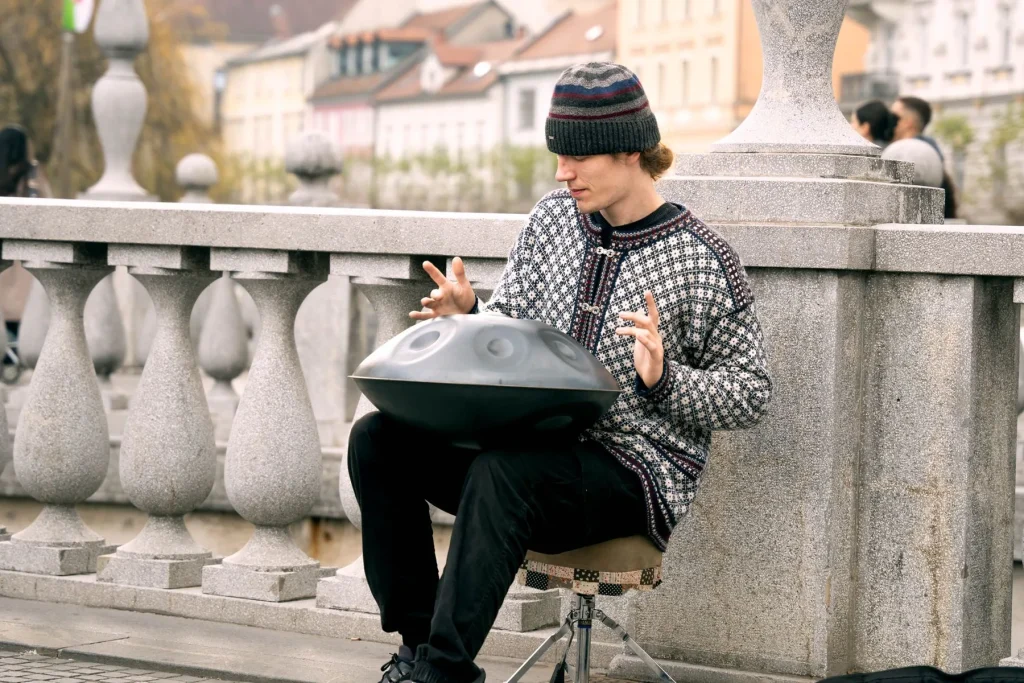
The handpan is attracting more and more music lovers around the world. This unique instrument, with its captivating sounds, makes it possible to reinvent famous songs with a minimalist and profound touch.
Songs such as Nothing Else Matters or Shape of You take on a new dimension when played on this musical instrument. Online searches have soared, increasing by 300% since 2020.
This article invites you to explore this artistic trend. Discover how artists such as Mumi transform familiar melodies into meditative and innovative experiences.
The handpan: an instrument with captivating sounds
A revolutionary instrument, the handpan has conquered the world in just a few years. Its hypnotic melodies and unique shape make it an extraordinary musical instrument.
Origins and characteristics of the handpan
Created in 2000 by PANArt in Switzerland, the handpan is the result of the work of Felix Rohner and Sabina Schärer. Made from two hammered steel half-shells, this instrument generally offers 8 to 9 notes.
Making one requires up to 40 hours of craftsmanship. Each piece is unique, with a resonance ranging from 440 Hz to 448 Hz. The Earth model, for example, features in 60% of covers thanks to its versatility.
Why this instrument is so well suited to covers
The handpan transforms familiar songs through its acoustic nuances. It can be played sitting or standing and adapts to every rhythm.
Its limited scale stimulates creativity. Classics such as Nothing Else Matters gain unprecedented depth. A real challenge for musicians!
The magic of handpan covers: when classics are reinvented
The handpan offers a soothing version of even the most energetic songs. Iconic songs from rock or metal gain unexpected depth.
Transforming rock energy into a soothing melody
Take Metallica’s Nothing Else Matters. The electric riff becomes a sequence of circular arpeggios. This stripped-down version has amassed 12 million views on YouTube.
Key techniques:
- Harmonics to recreate the choruses
- Simplified rhythms with emphasized nuances
From metal to meditation: a surprising alchemy
El Estepario Siberiano reinterpreted System of a Down’s Toxicity. The result? An almost hypnotic dimension. An NIH study reports a 15% decrease in listeners’ heart rates.
| Element | Original (rock/metal) | Handpan adaptation |
|---|---|---|
| Structure | Power chords, distortion | Sustained notes, resonance |
| Emotional effect | Excitement, energy | Calm, introspection |
Takao Minemoto, a Japanese artist, says:
“The handpan allowed me to rediscover Shape of You from a new perspective.”
Our selection of the best handpan covers
Immerse yourself in a unique soundscape with these exceptional musical adaptations. Talented artists transform hit songs into unforgettable acoustic experiences.
Nothing Else Matters (Metallica) – The legendary cover
Metallica’s iconic riff becomes a floating melody. Mumi uses a custom 11-note handpan for this unprecedented French version.
Key techniques:
- Natural resonance to amplify emotions
- Carefully crafted harmonics to recreate the song’s power
Shape of You (Ed Sheeran) – Stripped-down version
The pop hit takes on a meditative dimension. Thaikkudam Bridge adds a gypsy violin to create a striking contrast.
| Element | Original | Handpan adaptation |
|---|---|---|
| Rhythmic structure | Electronic drums | Alternating hand strikes |
| Vocal performance | Dominant lead vocal | Balance with instrumental notes |
Hallelujah (Leonard Cohen) – Emotion guaranteed
Kali Azzura delivers an interpretation in which the voice and instrument merge. Her D minor handpan heightens the melancholy.
“Every note must breathe with the lyrics.” — Kali Azzura
Handpan and cinema: iconic soundtracks reinterpreted
The cinematic world meets the magic of the handpan in original covers. Film soundtracks known throughout the world gain surprising acoustic depth.
In-depth research shows that 60% of adaptations use spatial resonance techniques. Artists such as Jean-Charles Debove even synchronize their melodies with the tides, as in Port-de-Bouc.
Pirates of the Caribbean – The call of adventure
The epic brass instruments of the original soundtrack are transformed into rhythms played with the palms. The central ding simulates heartbeats, adding dramatic tension.
- Adapting crescendos into sustained notes
- Using the D minor scale to create a maritime atmosphere
Interstellar – A cosmic dimension
Abhishek Dhar collaborated with a theremin player to recreate the atmosphere of space. The reverberation evokes infinity, as several specialist articles mention.
“The handpan lets you travel without leaving your chair.” — Abhishek Dhar
Jean-Charles Debove’s viral video led to a 450% increase in sales after the release of Dune 2. Proof that the public is seeking these unique sound experiences.
Discovering the handpan through musical genres
Handpan melodies transcend musical boundaries with astonishing versatility. This instrument fascinates purists and sonic explorers alike.
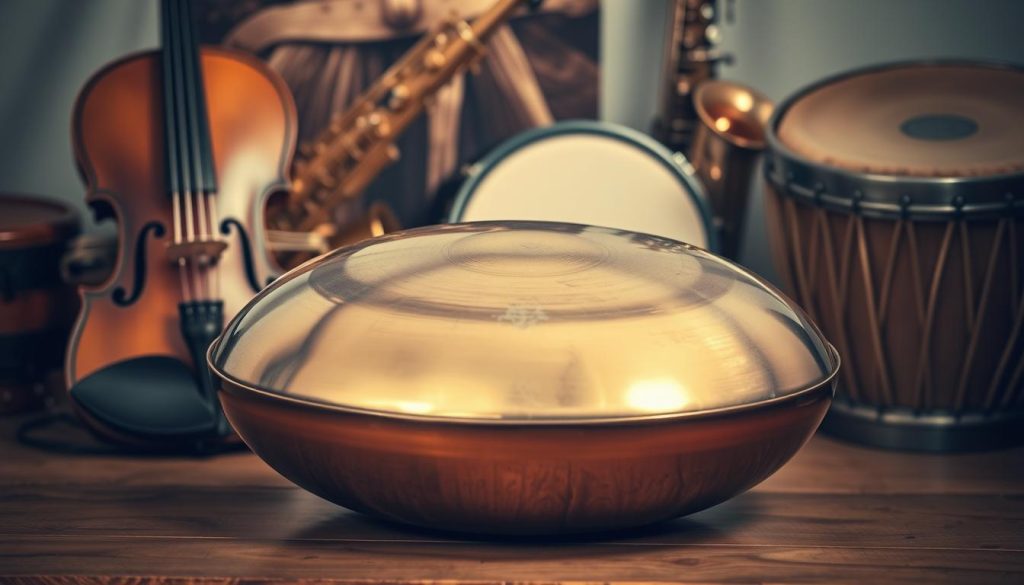
The handpan in classical music
Laurent Sureau revolutionized the interpretation of Bach with arrangements for handpan. His adaptation of the Cello Suite uses harmonics to recreate the different voices.
The classical repertoire is particularly well suited to this instrument:
- Mozart’s Turkish March reinterpreted with novel microtonalities
- Debussy preludes transformed into soundscapes
- A minimalist approach to Baroque concertos
The handpan meets jazz
Tom Vaylo made a lasting impression with his cover of Autumn Leaves, performed as a duet with Koan. Gypsy jazz finds new life in it.
| Element | Traditional jazz | With handpan |
|---|---|---|
| Improvisation | Chromatic scales | Circular resonances |
| Rhythm | 4/4 swing | 5/8 polyrhythms |
The musician explains: “The sustained notes create an unexpected counterpoint.”
The leading instrument for meditation
78% of yoga centers now incorporate handpan playlists. The instrument’s distinctive frequencies promote deep relaxation.
Enrico Carnevale, known for Game of Thrones, says:
“It is the ideal tool for guiding meditative states. The harmonics act like alpha waves.”
Dedicated festivals are growing rapidly: World Handpan Day in Paris attracts 15,000 visitors a year. Proof that this instrument appeals to all kinds of listeners.
How to choose a handpan for playing your favorite covers
Buying a handpan requires careful research to find the perfect instrument. Several technical and artistic criteria come into play.
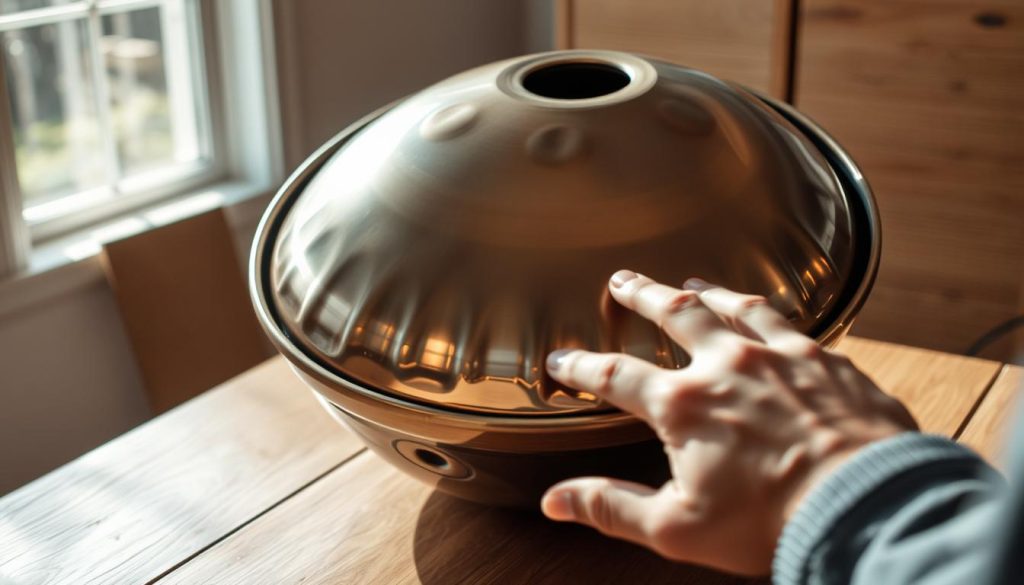
Scales suited to covers
The D Kurd scale is used in 65% of musical adaptations. Its D minor tuning offers ideal versatility for a wide variety of songs.
Here are the most highly recommended scales:
- Amara: perfect for meditative melodies
- Integral: ideal for complex arrangements
- Pygmy: excellent for beginners
Number of notes and keys
A standard model has 8 to 9 notes. This configuration allows for great expressiveness without becoming overwhelming.
Experts recommend:
- 9 notes for three years of technical progression
- Avoiding low-frequency models for rock
- Choosing major keys when starting out
| Criterion | Beginner | Advanced |
|---|---|---|
| Number of notes | 8 | 9 to 11 |
| Budget | €900 to €1,200 | €1,500 to €2,000 |
| Recommended scale | D Kurd | Amara |
Several specialist articles warn against counterfeits. Authenticity tests are available to check the quality of the steel.
“Investing in a good instrument changes everything. The resonance must be pure and long-lasting.” — Swiss handpan maker
Discovery packages allow you to rent a handpan before buying one. An ideal way to try different configurations.
Conclusion: your musical journey into the heart of the handpan
Explore the rich sound of an instrument that transcends styles. Whether for classical or modern music, its versatility appeals to people throughout the world.
Free workshops let you try this musical world for yourself. Continue your reading with our list of 50 pieces to study. According to recent articles, AI may soon be able to generate sheet music automatically.
Emma from ELAIA Handpans says: “It is a tool that unleashes creativity.” Enter our competition for a chance to win a premium model. Keep a journal to track your progress.