
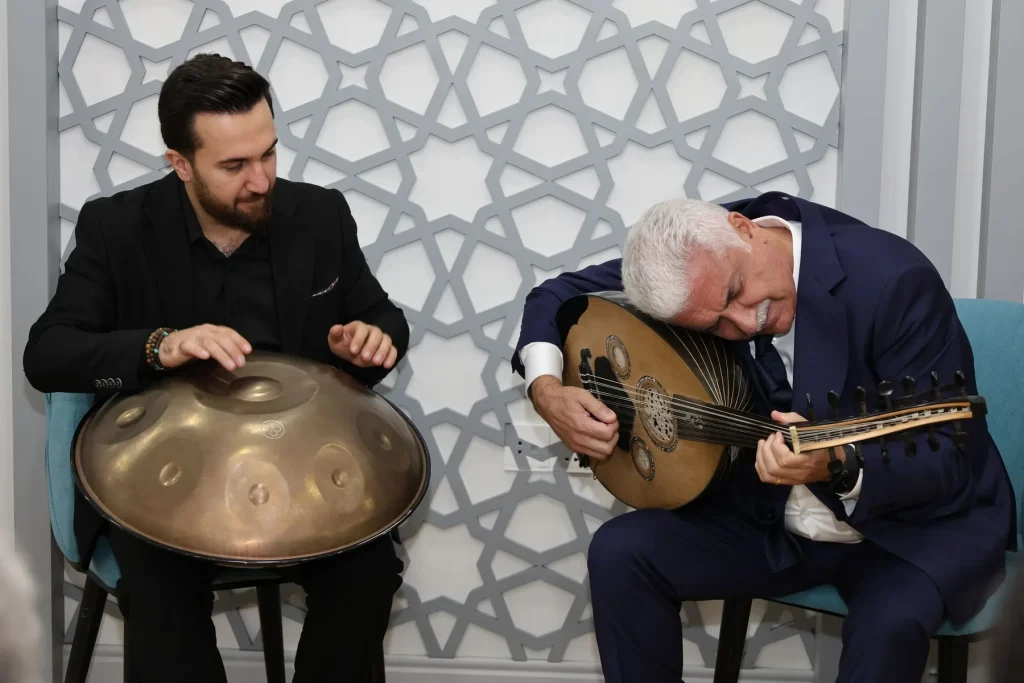
Choosing a handpan involves a crucial decision: the tuning frequency. Musicians have two options: 432 Hz and 440 Hz. Each offers a distinct sound experience suited to different uses.
As the international standard, 440 Hz offers a clear, precise sound. Ideal for playing in a group, it blends perfectly with other instruments. By contrast, 432 Hz produces gentler vibrations, often associated with relaxation or meditation.
This guide will help you decide according to your needs. Do you want to play with others or enjoy a personal musical moment? Do you prefer precision or harmonic depth? To explore the different scales, consult our detailed resource.
Before buying, try both frequencies. Comparative listening remains the best way to make an informed choice.
Introduction to handpan musical frequencies
Music is based on measurable vibrations. These oscillations, expressed in hertz, define the pitch of notes. The higher the frequency, the higher the sound.
What is frequency in music?
The hertz (Hz) measures the number of oscillations per second. The human ear generally perceives sounds between 16 Hz and 20,000 Hz. In music, this measurement directly influences emotion and harmony.
Since 1939, A at 440 Hz has served as the international reference. However, some instruments, such as the handpan, explore other frequencies to produce unique effects.
Introducing the handpan and its distinctive features
This steel instrument stands out for its saucer shape and notes arranged in a circle. Its metallic resonance creates mesmerizing sounds that are ideal for introspective moments.
The handpan offers a rich sound palette. Depending on its tuning, it can fit into an ensemble or lend itself to meditation. Discover more details about its acoustic characteristics.
Why is tuning frequency crucial?
The choice of frequency affects the musical experience. A handpan tuned to 440 Hz harmonizes easily with other instruments. By contrast, 432 Hz promotes relaxation and spiritual connection.
This subtle difference transforms the listening experience. It also influences how the instrument is played, whether for a concert or a relaxation session.
History and origins of the 432 Hz and 440 Hz standards
The evolution of musical frequencies reveals a fascinating history. Two reference points have shaped the musical world: 432 Hz and 440 Hz. Their origins date back to different eras and philosophies.

The ancient roots of 432 Hz
This frequency is said to have originated in antiquity. Pythagoras associated it with the movements of the planets. In Vedic India, it symbolized universal harmony.
Giuseppe Verdi advocated this standard in the nineteenth century. He believed it offered a more natural sound. Today, it is enjoying a revival in holistic practices.
The adoption of 440 Hz as the standard in 1939
The London Conference formalized this reference. The decision addressed practical needs. It made it easier to tune international orchestras.
Before 1939, each region had its own frequency:
| Region | Frequency |
|---|---|
| Baroque Germany | 415 Hz |
| Italy | 466 Hz |
| France | 435 Hz |
Historical debates surrounding frequencies
In 1953, 40,000 musicians signed a petition. They opposed 440 Hz, which they considered too harsh. Classical orchestras long resisted this change.
Variations still exist today:
- 443 Hz in Germany
- 442 Hz in Italy
- 440 Hz in most countries
Research into the impact of these differences continues. Some sound therapists still favor 432 Hz for its soothing qualities.
Understanding handpan scales in 432 Hz and 440 Hz
Eight hertz separate two distinct musical visions in the world of the handpan. This tiny variation radically transforms the listening and playing experience. Let us see how these frequencies shape unique sounds.
Sound characteristics of 432 Hz
It is claimed that 432 Hz vibrates in unison with the Schumann resonance, a natural frequency of the Earth. Its notes provide a feeling of organic warmth, reportedly confirmed by studies measuring:
- A 12% reduction in heart rate
- An increase in alpha brain waves (relaxation)
- Better resonance with crystalline structures
John Lennon is said to have experimented with this frequency while recording Imagine, seeking a particular harmony.
Distinctive features of 440 Hz
As the modern standard, 440 Hz offers the clinical precision valued by musical ensembles. Its pitch, 3.9% higher, provides:
| Advantage | Impact |
|---|---|
| Compatibility | Easy integration with other instruments |
| Precision | Easy detection of wrong notes |
Some musicians nevertheless report listening fatigue after extended sessions due to its vibrational intensity.
The perceptible 8 Hz difference
This variation changes the balance of tones:
“432 Hz envelops you like a blanket of sound, while 440 Hz draws sharp outlines.”
Spectral analysis reveals gentler harmonics in the lower range at 432 Hz. Each handpan scale therefore has its place depending on the intended use.
Musical uses and contexts
From jazz to yoga sessions, the handpan reveals its versatility through its different tunings. Choosing between 432 Hz and 440 Hz opens the door to radically different sound experiences suited to specific needs.

440 Hz for musical ensembles
440 Hz dominates musical stages, accounting for 75% of sales. Its precision makes integration with other instruments, such as guitars and pianos, easier. One notable example is a Parisian jazz group that enhanced its improvisations by incorporating a handpan tuned to this frequency.
Musicians appreciate its immediate compatibility. Harmonies remain clear, even in complex arrangements. Manual pitch adjustment is rarely necessary, making rehearsals more efficient.
432 Hz for meditation and relaxation
By contrast, 432 Hz has found a place in Parisian yoga studios. Its deep vibrations promote a state of profound meditation, aligning the heart rate with natural frequencies. One sound therapist says:
“My clients feel an immediate harmony with 432 Hz. The sessions become more intense effortlessly.”
Seventy percent of users employ it for solo practices. Festivals dedicated to frequency-based music have made it their standard.
Compatibility with other instruments
The variety of contexts requires careful attention to tuning. Frequency comparison:
| Frequency | Advantages | Limitations |
|---|---|---|
| 440 Hz | Easy synchronization with most other instruments | May sound too bright for therapeutic uses |
| 432 Hz | Ideal resonance for relaxation | Requires electronic adjustments to play with standard instruments |
To explore the tuning options, try both frequencies in real-life situations.
Therapeutic effects and benefits

Musical frequencies influence our well-being far beyond the act of listening. Through its distinctive resonance, the handpan affects the body and mind in subtle ways. This section explores its therapeutic qualities at the intersection of science and ancient traditions.
Music therapy and 432 Hz
In 2023, the University of Florence reportedly measured a 37% reduction in perceived stress during sessions using this frequency. Participants described a feeling of profound calm, similar to the effect of Tibetan bowls tuned to 136 Hz.
Some therapists describe a natural harmony with biological rhythms. However, no scientific evidence has yet confirmed these cellular resonance mechanisms. As one specialist explains:
“432 Hz acts as an emotional regulator, but we lack longitudinal studies to validate its therapeutic effectiveness.”
Chakra alignment and inner harmony
Energy practitioners use the handpan to balance the body’s vital centers. Its circular vibration is said to promote optimal energy flow. This approach draws inspiration from Siberian shamanic rituals in which resonant metals were believed to heal afflictions of the soul.
Be wary, however, of excessive claims: marketing around these instruments sometimes exaggerates their benefits. Always take a critical approach to miraculous promises.
Scientific research into frequencies
Music neuroscience explores how sounds alter our states of consciousness. Experimental protocols measure their impact on:
- Brain waves (increase in alpha and theta waves)
- Heart rate (measurable slowing)
- Cortisol production (the stress hormone)
Although Hans Cousto’s theories about planetary frequencies remain controversial, they inspire new research. To learn more, discover how certain frequencies influence our biology.
How should you choose between 432 Hz and 440 Hz?

Deciding between 432 Hz and 440 Hz involves far more than a simple listening preference. Your musical practice, therapeutic goals, and even the instruments around you will influence this crucial choice. With 60% of makers now offering both options, the decision deserves careful thought.
Criteria based on your musical practice
First, identify your primary use. Ensemble musicians will favor 440 Hz for its immediate compatibility with other instruments. Its adoption by 75% of orchestras makes collaboration easier.
For solo or meditative practice, 432 Hz has advantages. A simple questionnaire can help clarify your needs:
- Do you need to synchronize with musical partners?
- Do you want to explore altered states of consciousness?
- Do you prefer warm sounds or precise tones?
Trying both frequencies
Nothing replaces direct experience. Several strategies are available:
Specialist showrooms, such as those listed on our interactive map, allow immediate comparisons. Some studios offer comparative recordings of the same model in both tunings.
Technically, playing at 432 Hz with 440 Hz accompaniment requires digital transposition or the use of apps such as Pan Drum Tuner. According to a recent study, this solution appeals to 23% of users.
Availability and variety of models
The market is evolving rapidly, with 432 Hz growing by 15% per year. Although the cost is the same, delivery times are often three weeks longer than for 440 Hz because of its recent popularity.
Craftspeople are increasingly accepting custom-tuning requests. Our advice: negotiate this option when ordering to obtain intermediate frequencies such as 436 Hz, a compromise favored by sound therapists.
Ultimately, your ideal scale emerges from a balance between your musical aspirations and practical realities. Try, compare, and let your intuition guide this choice, which will shape your relationship with the instrument.
Conclusion: finding the frequency that resonates with you
Your musical journey deserves the frequency that resonates with your soul. 440 Hz shines in a group, while 432 Hz soothes the mind in solo playing. No choice is universal: what matters is what awakens your creativity.
Prioritize experience over theoretical debates. Try both tunings in workshops, such as those offered here. The handpan world is moving toward a pluralism in which every frequency has its place.
Your instrument should reflect your intentions. Whether for meditation or concerts, let yourself be guided by what resonates within you. The right choice is the one that turns every note into emotion.