
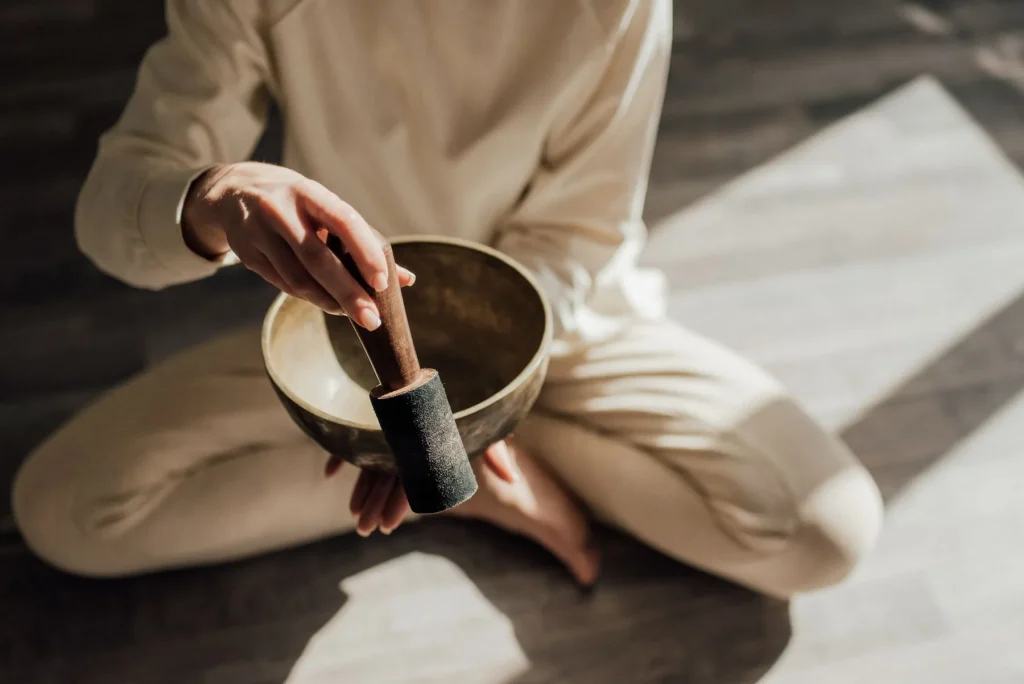
The right support changes everything. Drawing on more than ten years of experience using Tibetan singing bowls, the author explains why a stable support improves sound and well-being during meditation.
Placing an instrument directly on a hard surface creates unwanted noise and reduces the purity of its notes. A support absorbs unwanted vibrations and promotes concentration.
This practical guide explains how to choose a Tibetan singing bowl and its support to get the most from singing bowls. You will learn how to protect your instruments and harmonize each chakra through sound.
For detailed advice about support types and recommended dimensions, see our guide to choosing a singing bowl cushion. In practice, a good support ensures pure vibrations every time and enriches your wellness routine.
Why use a cushion for your Tibetan singing bowl?
The right support prevents interference and preserves the clarity of the vibrations. It creates a soft interface that limits unwanted noise when the instrument is struck or rubbed.
Acoustic stability
Acoustic stability is essential for producing pure sounds. A stable base prevents the bowl from sliding because of the vibrations and dispersing its sound energy.
Every note gains length and richness when the instrument rests on a surface that absorbs unwanted frequencies. This enhances rest and relaxation.
Protection from impacts
Using a support also protects against accidental impacts. A blow against a hard surface can crack the metal and damage the object.
Paying attention to where you place the instrument prevents slips that undermine the desired effect. For practical advice, see our guide to choosing a singing bowl cushion.
- Stability: the support ensures clear sounds without interference.
- Protection: it prevents impacts and protects the instrument.
- Resonance: vibrations are transmitted harmoniously, promoting relaxation and chakra balance.
Tibetan singing bowl cushion: what is it really for?
For every note to reveal its full richness, the instrument must rest on a base that respects its resonance.
Singing bowls have been used for millennia for their therapeutic and spiritual properties. The support plays a discreet but essential role: it isolates the instrument from the floor and prevents energy loss.
By limiting contact with hard surfaces, the base allows vibrations to spread freely. Notes gain sustain and clarity, improving the sound experience during relaxation or chakra work.
A good base respects the structure of the Tibetan singing bowl and does not alter its timbre. For high-quality bowls, choosing a suitable support preserves the purity of the sounds and the unique character of each instrument.
- Isolation: the base prevents interference and strengthens vibrations.
- Resonance: every note can develop for longer and with greater richness.
- Protection: contact is gentle and the metal remains protected.
The risks of using no support
Without suitable support, the instrument may slide and its sound quality can immediately deteriorate. A fall can irreparably crack or deform a Tibetan singing bowl and compromise its timbre.
Direct contact with a hard surface generates unwanted noise. These sounds disrupt concentration and prevent the deep relaxation required for meditation.
During sound massages, stability is crucial: without it, the vibrations collide with the floor and provide fewer benefits to the body.
- Risk of irreversible damage to the instrument and loss of note purity.
- Loss of concentration: attention focuses on the fear of a fall, creating stress.
- Massage and relaxation sessions may be less beneficial to well-being.
| Risk | Effect | Quick solution |
|---|---|---|
| Fall | Cracking, deformation | Use a stable, nonslip support |
| Unwanted noise | Loss of sound clarity | Place the instrument on an insulating base |
| Instability during a session | Stress and reduced concentration | Check the position and technique before every use |
The different types of support available
Every type of support colors the instrument’s resonance and its effect on the chakra. The main options are rings, padded models, and thin mats.
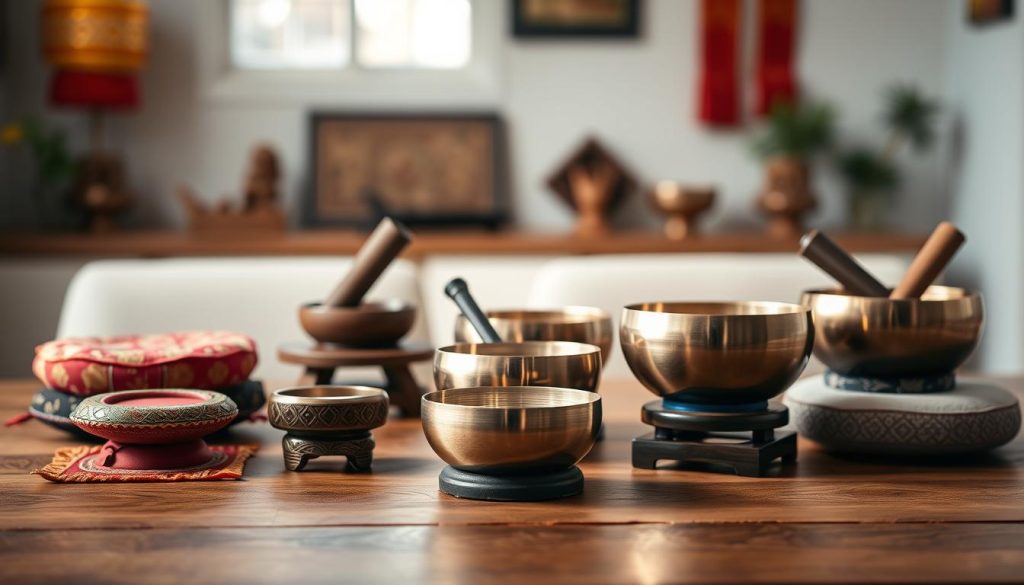
Doughnut-shaped rings stabilize the singing bowl and promote a clear note.
Padded models provide comfort and protection. They work well with metal bowls and are available in cotton or silk. Silk remains more expensive, but it provides a refined appearance.
Mats, which are often thinner, allow the resonance to spread more widely. Some bowls are better suited to this type of support, which allows the harmonics to propagate more effectively.
- Variety: from understated mats to decorated supports, every item has its own character.
- Suitability: choose the support size according to your bowl to ensure stability.
- Respect: the choice also reflects the care given to these sacred instruments.
A closer look at the ring-shaped cushion
The padded ring transforms how the instrument is held and immediately improves sound clarity.
Advantages of the doughnut shape
The doughnut shape is the most common type of support for a Tibetan singing bowl. It centers the instrument and reduces unwanted contact points.
Follow this simple rule: the ring’s diameter should be 85% of the diameter of your instrument. This supports the piece without compressing it.
- Optimal support: the ring prevents slipping and protects the material.
- Preserved resonance: every note can vibrate freely, which is useful during chakra work.
- Durability: this type of support extends the life of your singing bowl while remaining attractive in a meditation space.
“A well-chosen support makes all the difference to sound quality.”
Choosing this ring is a sensible investment for protecting your instrument and fully enjoying the benefits of singing bowls.
The distinctive features of padded cushions
Padded models showcase the instrument while providing gentle protection.
Various shapes: they may be round or rectangular. Some feature decorative tassels at the corners and beautiful embroidery.
Appearance and function: these supports provide a traditional presentation for your Tibetan singing bowl and are ideal for display. Their thickness can sometimes slightly soften the note produced.
The padding affects the transmission of vibrations. Cotton gives the timbre more warmth, while felt restrains the harmonics a little more.
Practical protection: every singing bowl benefits from a soft base that prevents scratches and extends the instrument’s life.
- Balance: large bowls sit more securely and make chakra work easier.
- Stability: choosing a support slightly larger than the bowl ensures secure support during prolonged use.
- Functional beauty: these models combine decoration and practicality for singing bowls.
Using a mat for better resonance
A thin mat changes how every note travels through the room. Lightweight and easy to carry, it provides a subtle alternative that respects the purity of the sound.
The mat’s limited thickness reduces damping and promotes the transmission of vibrations. This increases the note’s length and clarity, which is useful in meditation and sound massage.
The designs, often inspired by Buddhist symbols such as the flower of life, add an attractive touch while remaining practical for transport. A mat is recommended for those seeking a clean sound during their practice.
- Pure resonance: the vibration travels without being muffled.
- Mobility: ideal for traveling sessions and workshops.
- Concentration: a stable base that reduces stress and improves concentration.
This guide recommends a mat for sound-massage practitioners and for any wellness-focused use. It enables precise work on every chakra and helps the mind achieve lasting relaxation.
| Feature | Effect on resonance | Practical advice |
|---|---|---|
| Very thin | Maximum transmission of vibrations | Choose an unpadded model |
| Symbolic designs | Visual comfort and tradition | Prioritize fabric quality |
| Lightweight | Easier transport to workshops | Carry it in a protective case |
To enhance your practice and discover playlists suited to relaxation, see our handpan music selection.
The special use of a rubber ring
Minimal support can transform an instrument’s stability and tonal quality.
The rubber ring, often called an O-ring, is ideal for flat-bottomed crystal bowls. It creates a small contact point. The vibration therefore avoids the hard surface and retains its purity.
Recommended size: the O-ring should measure approximately half the bowl’s diameter. This proportion stabilizes the object without compressing its base.
This type of support is also suitable for Tibetan alloy bowls, although traditional padding is often preferred for metal. Rubber protects against irregularities and limits direct contact.
In practice, the ring provides stability for heavy crystal singing bowls. It demonstrates a detailed understanding of each instrument’s needs and keeps it secure during sessions.
| Use | Advantage | Advice |
|---|---|---|
| Crystal bowls | Minimal contact and pure sound | Choose an O-ring approximately 50% of the diameter |
| Alloy bowls | Possible stability | Test with and without padding |
| Rough surface | Protection from irregularities | Choose soft rubber |
Why display stands should not be used for playing
Decorative stands are designed for display, not sound performance. Their solid wood blocks vibrations and creates unwanted noise. This alters the quality of the note and interferes with listening.
Do not play on these supports: their rigidity encourages impacts and increases the risk of a fall. Your instruments deserve a base that lets the resonance develop during chakra work or a relaxation session.
Display stands are perfect for showcasing pieces. They remain purely decorative. Reserve them for display when you are not using your Tibetan singing bowl.
Practical advice: always choose a soft, stable base for playing. This protects the instrument and optimizes the sustain.
| Problem | Effect | Solution |
|---|---|---|
| Rigid structure | Unwanted noise, loss of clarity | Use a suitable, soft support |
| Instability | Falls and damage | Place the instrument on a nonslip base |
| Decorative use | Prevents natural resonance | Reserve the stand for display |
Why suction cups are useful to therapists
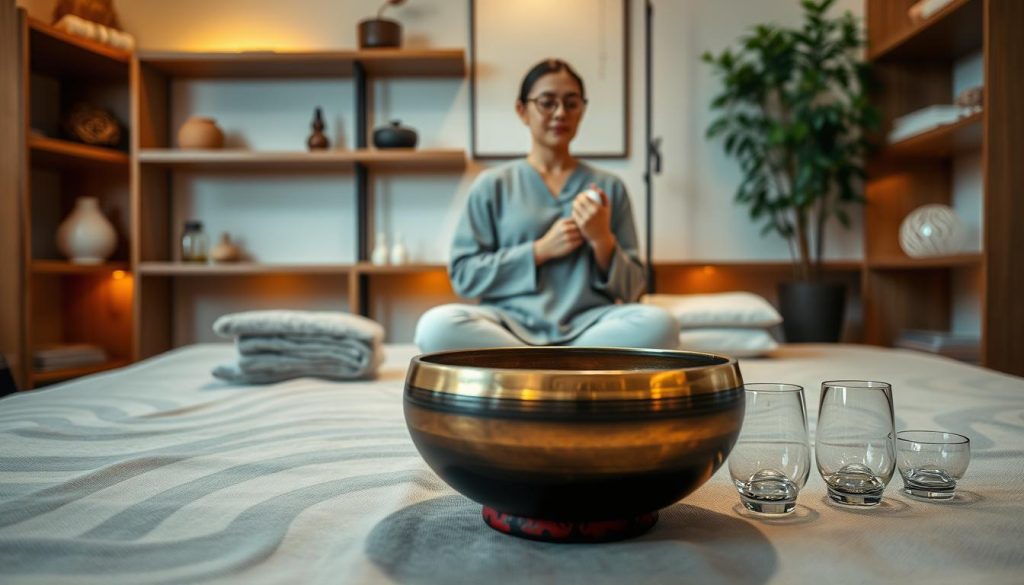
A suction cup provides precise control of the support, allowing sound waves to be directed toward a specific area of the body.
Used by practitioners, it makes it possible to lift the Tibetan singing bowl with one hand and direct the instrument toward a precise point. This technique facilitates targeted sound massage and concentrates vibrations on sensitive areas.
The practitioner can therefore work on specific chakras. The movement enhances relaxation and helps release stress and tension from the body. This produces more personalized treatment suited to each person’s sensitivity.
This method requires great care. Every note and vibration must be adjusted to preserve the patient’s comfort and concentration.
- Precision: directs vibrations toward a point on the body.
- Mobility: allows the bowl to be moved easily during the massage.
- Professionalism: improves the effects and well-being provided by sessions.
| Use | Advantage | Advice |
|---|---|---|
| Targeted direction | Vibrations concentrated on the chakra | Control the distance and angle |
| Moving treatment | Dynamic, precise massage | Practice the technique before the session |
| Individual session | Increases relaxation and concentration | Adapt the intensity to the person |
Criteria for choosing the right accessory
The choice of padding determines the stability and precision of every strike.
Padding quality
Choose dense padding that retains its shape. Firm support prevents the bowl from “floating.”
Overly soft support reduces the note’s sustain. Choosing padding suited to the instrument optimizes the sound’s duration.
Natural materials
Materials such as cotton and felt transmit harmonics more effectively. They respect the bowls’ energy.
For practitioners, using natural fibers protects the instruments’ resonance and longevity.
Appearance and symbolism
Appearance matters. Sacred designs or mantras add a ritual dimension.
Check the size and weight to ensure the support is compatible with the Tibetan singing bowl and your practice.
- This article details the essential criteria for choosing a Tibetan singing bowl and its support.
- Instruments require natural materials for authentic resonance.
- Appearance enriches their use, especially during chakra work.
Matching the support to the size of your instrument
Choosing a custom-sized support protects the instrument and releases its full sonic richness.
The support’s diameter must suit that of the bowl. An overly large base allows the object to move and reduces its stability.
Conversely, a support that is too small creates pressure points. The balance is disrupted and the note loses sustain.

Large bowls need a robust base to transmit deep vibrations to the body. Small bowls are better suited to thin rings that center the instrument.
During a sound massage, stability prevents any imbalance while striking. Energy therefore flows more effectively and the treatment becomes more precise.
- Proportion: adjust the support’s diameter to approximately 85% of your bowl’s diameter.
- Material: dense padding provides stability without muffling the note.
- Setup: check the support before every session to ensure a smooth experience.
To learn more about choosing and using one, see our beginner’s guide.
Common setup mistakes
Setting up an instrument without care often produces unwanted vibrations and a loss of sustain.
Do not grip the object in your hand. Holding it too tightly blocks the resonance and prevents the note from developing.
Avoid placing your bowl on an unstable surface. A wobbly base causes noise and slipping and may damage the body of the instrument.
This mistake makes even the best striking technique ineffective. If the item is not centered properly, sound quality decreases.
- An incorrect hand position muffles the sound.
- Unprotected hard surfaces damage the metal or structure.
- Poorly matched supports generate unwanted vibrations for the practitioner and those nearby.
“Learning to set up your instrument correctly is essential to mastering sound therapy.”
To explore the practice in greater depth and choose a suitable support, see our guide to everything you need to know about singing bowls. Proper positioning protects the body of the instrument and optimizes every session.
Integrating the support into meditation rituals
Beginning and ending a session with a precise sound helps the mind enter and leave meditation. Placing your instrument on a stable base creates a focal point for concentration.
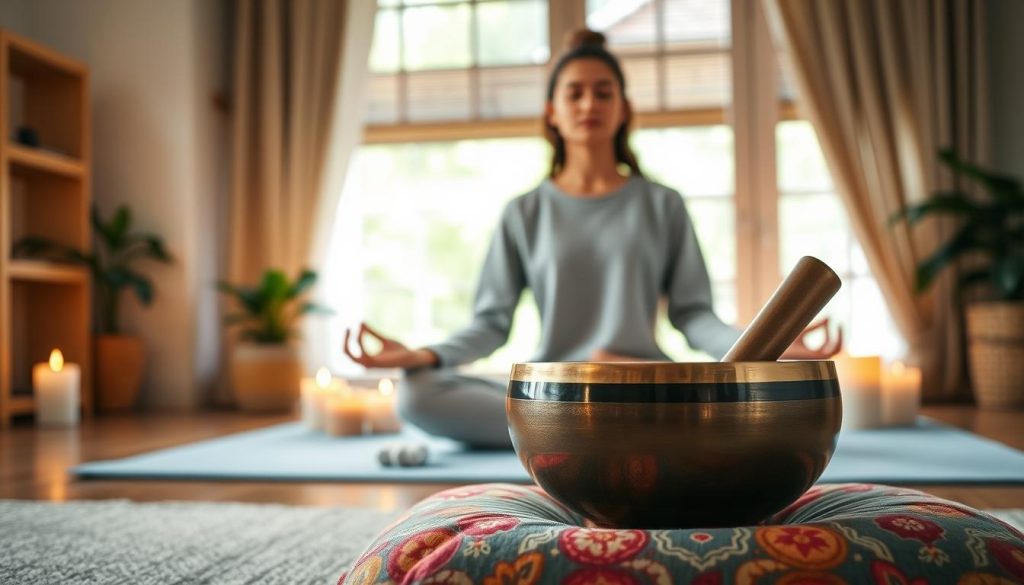
Use sound to mark transitions: one gentle strike at the beginning and a final signal at the end. This routine promotes deep relaxation and helps stressed people regain calm and well-being.
Engraved mantras are activated by vibration. When you strike the instrument, the inscriptions awaken and reinforce the benefits of the practice.
The support then becomes more than an accessory: it structures the session. It facilitates a sound massage that soothes the body and calms the mind. The position of the object on its support prepares the body to receive the calming effects.
- Grounding: mark the beginning and end of meditation to improve concentration.
- Harmonization: the sounds help with chakra work and release tension in the body.
- Simple practice: a repeatable technique that turns your instrument into a guide for relaxation.
“A regular sound ritual increases the reach of the sounds and consolidates their relaxing effect.”
Tips for maintaining your sound-therapy accessories
Regular maintenance extends the life of your instruments and preserves their original timbre. Always clean their surfaces with a soft, dry cloth after every session.
Avoid prolonged contact with water for metal pieces: moisture promotes corrosion and impairs their sonic benefits.
For deeper cleaning, apply a little white vinegar or lemon juice to a cloth. Rub gently, then wipe immediately to prevent oxidation.
- Storage: keep accessories in clean cases to prevent dust and maintain the instruments in good condition.
- Supports and textiles: shake and air the supports to prevent dirt from accumulating.
- Mindful cleaning: caring for the tools strengthens the energy during meditation and massage.
Simple maintenance reduces the stress associated with use and helps the body and mind enjoy relaxation fully. To enrich your practice and discover additional sound exercises, see this handpan tutorial.
“Gentle cleaning honors the instrument and improves every sound-massage session.”
Conclusion
Choosing the right support turns every session into a richer, more stable sound experience.
This article shows that using a suitable support protects your Tibetan singing bowls and optimizes their benefits. The right base prolongs the vibrations and improves the quality of the timbre.
Practicing regularly with a suitable accessory helps reduce stress and promotes deep, serene meditation.
Investing in a quality support is a gesture of respect for your instruments. It ensures their durability and effectiveness during future sound-therapy sessions.