
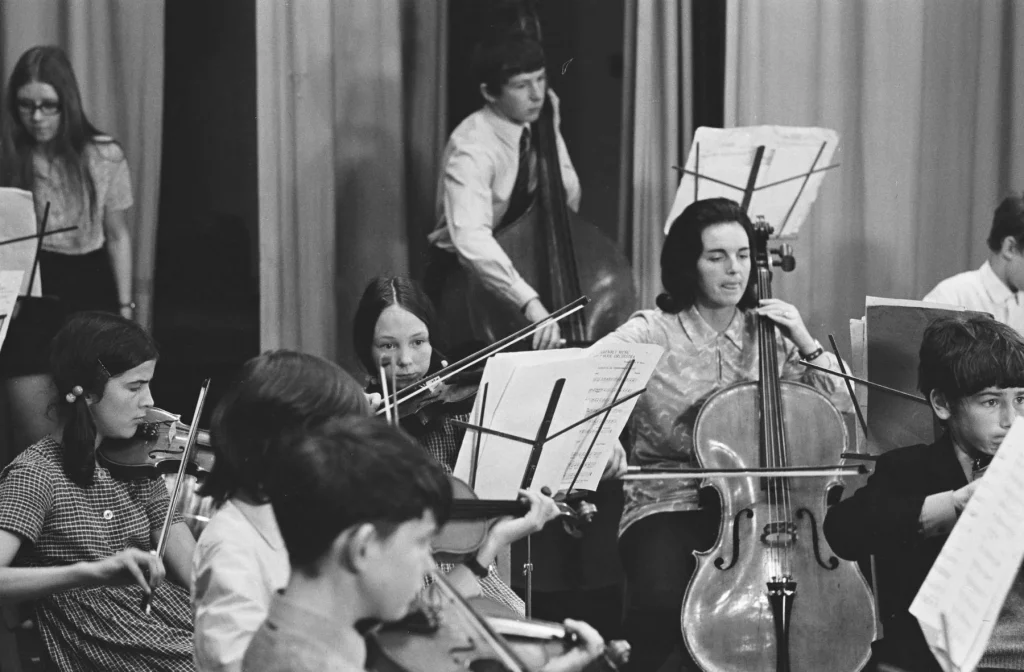
The world of classical music long overlooked women conductors. But thanks to certain women, the field has changed. They have shown that conducting is not reserved for men.
This article explores their important role and the challenges they have overcome. You will also discover their contributions to the evolution of classical music. For more information, read this article about influential women conductors.
An overview of the history of women conductors
The history of women conductors is rich with pioneers who broke down barriers. Since the nineteenth century, women such as Augusta Holmès and Nadia Boulanger have exerted a notable influence. They paved the way for new generations.
Pioneers in the nineteenth century
The first women musicians faced many challenges. They had to fight prejudice and discrimination. Despite this, they created opportunities for other women.
Their talent was recognized, but they encountered obstacles. Lack of recognition and isolation were their main challenges. Their journeys laid the groundwork for future women musicians.
The challenges faced by women musicians
Today, women musicians working as conductors face many challenges. A recent study shows that only 4% of conductors in France are women. This shows how persistent the difficulties remain.
Despite this, more and more women are emerging. Their history has been marked by obstacles, but their determination is admirable.
To better understand the situation, it is important to consult a variety of sources. The work of experts such as Yannick Nézet-Séguin helps bring visibility to these artists. It provides a platform for their history.
The most influential women conductors
The world of conducting has seen many talented women. They have broken down barriers and proved their worth. Their journeys have been marked by challenges and a quest for recognition.
Marin Alsop: a pioneer in conducting
Marin Alsop changed the landscape when, in 2005, she became the first woman to lead a major American orchestra, the Baltimore Symphony Orchestra. She opened doors for women in classical music. Her leadership and commitment to equality inspire new generations.
Eun Sun Kim: the first woman to lead San Francisco Opera
Eun Sun Kim made headlines by becoming the first woman to lead San Francisco Opera. This was an important milestone, despite anti-Asian racism. Her talent and commitment are helping to diversify conducting and challenge stereotypes.
Debora Waldman: her impact in France
Debora Waldman made her mark on the music world in France by becoming music director of the Orchestre d’Avignon-Provence. She promoted classical music and made it more accessible in France. Her fresh perspective on classical works enriched musical culture and strengthened women’s leadership in the field.
How conducting statistics have evolved
Statistics show that women are gaining ground as conductors. However, major inequalities persist worldwide. These figures help us understand how roles are evolving and how women’s position is improving.
Recent SACD figures
The SACD recently reported an increase in the number of women conductors. Their share rose from 5.9% to 7.9% between 2020 and 2022. This indicates progress, but much remains to be done to achieve gender balance in orchestras.
International comparison: France’s position
In an international comparison, France ranks seventh, with 10.5% of conductors being women. Belgium and Norway have much higher rates. This shows that France must do more to promote gender parity.
Progress and persistent obstacles
Despite the progress made, significant challenges remain. Women’s representation is particularly low in Germany and Italy. Opportunities must be created and stereotypes challenged to encourage more women to conduct orchestras.
The role of women conductors in the world of classical music
Women conductors play an essential role in the evolution of classical music. They do more than conduct concerts. They also help bring recognition to often-overlooked women composers. By reviving their works, they enrich the musical repertoire.
Their contributions to the visibility of women composers
Marin Alsop and Simone Young paved the way for future generations. They show that talent is not determined by gender. Their efforts have increased the presence of works by women composers in orchestral programs. The “La Maestra” competition is an example of support for women conductors.
Inspiration and motivation for new generations
Women conductors inspire and motivate young women musicians. They show that it is possible to build a brilliant career, even in a challenging field. Orchestras such as the Toronto Symphony Orchestra reinforce this commitment to young artists. Their determination helps create a more open and inclusive musical culture.
| Period | Percentage of women conductors | Impact on the visibility of women composers |
|---|---|---|
| Nineteenth century | 10% | Limited |
| Early twentieth century | 15% | Emergence of figures such as Nadia Boulanger |
| 1960s | 25% | Growing recognition |
| 1980s–1990s | 30% | Persistent prejudice |
| Today | 45% | Reduced disparity thanks to targeted initiatives |
Conclusion
Women conductors have made great progress in recent years. This reflects positive change in classical music. Their influence shows that expectations are evolving and that the orchestral world is becoming more open to young talent.
Despite the challenges, their success points to a more diverse and equitable future for classical music. It is essential to support these women in leadership positions. Their presence enriches music and encourages young people to pursue their dreams.
The road to equality is long, but every step forward matters. This summary shows the growing importance of women conductors. They are transforming music and creating new possibilities for those who wish to enter the music world.
FAQ
What are the main contributions of women conductors to the world of classical music?
Where does France rank in terms of orchestras conducted by women?
Who are some of the most influential women conductors?
Are there any recent statistics on women in conducting?
What initiatives support women conductors today?
Source links
- https://apnews.com/article/female-conductors-lyniv-scappucci-alsop-zhang-met-89843777061845e1975223bb2de17f36
- https://peabody.jhu.edu/faculty/marin-alsop/
- https://research-repository.uwa.edu.au/en/publications/economics-of-visibility-the-gendered-body-on-the-orchestral-podiu/
- https://ggpaa.ca/celebrations/gg2025-program_eng_final_250702.aspx