
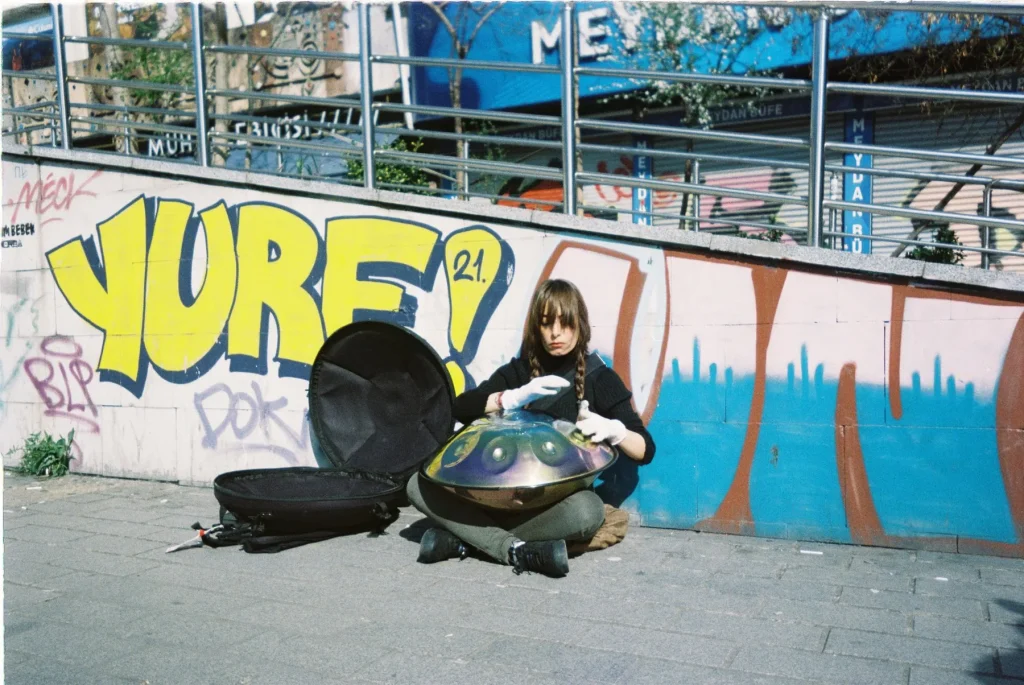
The handpan is much more than an instrument: it is a voice through which you can express unique emotions. This article guides you beyond the basics so you can develop a personal musical expression. You will discover how to play with greater fluidity and creativity.
Whether you play a D Kurd model or an uncommon scale, the techniques vary. Resources such as Thierry Bleton’s videos or specialized sheet music will help you progress.
We will cover 10 key topics, from complex rhythms to melodic improvisation. Ready to transform your playing? Let’s begin.
Introduction to the handpan and its melodic potential
Part percussion and part melody, the handpan offers an unrivaled sound palette. This instrument, made from two hammered steel shells, produces both rhythms and harmonies. Its acoustic mechanism, based on a hemispherical cavity, gives it deep resonance.
What is a handpan?
The handpan emerged from the evolution of the Hang drum in the 2000s. Unlike traditional percussion instruments, it lets you layer notes to create complex melodies. According to ZenaPan, 70% of models are tuned to D minor, an ideal scale for beginners.
- Construction: nitrided steel for optimal durability.
- Playing: it can be played with the fingers or mallets to vary the textures.
- Comparison: more intuitive than a steel tongue drum for harmonic sequences.
Why work on melodic techniques?
92% of musicians say that mastering striking techniques improves their expressiveness. Thierry Bleton emphasizes:
“The handpan reveals itself when you explore its nuances, not just its rhythms.”
Choosing a suitable scale, such as the Hijaz mode, can transform the way you play the handpan. Melodic exercises also develop your musical ear, which is essential for improvisation.
The fundamentals: posture and instrument position
Good posture is essential for getting the best sound from your handpan. It directly affects resonance and playing comfort. Here is how to optimize your position for a harmonious result.
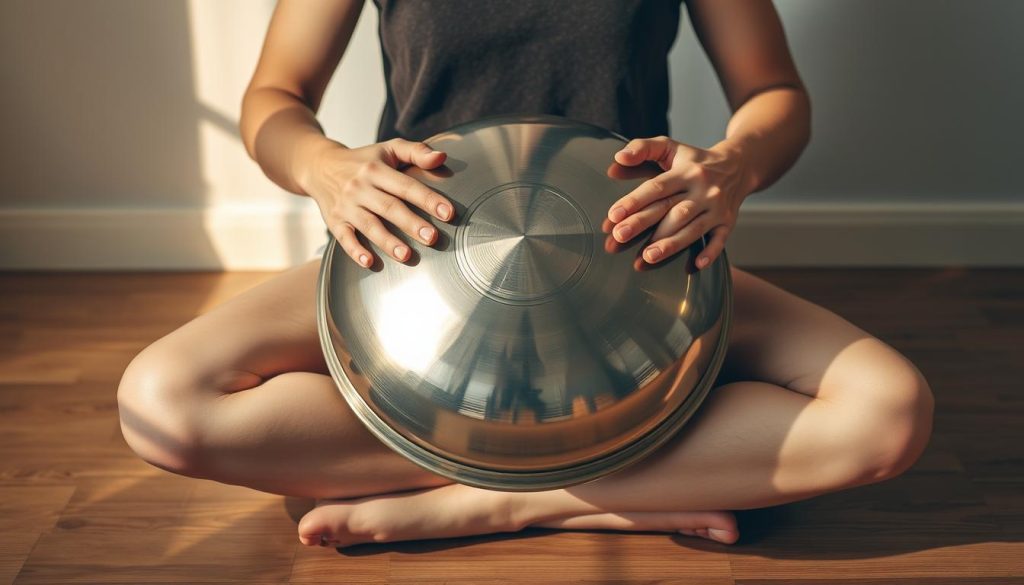
Optimal position for resonance
Place the instrument on your thighs at a 30° angle. This tilt allows the notes to travel freely. Keep your free hand 5 cm above the surface to avoid muffling the sound.
Try three different positions to compare their resonance. Proper positioning amplifies the intensity of the sounds produced. Use an adjustable stand or acoustic cushion if necessary.
Hand and finger placement
The secret lies in the way you use your fingers. Find the ideal “contact point” for each note with your fingertips. This ensures a precise, clear strike.
- Sustain a note for 8 seconds without unwanted noise.
- Adjust your posture if you are left-handed to achieve better balance.
- Avoid unnecessary tension in your shoulders.
According to ZenaPan, room temperature can affect how the instrument is held. An environment that is too cold reduces freedom of movement.
“Ideal posture frees the sound, not the body.”
Mastering essential striking techniques
The precision of your strikes defines the soul of your performance. A methodical approach unlocks the instrument’s full sonic potential, from delicate nuances to powerful accents.
The fingertip touch
Your fingertips act as an intermediary between your intention and the sound. A 30° strike, known as a tap, produces a clear tone that is ideal for airy melodies. To strike notes accurately, keep your nails short and use the pads of your fingers.
According to a spectral analysis, the central area of the notes produces richer harmonics. Experiment with different positions to discover unexpected textures.
Controlling intensity
Dynamics transform a sequence of sounds into a musical narrative. The Bleton method recommends a ratio of 70% soft finger strikes to 30% strong palm strikes.
- Warm up your hands with progressively increasing pressure exercises.
- Use a metronome at 60 BPM to stabilize the rhythm.
- Try the controlled rebound technique for fast sequences.
Alternating the left and right hands
Hand coordination is crucial for complex phrasing. Compare scales such as B Kurd and D Celtic: each requires a specific alternation pattern.
Practice mirrored sequences to balance your dexterity. Silences, which are often overlooked, structure the melodic flow. As a teacher from the PANArt school notes:
“The space between notes is as eloquent as the notes themselves.”
Advanced handpan techniques: enriching your melodic playing
Exploring the handpan’s nuances opens up unsuspected sonic horizons. To move beyond the basics, you must master different techniques that turn every note into a story. This section explains how to structure your practice to make your playing more expressive.
Specific scales and arpeggios
Modes such as Aeolian and Hijaz offer unique colors. The Harmonic Minor mode, for example, creates a dramatic effect that is ideal for moving compositions. Use the circle of fifths to guide your improvisations.
- Practice micro-intervals on a custom-tuned handpan.
- Combine pentatonic scales with complex rhythms.
- Try arpeggios in fourths across two octaves.
Exercises for melodic fluidity
Fluidity comes from methodical practice. Musicians such as David Charrier recommend 20 minutes of thematic scales each day. Analyze pieces such as Spiral Dance to understand how sequences flow.
Collaborate with other modal instruments, such as the shruti box or tanpura, to enrich your listening. Impro-Visor software can simulate accompaniments and refine your timing.
“Melody is born from mindful repetition, not chance.”
The art of special effects on the handpan
The handpan reveals its magic when you explore its special effects. These techniques transform simple notes into captivating soundscapes. Whether you are a beginner or an experienced player, mastering these effects adds a unique dimension to your percussion instrument.

Glissandos and slides
To slide your fingers across the notes, apply light, continuous pressure. A successful glissando lasts between 1.5 and 2 seconds. Silk gloves can help make the movement smoother.
Practice this technique on ascending and descending scales. This develops precision and coordination.
Vibrato and muted notes
Vibrato is produced by applying lateral pressure with your fingers on the notes. Vary the speed to produce different emotional effects. Muted notes, meanwhile, create striking contrasts.
- Sustain the note while oscillating slightly.
- Experiment with varying intensities.
Natural harmonics
The “water drop” technique releases crystalline harmonics. The nodes vary depending on your handpan model. Try different positions to find the most resonant areas.
| Effect | Technique | Ideal duration |
|---|---|---|
| Glissando | Continuous pressure | 1.5 to 2 sec. |
| Vibrato | Lateral oscillation | Variable |
| Harmonics | Light strike on the node | 3 to 4 sec. |
For handpan players, combining these effects with a loop station opens up endless possibilities. Draw inspiration from Manu Delago’s style to stimulate your creativity.
“Effects are like colors: mix them with intention.”
Developing your sense of rhythm
Rhythm is the soul of the handpan, transforming every note into a living pulse. To go further, you need to explore complex structures and varied patterns. Here is how to refine your perception and execution.
Advanced polyrhythms
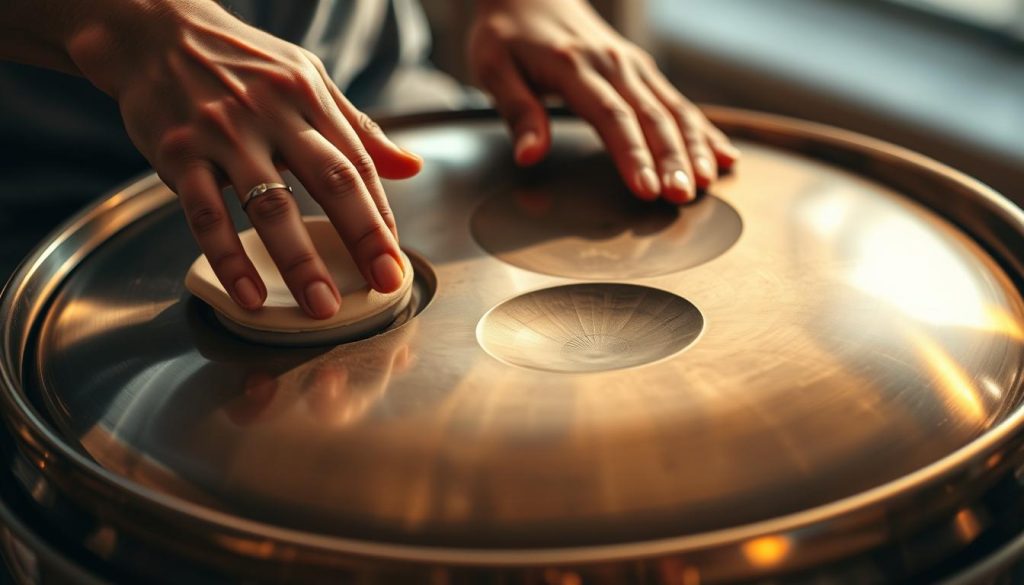
Polyrhythms add a fascinating dimension to your playing. The key “3 against 2” exercise, with dynamic alternation, is ideal for getting started. Use a metronome to stabilize your tempo.
- Practice rhythmic cells inspired by cajón drumming.
- Break patterns down into syllables to memorize them more easily.
- Collaborate with a group or with instruments such as the udu.
Syncopation and offbeats
Syncopation creates sonic surprises. Analyze traditional rhythms such as the Yoruba bembé, adapted for the handpan. Your hands must work in perfect coordination.
| Exercise | Duration | Goal |
|---|---|---|
| 3 against 2 | 5 min/day | Coordination |
| Mirrored syncopation | 10 min/day | Precision |
For ambitious players, Tempo Advance software helps you work on subdivisions. Set SMART goals to make progress each month.
“Rhythm is the art of sculpting time.”
Optimizing note resonance
A handpan’s sound quality depends greatly on its resonance. To obtain full, vibrant notes, you need to understand how to control and amplify them naturally. Here are proven methods for optimizing each sound.
Controlling sound duration
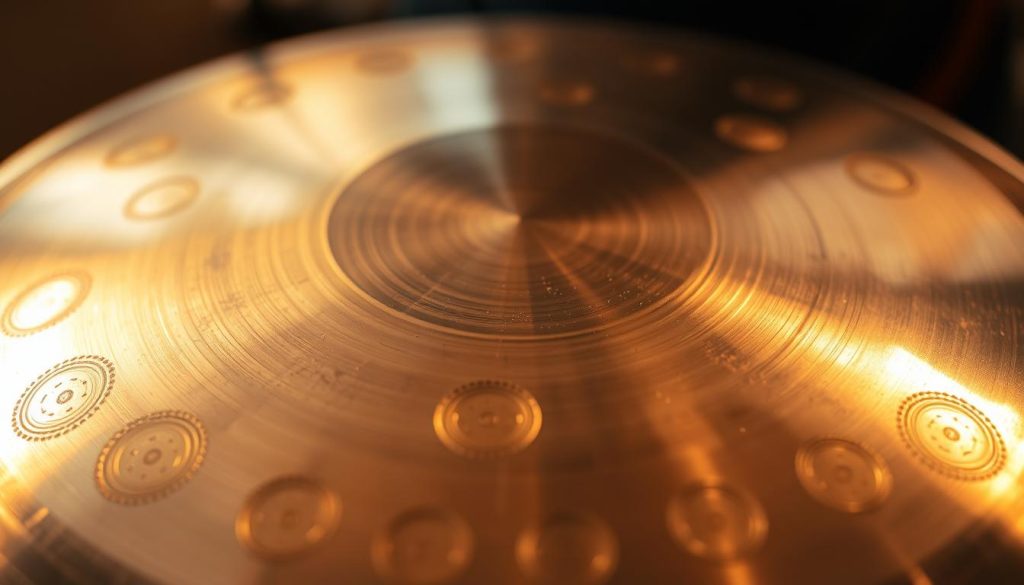
The palm damping technique reduces note sustain. Place your palm lightly near the center of the note to attenuate the sound gradually. This way of playing provides precise control over intensity and duration.
- Experiment with different supports: cushions, knees, or wooden stands.
- Use binaural recordings to analyze the sound’s spatial qualities.
- Practice breathing in sync with the decay of the notes.
Natural amplification techniques
Relative humidity affects resonance, which increases by 15% in humid conditions. Position your handpan 1.2 m from the wall for optimal sound reflection. Materials such as nitrided steel offer better durability than stainless steel.
For overly reverberant environments:
- Add rugs or heavy curtains.
- Create an acoustic map of your playing space.
- Try different positions in the room.
“Perfect resonance comes from harmony between the instrument and its environment.”
Melodic improvisation
Turning notes into spontaneous narratives: that is the art of melodic improvisation. This practice unleashes creativity while allowing you to explore unique sonic worlds. Unlike written compositions, it requires active listening and an immediate response.
Building musical phrases
The Lydian Chromatic Concept method, adapted by handpan musicians, structures improvisation around tonal centers. Start with constrained exercises:
- Improvise for 5 minutes using only 3 randomly selected notes
- Use an electronic drone as a modal foundation
- Experiment with “mirror playing” as a duo to develop mutual listening
Apps such as Harmonai analyze your progressions in real time and identify patterns to develop. To go further, discover how to deepen your handpan practice through specialized workshops.
Developing your harmonic ear
Fluid improvisation requires an ear trained in modal nuances. Here is an effective routine:
| Exercise | Duration | Effect |
|---|---|---|
| Study of Berber scales | 10 min/day | Expands melodic vocabulary |
| Daily recordings | 5 min | Helps measure progress |
Collaborate with dancers to translate movement into musical phrases. As a modal jazz master notes:
“The harmonic ear becomes sharper when you dare to venture off the beaten path.”
This holistic approach turns every session into a laboratory for spontaneous creations.
Playing in an ensemble: accompaniment techniques
Interaction with other instruments reveals a new dimension of the handpan. This practice requires active listening and a command of frequencies, particularly within the ideal range of 80 Hz to 1.2 kHz. Common setups often pair the instrument with a shruti box and light percussion.
Synchronizing with other instruments
Accurate intonation in concert rests on three pillars:
- Tuning beforehand with all the group’s musicians
- Using in-ear monitoring systems with a click track for complex tempos
- Exercises for identifying masked frequencies
For a handpan-cello-flute trio, divide the registers as follows:
| Instrument | Frequency range | Typical role |
|---|---|---|
| Handpan | 80 Hz to 1.2 kHz | Harmonies and rhythms |
| Cello | 65 Hz to 1 kHz | Melodic lines |
| Flute | 250 Hz to 2.5 kHz | Ornamentation |
Creating soundscapes
Micro-intervals, such as quarter tones, add harmonic richness to compositions. Try these approaches:
When accompanying a slam poem, alternate between:
- Background note clusters
- Rhythmic accents on key words
- Strategic silences
Adapt classical pieces by simplifying their melodic lines while retaining their harmonic essence. As composer Éric Sammut notes:
“Good accompaniment knows how to go unnoticed while supporting the ensemble.”
This collective creativity turns every performance into a unique experience in which the handpan becomes both soloist and conductor.
Conclusion: toward complete mastery
Your journey with the handpan is only beginning. By combining the 10 pillars covered here, you will develop a unique and personal playing style. Every session is a new sonic adventure.
Create a 6-month plan:
- 2 months to perfect the fundamentals
- 2 months to explore improvisation
- 2 months to compose your own melodies
Creativity is born from experimentation. Attend festivals and connect with other enthusiasts. Online masterclasses also offer enriching perspectives.
Remember: this instrument is meant to be experienced with passion. As seasoned players say, “the handpan sings when the heart brings it to life.” Now it is your turn to create your own voice.